

Five questions connect this edition: how can disruption in Hormuz become a food crisis across Africa and Asia, what does regional reassurance deliver when coercion stays below war, what should Greenland receive in return for strategic access, who protects merchant shipping from uncrewed attack, and who decides when climate research becomes an intervention in the ocean?
What Connects The Week
Each of this edition's stories begins with an action in a particular stretch of water, yet its consequences quickly move into another system. Disrupted fertilizer shipments through Hormuz threaten planting seasons far from the Gulf. Interference with a medical evacuation turns a sovereignty dispute into a question of access to care. An Arctic security agreement reaches into debates over democratic consent, economic return and control of natural resources.
The same movement is visible when uncrewed attacks on merchant ships create demands on navies, alliances, insurers and rescue services, or when research intended to remove carbon from the atmosphere requires governments to decide what may safely be placed in the ocean. Maritime decisions travel because the systems they affect are connected long before institutions respond to them. The recurring challenge is to recognise those wider consequences early enough for responsibility, authority and protection to travel with them.
QUESTION: How far can a maritime decision travel before responsibility catches up with its consequences?
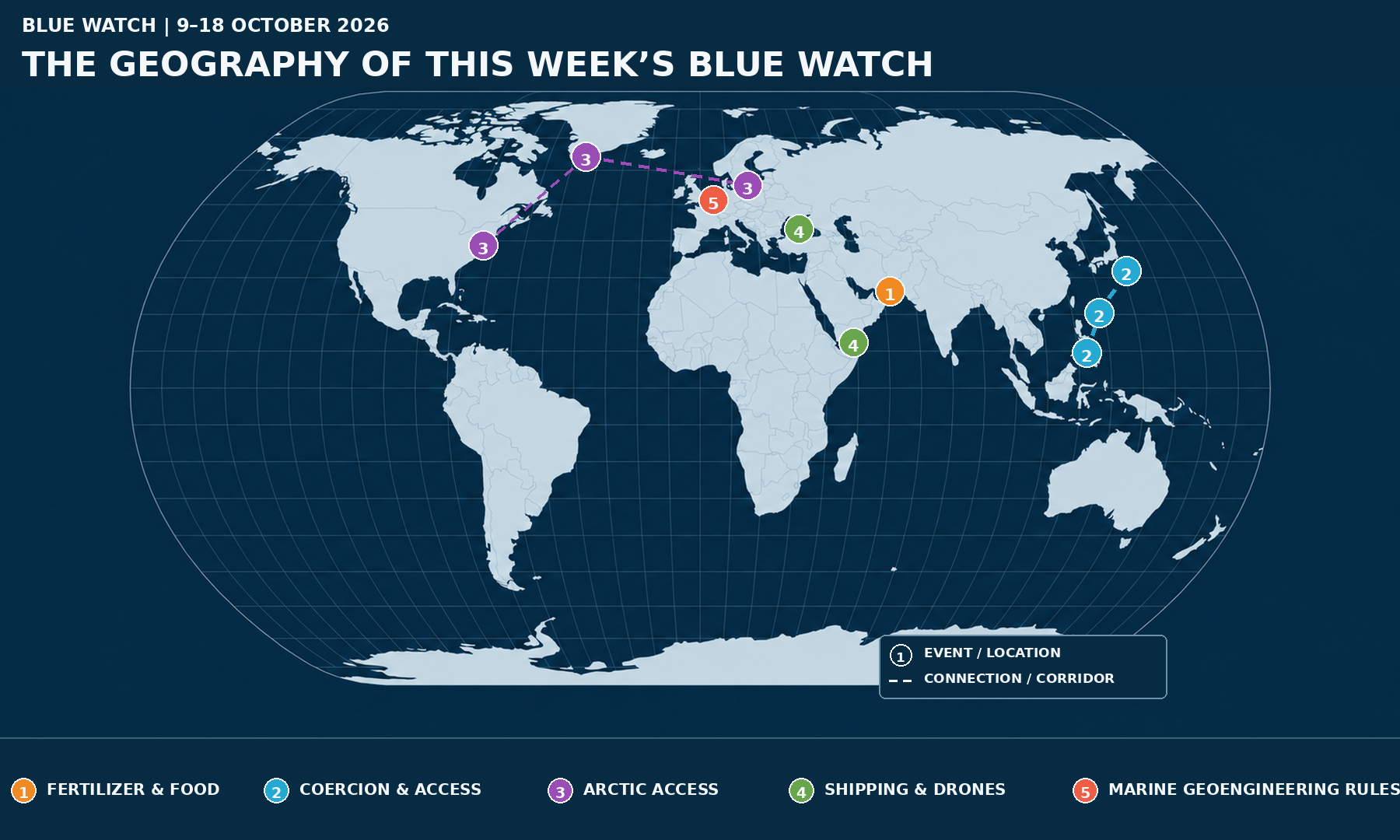
Disclaimer: the map is AI-generated - some dots or routes may not be very precise, but have been retained to show complex links or re-rerouting
1. Hormuz fertilizer delays are threatening future harvests
Question: How can disrupted passage through Hormuz become a food crisis across Africa and Asia?
The Blue Watch Read
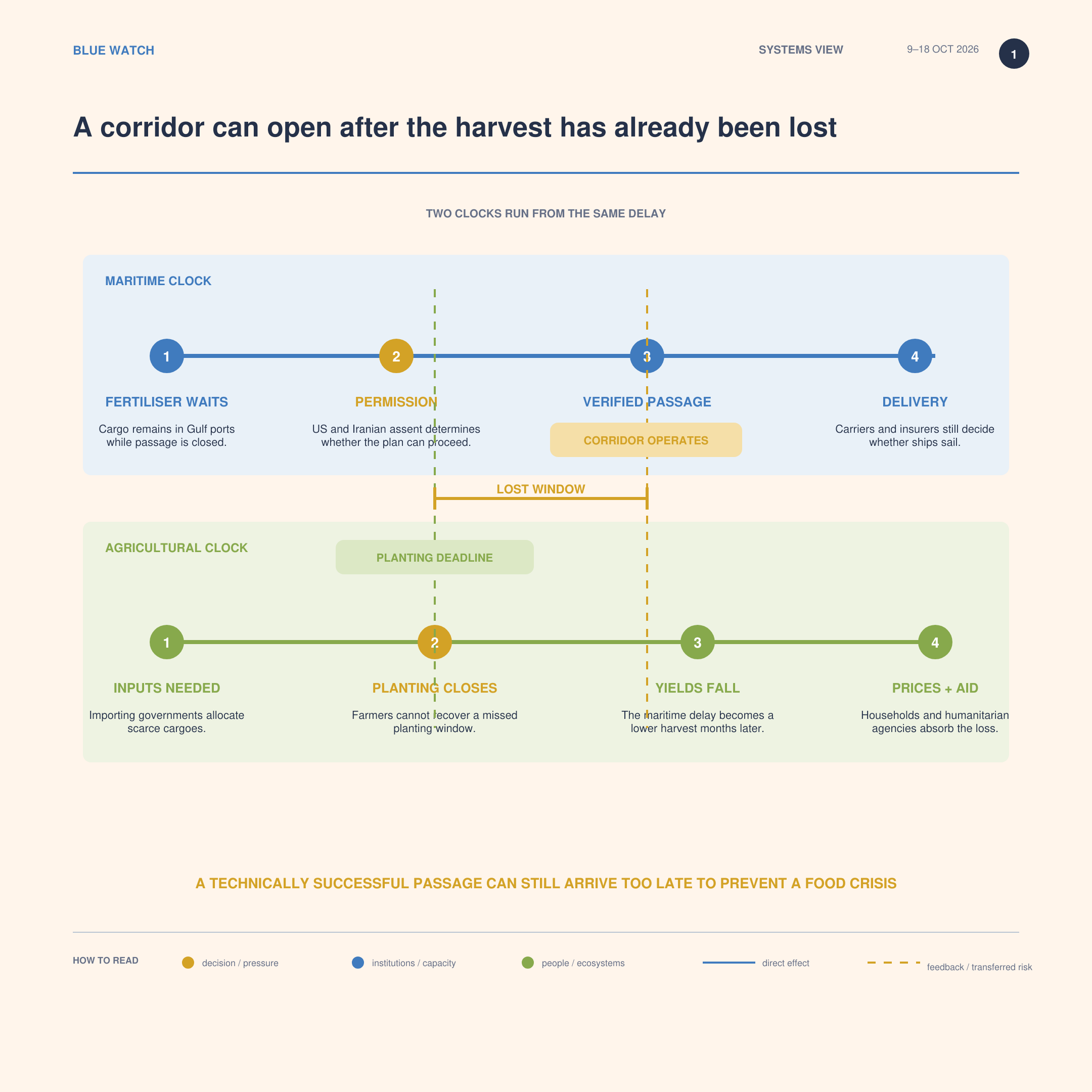
A potential humanitarian crisis is forming several steps beyond the ships waiting to leave the Gulf. Before the conflict, the Strait of Hormuz carried roughly one third of globally traded urea and nearly half of seaborne sulphur, both essential inputs for agricultural production. With much of that trade stalled, the immediate problem is a shipping disruption; the larger danger will emerge when farmers in import-dependent countries cannot obtain fertilizer in time to plant or maintain yields. Lower production would then feed into higher food prices, greater pressure on household incomes and rising demand for humanitarian assistance across parts of Africa and Asia.
The warning is becoming urgent because agricultural calendars cannot wait for diplomacy. A United Nations taskforce has designed a mechanism that could begin operating within seven to ten days of agreement between Washington and Tehran. An Oman-based coordination centre would register vessels, verify cargoes with local authorities and track them through the strait, while five passages a day could preserve supplies to countries identified as being in critical need. The machinery is therefore largely ready; what remains missing is the political permission to use it before planting windows close. A decision made around Hormuz will help determine harvests months later and thousands of kilometres away.
Signals from the week
On 14 October, UNOPS head Jorge Moreira da Silva warned that agreement was needed within weeks to avoid missing planting seasons. The mechanism could be activated within seven to ten days of political approval. Reuters.
The proposal would use a coordination centre in Oman, monitors at Gulf ports and vessel tracking during transit. Five fertiliser vessels a day could maintain flows to countries identified as being in critical need. Reuters.
Before the conflict, Hormuz carried roughly one third of globally traded urea and nearly half of seaborne sulphur, leaving import-dependent agricultural systems exposed to prolonged disruption. Reuters.
The unresolved issue
The immediate question is whether a narrowly defined humanitarian mechanism can be insulated from the wider negotiations between Iran and the United States. Cargo verification and tracking may reassure the parties that fertilizer is moving for an agreed purpose, but the mechanism must still decide which countries qualify as being in critical need, which cargoes move first and who accepts the residual risk. Those choices will distribute scarcity before the first ship sails. If agreement arrives only after planting windows have closed, the mechanism may be technically successful and humanitarianly late; the crisis will already have shifted from maritime access to food production.
2. A medical evacuation became a sovereignty contest
Question: How can essential maritime access be protected when coercion stays below the threshold of war?
The Blue Watch Read
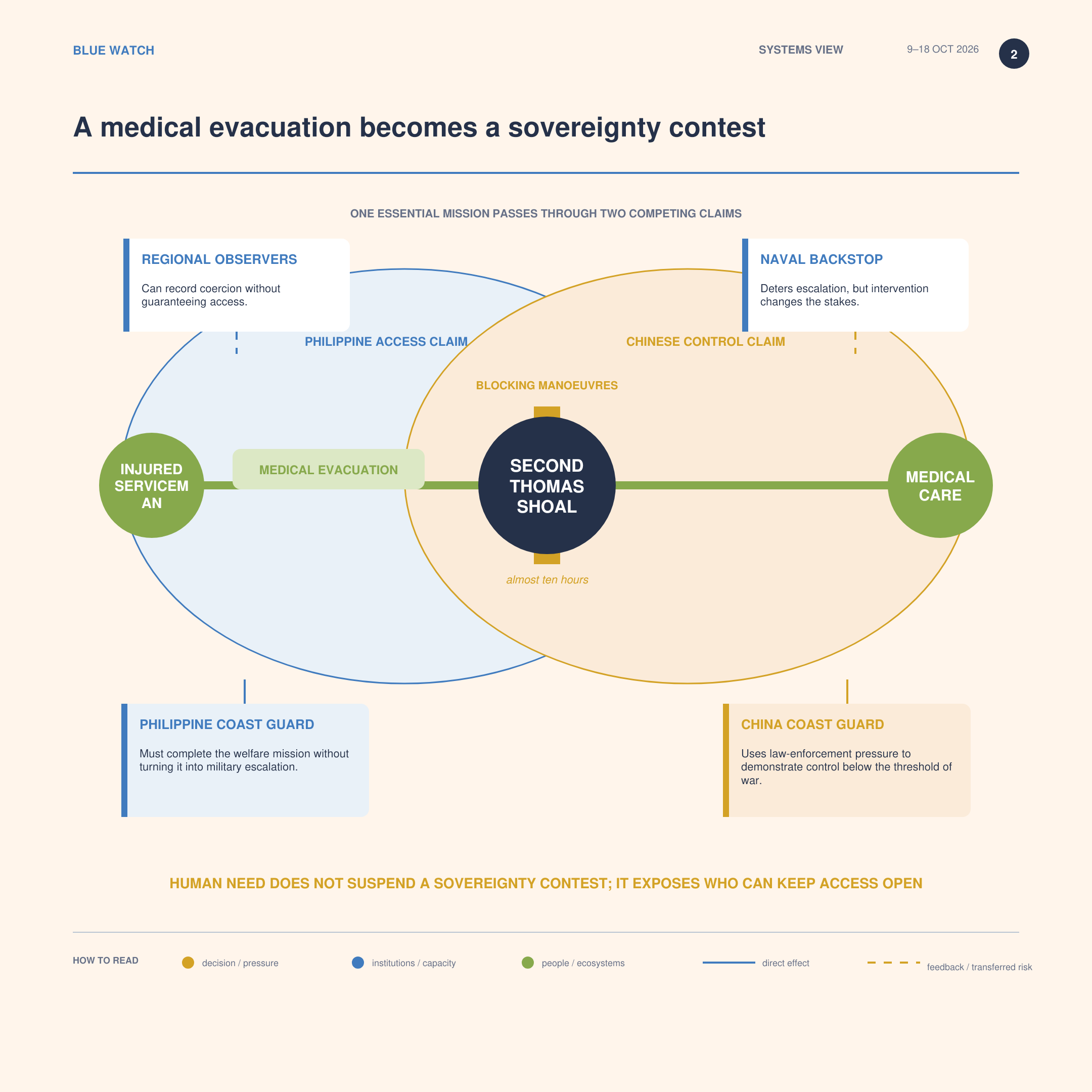
An injured Philippine serviceman aboard the grounded BRP Sierra Madre needed evacuation from Second Thomas Shoal on 8 October. The Philippine Coast Guard said Chinese vessels repeatedly blocked the operation; China Coast Guard cutter 5306 activated its water cannon while obstructing the patrol ship BRP Cabra, although the water did not hit it. The evacuation was eventually completed after almost ten hours. A practical welfare mission had become a contest over who could operate in disputed waters, forcing the coastguard to reach one person without allowing obstruction to become a military confrontation.
The same pressure on maritime access is visible farther north. Taiwanese officials told Reuters that China was combining military, coastguard and militia vessels in activity that could rehearse elements of a blockade, while the Liaoning carrier group's operations in the Philippine Sea and Luzon Strait drew monitoring by Japanese ships and aircraft. These episodes differ in scale, but both show how access can be constrained without a formal state of war. Surveillance and diplomatic criticism make coercion visible; they do not necessarily keep an evacuation, resupply mission or commercial route open while the obstruction is under way.
Signals from the week
The Philippine Coast Guard said Chinese vessels delayed the 8 October evacuation of an injured serviceman from Second Thomas Shoal by almost ten hours. Cutter 5306 activated its water cannon while blocking BRP Cabra, but the patrol ship was not hit. South China Morning Post.
On 10 October, the US State Department criticised Chinese activity east of Taiwan. Taiwanese officials said overlapping military, coastguard and militia operations could rehearse elements of a blockade. Reuters.
On 14–15 October, the Liaoning carrier group operated in the Philippine Sea and entered the Luzon Strait. Japanese ships and aircraft monitored the group, and fighters were scrambled in response to flight operations. USNI News.
The unresolved issue
Protecting access in these situations requires more than a promise of support after the event. Coastguards and civilian agencies need agreed communications, evidence-sharing and de-escalation procedures for medical evacuations, resupply attempts and rescue operations, while naval forces may provide surveillance or presence without taking control of the mission. The unresolved problem is how to make that support available during the obstruction itself without turning every essential movement into an armed escort or allowing the stronger actor to decide when ordinary maritime functions may proceed.
3. Greenland is deciding what strategic access should return
Question: What constitutes a fair exchange when strategic geography becomes a security asset?
The Blue Watch Read
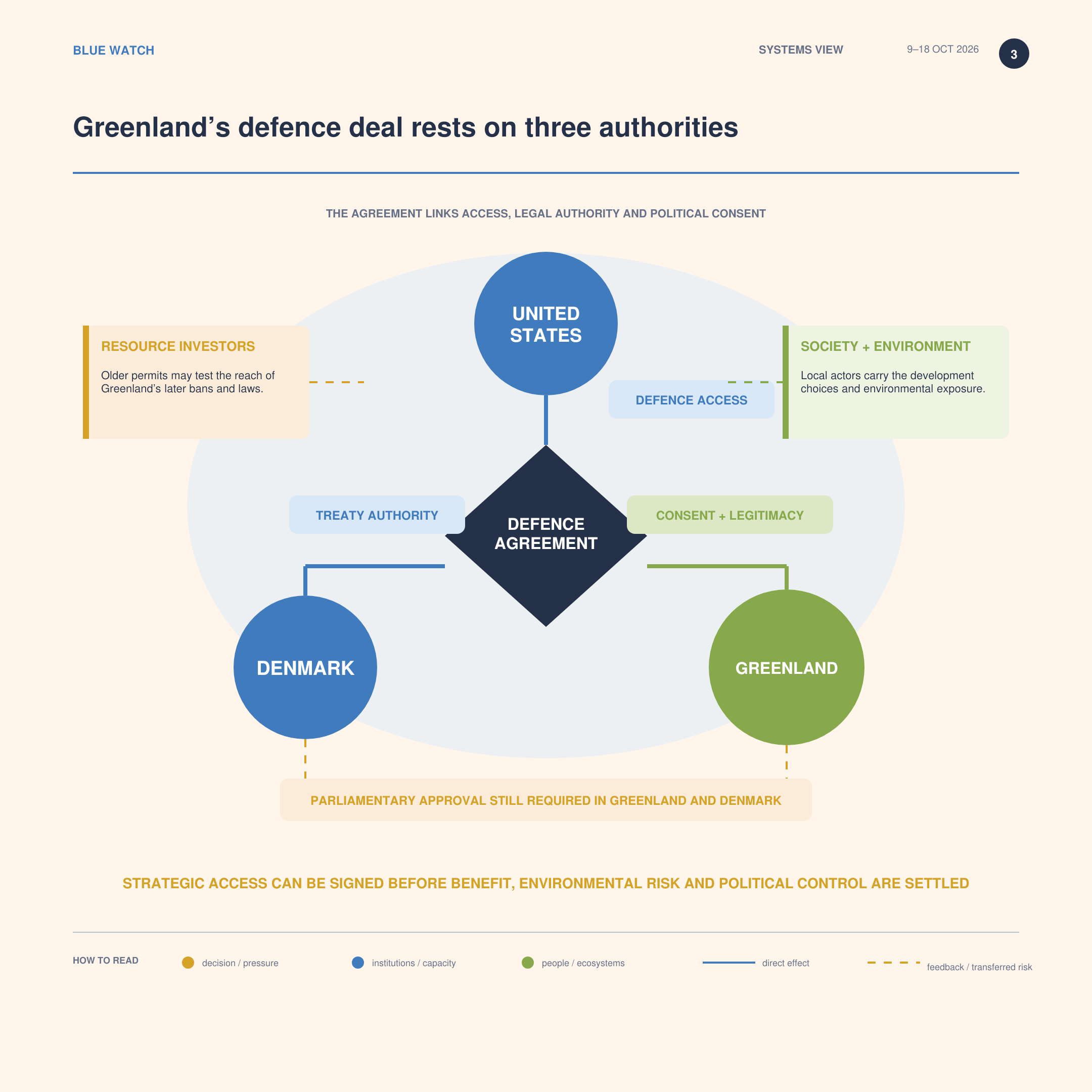
Greenland's parliament held the first reading of the new defence agreement with Denmark and the United States on 12 October. The governing coalition holds 19 of 31 seats, making approval likely, although the Danish parliament must also consent before the agreement can enter into force. It would add two US defence areas and pave the way for possible Golden Dome capabilities without setting out a concrete deployment plan. The opposition Naleraq party sees extensive American rights without a guaranteed economic return to Greenlanders and has called for a referendum after fuller public disclosure.
The argument became more pointed when Donald Trump claimed that major oil, gas and mineral exploration was about to begin in Greenland. Denmark's foreign ministry responded that US investors would receive no preference over investors from other NATO, EU and partner countries, and that any exploration must comply with Greenlandic law. Reuters noted that Greenland banned new oil exploration and uranium mining in 2021, while authorities are reviewing whether Greenland Energy can use permits issued before the ban. Defence access and resource rights remain legally separate, but the dispute shows why Greenlanders are asking whether greater strategic value will bring economic opportunity, environmental exposure or decisions over development that they cannot fully control.
Signals from the week
Greenland's parliament held its first reading on 12 October. The governing coalition holds 19 of 31 seats, but the Danish parliament must also approve the agreement and was due to begin considering it later in October; it is not yet in force. Reuters.
Naleraq called for a referendum, arguing that the rights granted to the United States were not matched by guaranteed economic benefits for Greenlanders. The Copenhagen Post.
Denmark said US investors would receive no preference over investors from other NATO, EU and partner countries and that exploration must follow Greenlandic law. Greenland is also reviewing whether pre-2021 permits remain usable. Reuters.
The unresolved issue
The agreement still leaves much of its practical implementation to later decisions, including the location and operation of new defence areas and the relationship between military activity and Greenlandic society. Parliamentary approval can provide legal authority, but durable consent will depend on whether Greenlanders can scrutinise those arrangements and influence their consequences. The harder question is how benefits, environmental exposure and political control will be distributed if strategic investment grows around the new access. Without that conversation, protection may be understood very differently in Nuuk, Copenhagen and Washington.
4. Drone attacks are forcing navies to decide which ships they can protect
Question: Who protects commercial crews when drone warfare reaches civilian sea lanes?
The Blue Watch Read
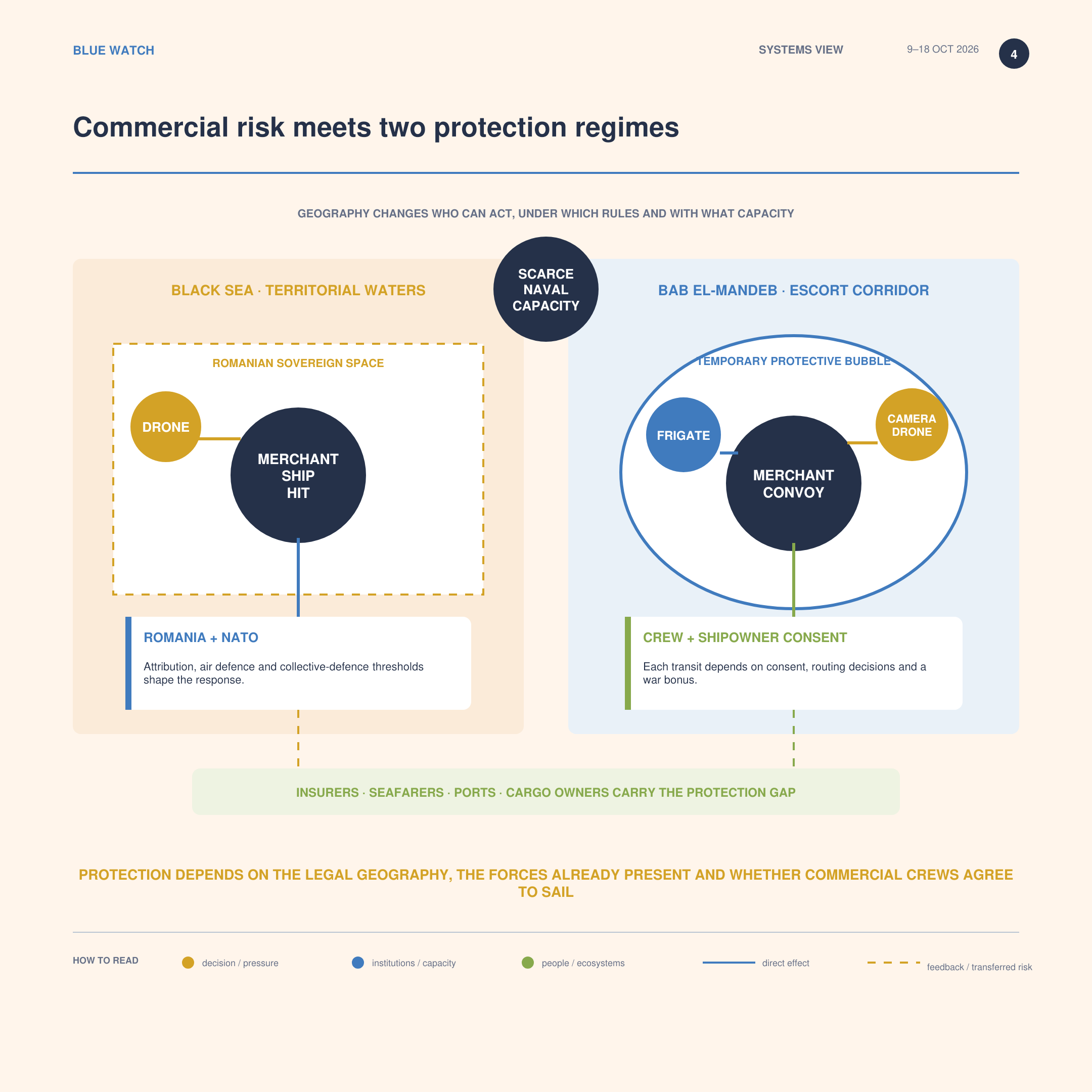
Drone attacks on at least seven commercial vessels in the Black Sea during October killed two people and left at least 25 missing, according to the Associated Press. One of the ships, Yara J, was struck in Romanian territorial waters, bringing the danger onto a NATO member's sovereign territory rather than leaving it in the less clearly protected space of an exclusive economic zone. Attribution remained disputed. Trade through Constanta had not been harmed, but war-risk premiums were rising across the wider Black Sea, and Bulgaria asked NATO for aircraft and counter-drone systems. The threat to commercial crews was therefore advancing faster than an agreed collective response.
Bab el-Mandeb shows what protection looks like when a warship is already present. On the night of 1–2 October, the French frigate Languedoc shot down what was believed to be a surveillance drone carrying cameras above a convoy that included CMA CGM Champs Elysees and an MSC ship. The escort created an immediate protective bubble, but Le Monde reported that the EU's Aspides mission generally had only two or three warships available. CMA CGM also requires every crew member to consent to each transit and pays a €1,500 war bonus. Protection therefore rests on scarce public assets, private routing decisions and the willingness of individual seafarers to accept the danger.
Signals from the week
Drone attacks struck at least seven cargo vessels in the Black Sea during October, leaving two people dead and at least 25 missing, according to AP. Yara J was hit in Romanian territorial waters; responsibility for individual attacks remained disputed. Associated Press.
Bulgaria asked NATO to reinforce its defences with combat aircraft and counter-drone systems and said it expected to join the alliance's Drone Edge initiative by the end of October. Reuters.
On the night of 1–2 October, Languedoc shot down a suspected camera-carrying surveillance drone above a convoy containing CMA CGM and MSC ships. CMA CGM requires every crew member's consent for the transit and pays a €1,500 war bonus. Le Monde.
The unresolved issue
The two theatres place different obligations on naval forces. An attack in Romanian territorial waters raises questions about national defence and alliance commitments; an escort in Bab el-Mandeb is a selective service delivered to ships that can enter a convoy and whose crews agree to sail. Neither model can cover every commercial vessel, and limited naval capacity forces decisions about priority, cost and acceptable risk. The unresolved issue is how governments, navies and shipowners should make those choices before an attack or an ad hoc escort decision determines whose crew, cargo or route receives protection.
5. Governments are drawing a line around ocean experimentation
Question: Who decides when climate research becomes an intervention in the ocean?
The Blue Watch Read
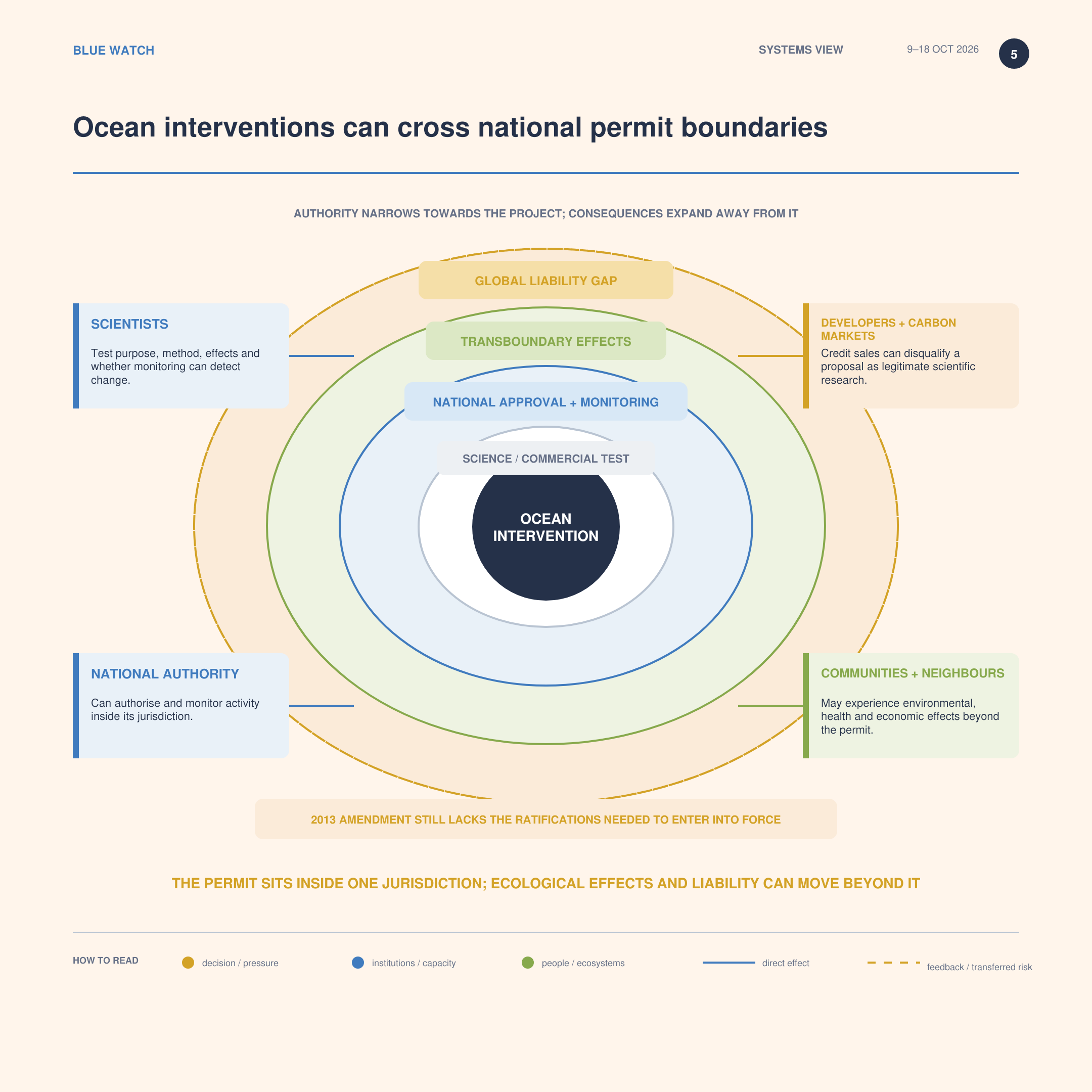
Governments meeting under the London Convention and London Protocol adopted three frameworks on 9 October for assessing research into ocean fertilisation, ocean alkalinity enhancement and the sinking of biomass. Each technique seeks to alter ocean processes so that more carbon is absorbed or stored, while uncertainty remains over effectiveness, verification and ecological consequences. The frameworks ask national authorities to determine case by case whether a proposal constitutes legitimate scientific research and whether it can proceed without creating unacceptable environmental risks.
That distinction matters because the same activity can be presented as an experiment, a climate intervention or a commercial carbon-removal project. The new assessments widen attention beyond physical and ecological effects to include social, cultural, economic and health consequences, including consultation with Indigenous Peoples where international law requires it. Yet the binding 2013 amendment intended to regulate marine geoengineering has been ratified by only nine countries and has not entered into force. The result is a stronger common test for research, but one whose application will still depend on national approval, monitoring and the willingness to act when an experiment could affect waters and communities beyond the authorising state.
Signals from the week
On 9 October, parties to the London Convention and London Protocol adopted assessment frameworks covering ocean fertilisation, ocean alkalinity enhancement and biomass sinking. International Maritime Organization.
CIEL and the framework texts say the assessments extend beyond physical and ecological effects to social, cultural and economic consequences, with the alkalinity framework also covering human health. Projects generating or selling carbon credits do not qualify as legitimate scientific research. CIEL.
The binding 2013 amendment remains short of the two-thirds threshold required among the London Protocol's 56 parties to enter into force. OceanCare; CIEL.
The unresolved issue
A government may authorise activity in waters under its jurisdiction, but altered currents, ecosystems and carbon claims do not necessarily remain within the same boundary. Effective oversight will require baseline evidence, transparent data, independent monitoring and a route for affected communities and neighbouring states to challenge an activity before harm becomes difficult to reverse. The unresolved issue is who provides that scrutiny when research is privately financed, conducted at sea and promoted as a response to a global emergency. Without clarity on responsibility and liability, the line between learning about the ocean and deliberately engineering it will remain vulnerable to commercial and political pressure.
What The Week Leaves Unresolved
What remains unresolved is how to govern consequences whose timetable and geography no longer match the decision that set them in motion. A fertiliser corridor may eventually work as designed and still fail the farmers it was meant to serve if it opens after planting windows close. In contested waters, the ability to observe coercion or deploy a naval backstop does not secure access for an evacuation. Both cases expose a gap between the moment at which an institution can act and the moment at which its action can still change the outcome.
That gap becomes more political when protection or access must be allocated. In Greenland, the legal authority to sign an agreement, the strategic value of the territory and the consent of the people who live there sit with different actors. Around merchant shipping, geography produces different protection regimes: an attack in territorial waters raises questions for a state and its allies, while an escorted passage through Bab el-Mandeb depends on naval availability, commercial judgement and crew consent. Scarcity therefore forces choices about who receives protection, who accepts the remaining risk and who pays when the protective system stops at the edge of a convoy or jurisdiction.
Marine geoengineering carries the same problem beyond the permit itself. National authorities may approve a project and require monitoring, yet its ecological, health and economic effects can cross borders before a binding global liability regime exists. Across the five stories, responsibility remains weakest where institutional mandates diverge from the timeframes, jurisdictions and communities affected. The unresolved task is to decide whose authority follows the consequence, when that authority should be activated and how those excluded from the original decision can influence what happens next.