

The work of defending together
Five questions connect this week: how do neighbours turn cooperation into practical protection, what happens when fisheries enforcement is obstructed, how secure are alternative export routes, who responds when war reaches nearby shipping lanes, and how much choice do the crews keeping trade moving really have?
WHAT CONNECTS THE WEEK
Regional and global cooperation ran through the discussions I moderated at the Trans-Regional Seapower Symposium in Venice. This week’s maritime developments bring those discussions into everyday decisions: who takes command, who can board a vessel, and who comes to help when a voyage ends in an emergency.
The answers depend on relationships extending well beyond navies. A cable emergency involves communications authorities and private operators; protecting fisheries requires evidence that inspectors can gather and act upon; a damaged merchant ship brings rescue services and environmental authorities into the same response. Meanwhile, the people aboard ships remain exposed to decisions about trade and security in which they may have little say. Looking across these stories, the test of cooperation is whether it prepares those actors to work together before events force them to do so.
QUESTION: When we agree to defend together, whose protection do we prepare for?
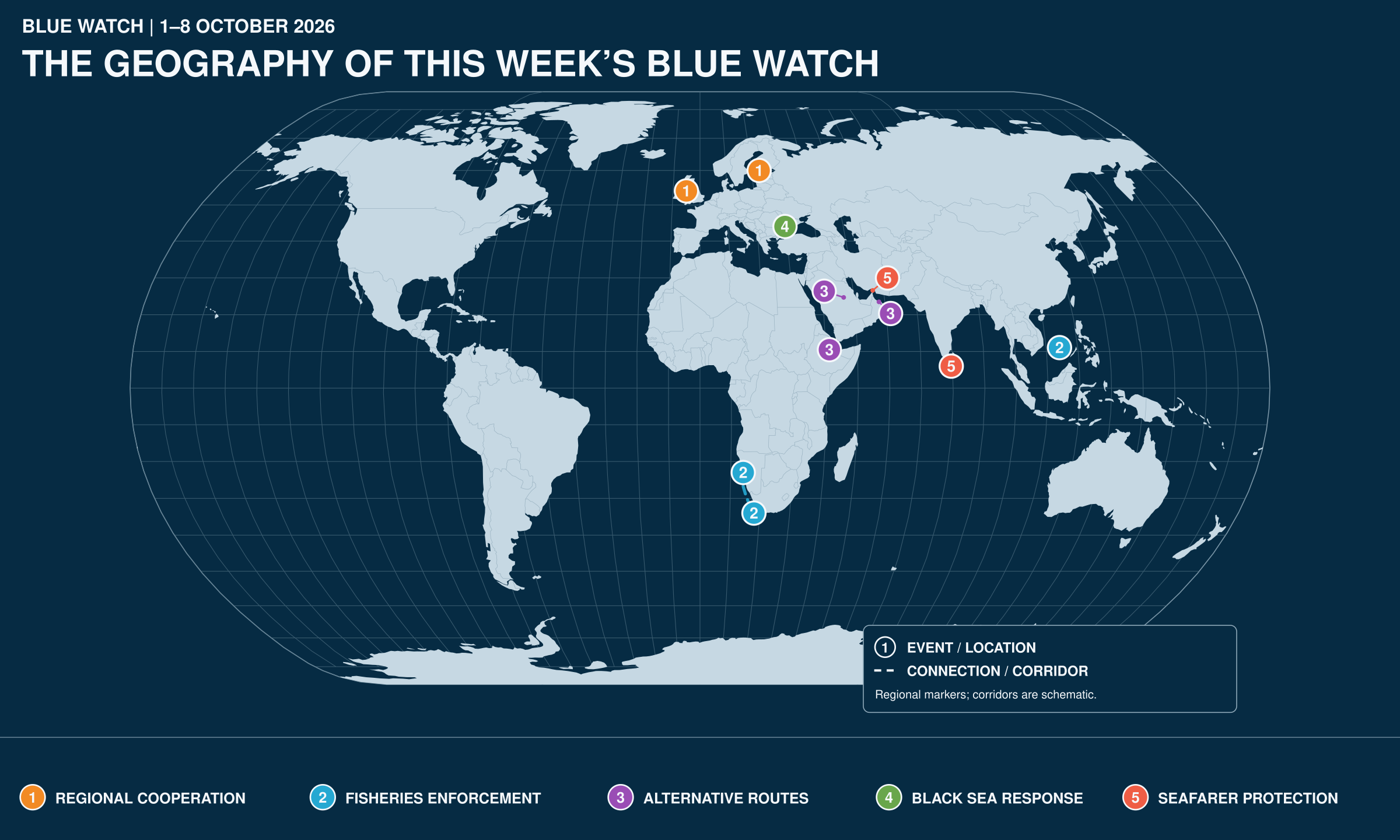
Disclaimer: the map is AI-generated - some dots or routes may not be very precise, but have been retained to show complex links or re-rerouting
1. Neighbours are putting cooperation to work
Question: What has to be shared before a country can help protect its neighbour?
The Blue Watch Read
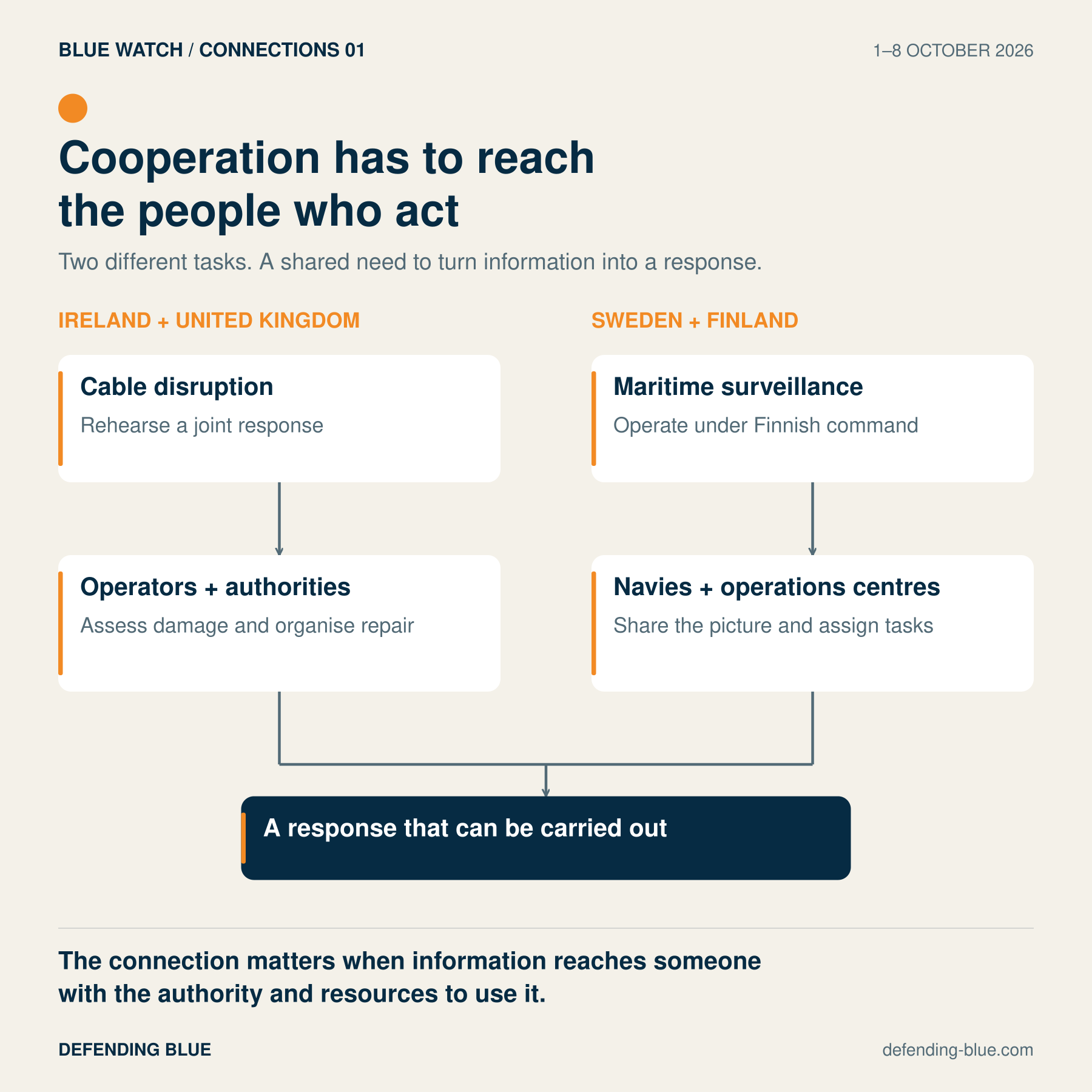
Two developments at the turn of the month show how cooperation becomes a working arrangement. On 30 September, Ireland and the United Kingdom held Eastern Pearl, a desktop exercise rehearsing their response to disruption of several subsea communications cables. In the Baltic, Sweden’s corvette Helsingborg operated under Finnish command to support territorial surveillance. Although the tasks differ, both require partners to establish who leads and how information will move before they face a real emergency.
That preparation matters to people far beyond the participating services. Cable connectivity supports businesses and public services, while maritime surveillance helps authorities understand activity around the coast. However, each arrangement covers only part of the work that an incident could create. Detecting a damaged cable must lead to coordination with its operator and a viable repair response; sharing a maritime picture must help the authority responsible for the next decision. The value of cooperation therefore rests on whether the people receiving the information can use it, with the resources and authority their task requires.
Signals from the week
On 30 September, Ireland and the UK held Eastern Pearl, their first joint desktop exercise simulating disruption to several subsea communications cables. The exercise provides the immediate lead-in to this reporting week. The Irish Times.
Sweden’s Helsingborg operated under Finnish command during week 40, supporting territorial surveillance and a shared maritime picture. The two countries’ maritime operations centres exchange information daily. Defence Industry Europe.
The unresolved issue
An exercise can test a procedure, but the harder test comes when several services need help at once. Who prioritises a repair, releases a scarce vessel or shares information with a commercial operator? Further cooperation will need to make those choices explicit, including how civilian organisations participate. Otherwise, partners may understand one another’s intentions while still encountering delays at the moment a task passes between them.
2. Protecting fish depends on who can reach them
Question: What happens to environmental protection when enforcement itself becomes contested?
The Blue Watch Read
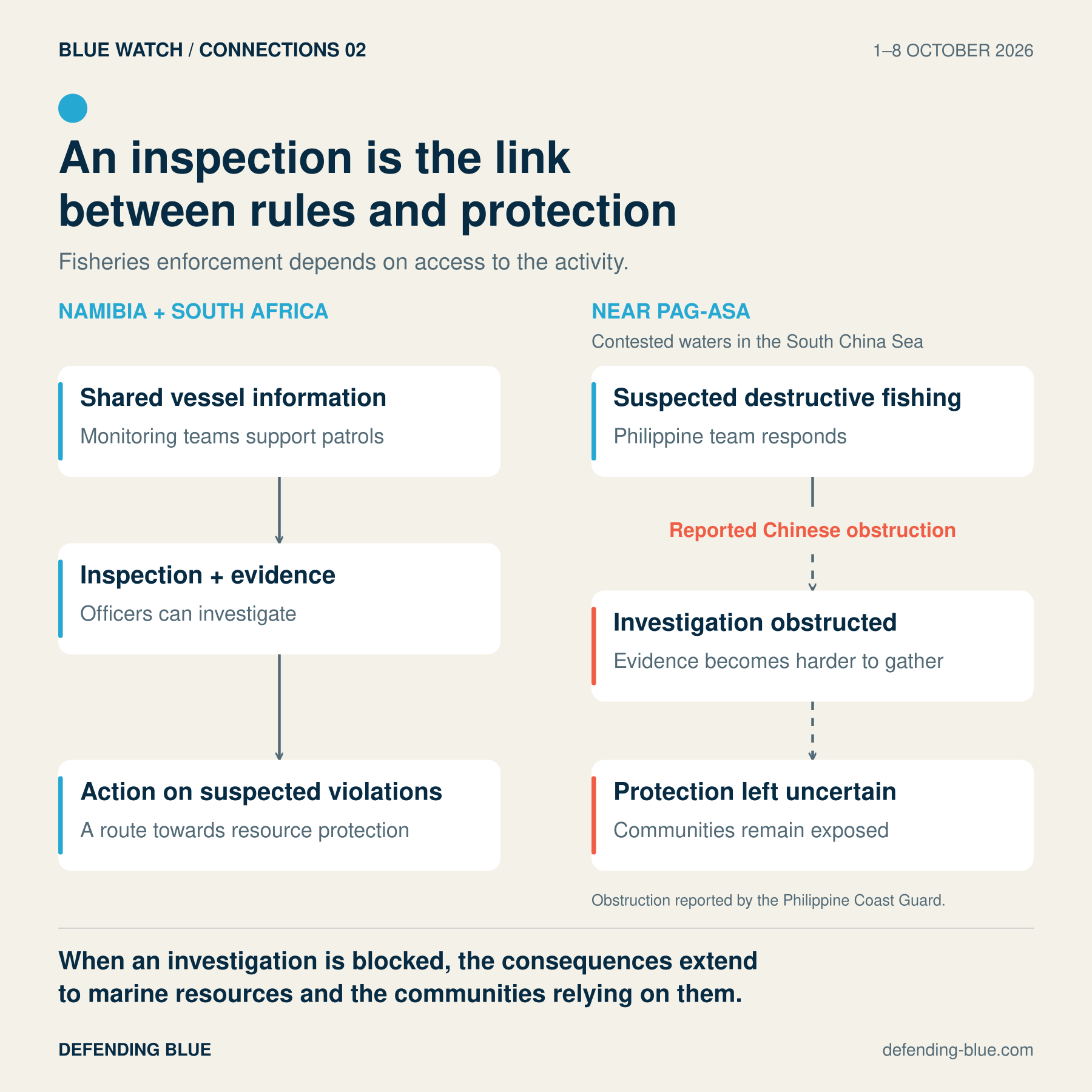
Namibia and South Africa’s joint fisheries patrol offers a practical example of cooperation around a shared marine environment. Officers from both countries worked aboard a Namibian patrol vessel and through a fisheries monitoring centre, connecting observations ashore with inspections at sea. Results reported on 5 October included around 32 tonnes of seized fish and 12 suspected violations. In contrast, the Philippine Coast Guard said Chinese vessels obstructed its response to suspected dynamite fishing near Pag-asa on 4 October. That account remains an attributed allegation, but it raises a direct question about the ability to investigate environmental harm.
The contrast matters because a conservation rule depends on officers being able to establish what happened. Where cooperation makes an inspection possible, evidence can lead to action against damaging activity. Where confrontation obstructs access, even determining whether an offence occurred becomes more difficult. For fishing communities, that uncertainty concerns the resources on which future catches depend. Coastguard and naval conduct therefore helps determine whether environmental protection can be put into practice, with consequences extending beyond the vessels involved in an encounter.
Signals from the week
Results reported on 5 October from Namibia and South Africa’s joint patrol included around 32 tonnes of seized fish and 12 suspected fisheries violations. South African officers worked aboard the Namibian patrol vessel and in its fisheries monitoring centre. The Namibian.
On 4 October, a Philippine inter-agency team responded to suspected dynamite fishing near Sandy Cays. The Philippine Coast Guard alleged that Chinese vessels obstructed the operation; the suspected offence and the fishermen’s nationality remain unestablished in that account. GMA News.
The unresolved issue
Cooperation needs to survive beyond a patrol, through the handling of evidence and the follow-up to suspected violations. In contested waters, there is an earlier difficulty: whether investigators can reach the activity at all. How can neighbouring authorities preserve the possibility of investigating environmental damage when they disagree about maritime claims? Without a workable answer, the dispute can leave communities and marine resources exposed while responsibility remains contested.
3. Alternative routes need protection of their own
Question: What happens when the routes absorbing diverted trade come under greater pressure?
The Blue Watch Read
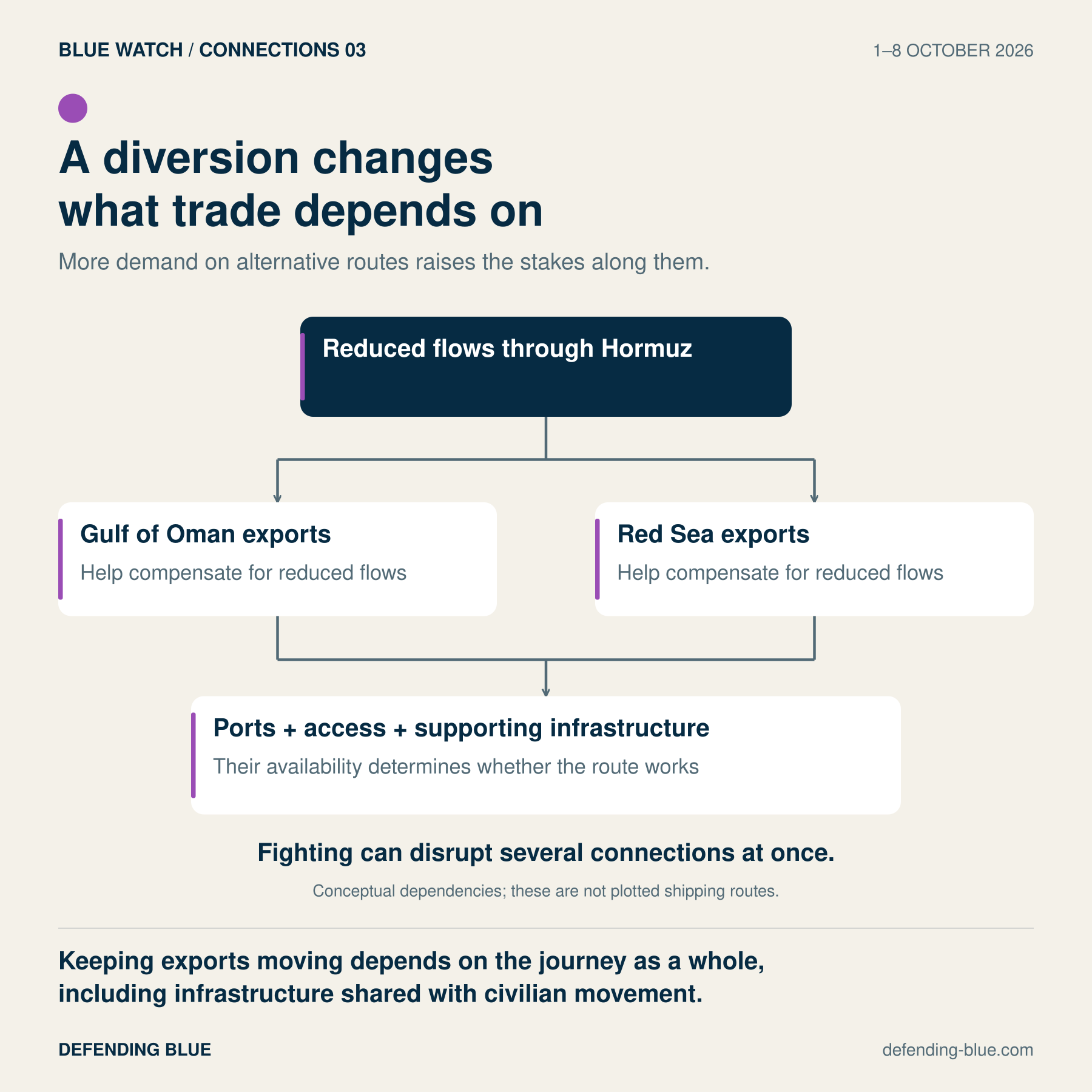
Saudi-backed Yemeni forces launched an offensive around Bab el-Mandeb on 5 October, while subsequent attacks reached airports in Saudi Arabia and Aden. The developments place the struggle over a maritime passage within a wider contest involving the infrastructure used to move people and supplies. At the same time, reporting on 8 October showed exports from the Gulf of Oman coast and Red Sea compensating for reduced oil flows through Hormuz. The routes carrying that additional demand consequently become more important to the wider trading system.
For producers and customers, maintaining export volumes may indicate that alternatives are working. Yet continued movement depends on ports and supporting infrastructure remaining usable, as well as ships being able to complete the passage. When fighting affects several of those connections, a disruption can narrow the options available to commercial operators and civilians at the same time. Securing territory near a strait may change the military situation, but operators still need evidence that the journey is sufficiently safe. Humanitarian access requires its own assessment, particularly where the same transport network serves people trying to leave the fighting.
Signals from the week
Saudi-backed Yemeni forces launched an offensive around Bab el-Mandeb on 5 October. Even if territorial gains were confirmed, the Houthis could retain the ability to strike vessels from other positions. Reuters.
Attacks on Aden airport and Riyadh were reported on 7 October as fighting intensified around the Red Sea coast. Financial Times.
Shipping data reported on 8 October showed increased exports from the Gulf of Oman coast and Red Sea compensating for reduced oil flows through Hormuz. Reuters.
The unresolved issue
Protecting an alternative route means understanding which parts of it could fail together. Governments, port operators and shipping companies therefore need to consider how military developments affect the entire journey, including access for civilian assistance. The unresolved question is whether plans for maintaining exports also preserve sufficient options for people whose urgent need is to move out of danger or receive essential supplies.
4. The Black Sea brings the consequences ashore
Question: How does a coastal state prepare for a maritime emergency created by a nearby war?
The Blue Watch Read
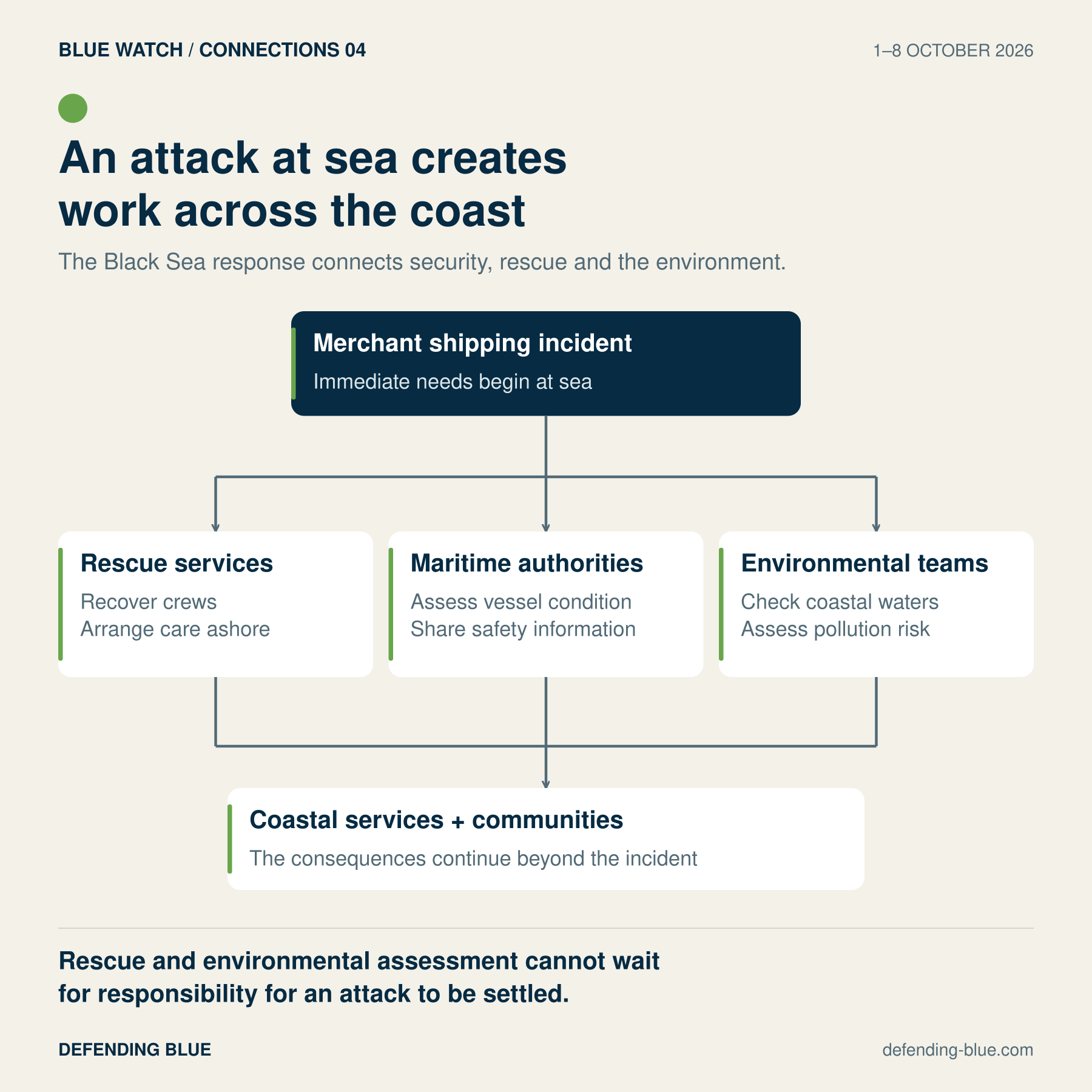
Incidents involving merchant ships in Romania’s and Bulgaria’s exclusive economic zones on 5–6 October brought the consequences of the war into neighbouring response systems. Bulgarian authorities reported drone attacks on two ships, while the cause of the fire aboard the vessel that sank off Romania remained unconfirmed by Romanian authorities in the reporting reviewed. That distinction matters for attribution. Nevertheless, rescue needs were immediate, and Bulgaria also began coastal water inspections for possible pollution.
The response shows how quickly a security incident creates work for civilian authorities. Rescued seafarers need care, damaged vessels require assessment, and environmental teams must establish whether the coast faces a threat. Because these tasks begin before responsibility for an attack is settled, responders cannot wait for the diplomatic picture to become clear. Cooperation must therefore connect maritime surveillance with rescue and environmental monitoring, so that information gathered for one purpose reaches the people making the next urgent decision. The potential consequences for coastal livelihoods make that connection relevant well beyond the shipping industry.
Signals from the week
The Royad Mammadov, carrying grain from Izmail towards Ravenna, sank after a fire off Romania on 5 October. Ukraine attributed the incident to an attack, while Romanian authorities had not confirmed the cause in the reporting reviewed. AdriaPorts.
Following the separate attacks in Bulgaria’s exclusive economic zone, authorities began coastal water inspections around Cape Kaliakra, Byala and Sozopol to assess possible pollution. The inspections were precautionary and did not establish that pollution had occurred. Bulgarian News Agency.
The unresolved issue
Neighbours need arrangements that allow rescue and pollution assessment to proceed while the cause and responsibility for an incident are still being investigated. That includes knowing who shares vessel information, who assesses environmental exposure and how additional assistance can be requested. The practical question is how to sustain that readiness if further incidents place repeated demands on the same coastal services.
5. Keeping trade moving has a human price
Question: How much choice do seafarers have when commercial and political pressure reaches their ship?
The Blue Watch Read
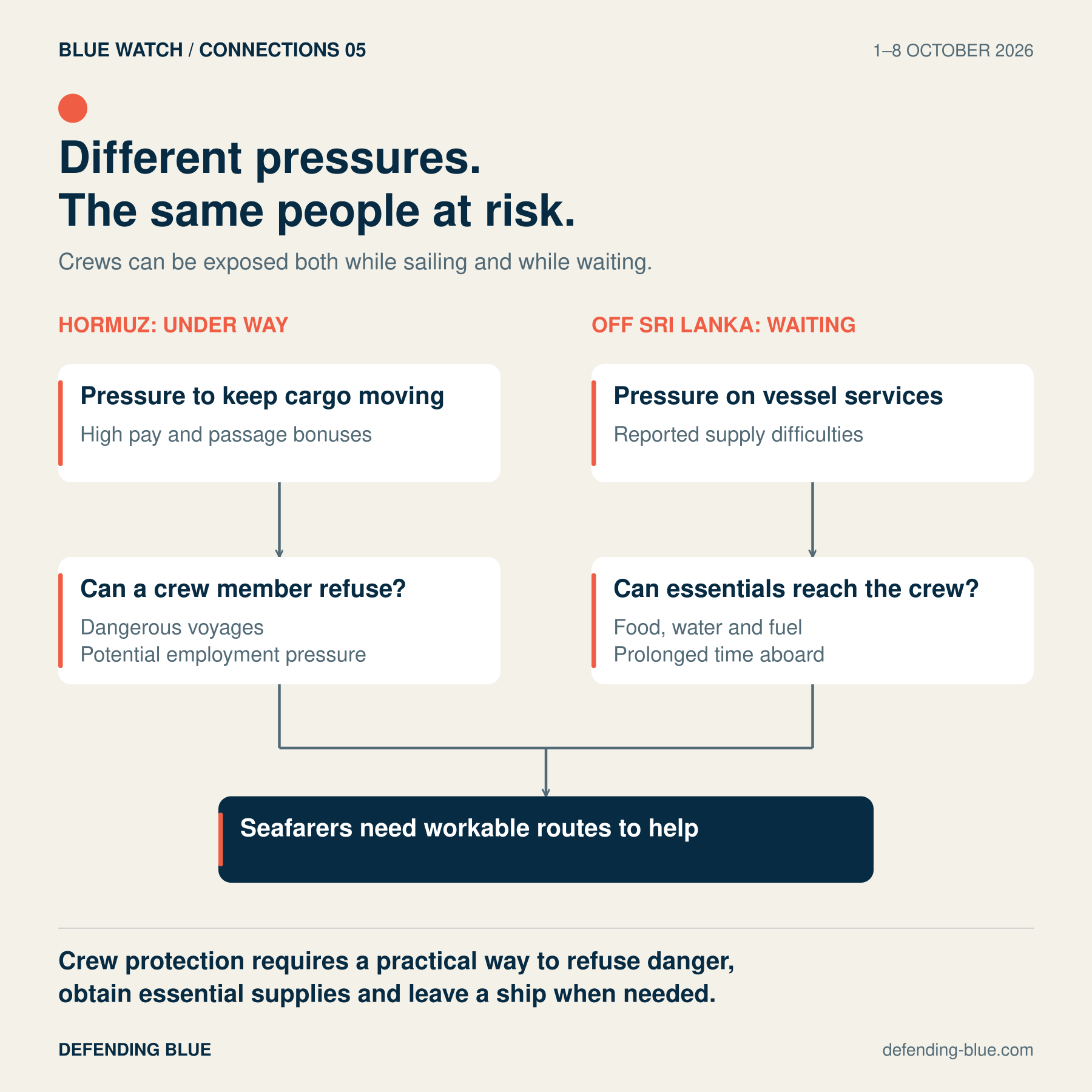
Reports of tanker captains receiving pay equivalent to US$100,000 a month, with additional bonuses for Hormuz passages, show the lengths to which operators will go to keep cargo moving through danger. However, the reporting also described pressure on some ordinary seafarers to accept hazardous voyages. Elsewhere, reports of dwindling provisions aboard Iranian tankers waiting off Sri Lanka show a different form of exposure: crews can face worsening conditions even when their ships are going nowhere.
These situations place seafarer welfare inside decisions made across shipping companies, governments and service providers. Higher pay may persuade someone to accept a voyage, but assessing that choice requires knowing whether refusal carries a threat to future employment and whether departure from the ship is practical. For waiting crews, the immediate question is whether food, water and assistance can reach them. In both cases, the continuity of trade or the pressure applied to a trading network can obscure the circumstances of the people aboard its vessels.
Signals from the week
TradeWinds reported on 7 October, citing the Financial Times, that some tanker captains were being offered US$50,000 bonuses for each Hormuz crossing. TradeWinds.
The same Financial Times reporting described pay equivalent to US$100,000 a month for some captains, alongside pressure on some ordinary seafarers to accept hazardous voyages. The Economic Times, citing the Financial Times.
SeaNews reported on 1 October that around 20 Iranian tankers waiting off Sri Lanka faced dwindling food, water and fuel supplies amid US pressure on services to the vessels. This describes supply difficulties, rather than a determination that all humanitarian assistance is prohibited. SeaNews.
The unresolved issue
The test is whether crews can obtain help before danger or deprivation becomes an emergency. That requires a practical route to raise concerns, secure supplies and arrange departure where necessary. Shipowners and the authorities involved need to make those arrangements workable even when the vessel’s commercial activity is disputed. A system that continues moving cargo should also be able to show how it protects the people making that movement possible.
What The Week Leaves Unresolved
The discussions in Venice emphasised the importance of working across regions. This week’s stories show why that ambition also needs to reach across professions. A naval relationship becomes more useful when it supports the authorities responsible for civilian infrastructure; fisheries cooperation earns its value through effective investigations; preparations for conflict need to include the services that receive its consequences ashore.
The next question is whose needs shape those preparations. Coastal communities, inspectors and seafarers may experience the consequences first, even when they have little influence over the decisions producing them. Bringing their requirements into cooperation from the outset would give a more concrete meaning to defending the ocean together.