

Blue Watch returns after a three-week pause while I was leading the editorial programme and moderating the Euronaval TV Studio. Two conversations from Paris run through this edition: what distributed systems can offer navies, and how differently allies judge the time they have left to prepare.
Five questions connect this edition: what does protecting an electricity cable require, who protects a coast from the consequences of war at sea, who can afford to act on a forecast, how ready can allies be when they work to different threat clocks, and what makes a rescue possible beyond the vessel itself?
What connects the week
Maritime security is often organised around an asset or an area, while its consequences are felt across systems that answer to different authorities. A power connection can draw navies into a sovereignty dispute before it carries electricity; an attack on a tanker can leave coastal authorities responding to pollution before its source is established. Weather warnings and allied readiness bring another constraint into view: authorities have to commit resources before they know exactly when, or how severely, a threat will materialise.
People and services with little influence over the original decision may still carry much of its cost. Ports must accommodate successive rescues alongside their everyday work, while coastal communities may be asked to suspend the activities on which their livelihoods depend. Their ability to absorb disruption becomes part of the capacity to provide protection. Following these connections means examining how security decisions distribute risk, and whether the support available reaches those expected to carry it.
QUESTION: Who does maritime security protect and who carries its costs?

Disclaimer: the map is AI-generated - some dots or routes may not be very precise, but have been retained to show complex links or re-rerouting
1 Energy security depends on permission at sea
Question: What does protecting an electricity connection mean when governments, navies and coastal communities face different risks?
The Blue Watch Read
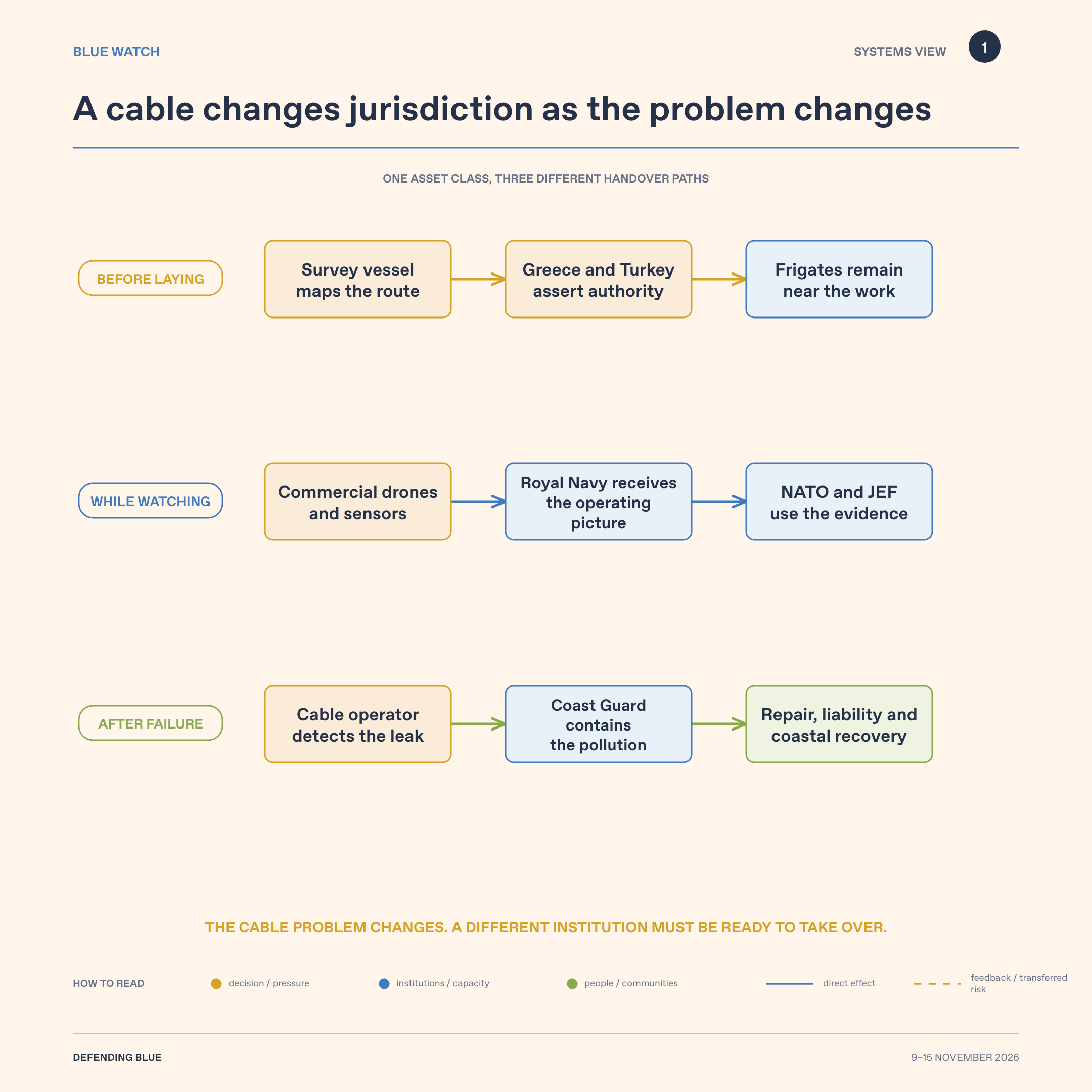
Cyprus’ route out of electricity isolation runs through contested waters. The French Abeille Marengo continued surveying for the Great Sea Interconnector near Greek and Turkish frigates, while Athens rejected Ankara’s claim to have authorised the work. Accepting another state’s permission can carry implications for whose jurisdiction is recognised. Energy security is therefore exposed to political pressure before there is a cable to defend.
Britain’s Atlantic Net would widen Royal Navy surveillance through commercial sensors and autonomous systems, giving practical relevance to the case for distributed uncrewed systems made at Euronaval by Exail’s Julien Lalanne de Saint-Quentin. The interconnector instead needs political room for civilian work to proceed. Off Leyte, an oil leak from a power cable, its cause still under investigation, required the operator and Coast Guard to protect the coast from the infrastructure itself. Together, these cases ask how cable protection accommodates the different risks faced by the network and the people along its route.
Signals from the week
The Philippine Coast Guard said an estimated 1,500–2,000 litres of mineral oil released from the Leyte–Cebu power cable had been contained. The leak had been detected on 4 November. Energy News PH.
The United Kingdom said a framework with Ocean Infinity Solutions was due to be signed, paving the way for £90 million in drones, sensors and AI systems for Royal Navy underwater surveillance. UK Government.
Greece rejected a Turkish Navtex claiming that the surveys had been coordinated with Ankara, maintaining that the route lay within areas authorised by Greece and Cyprus. eKathimerini.
Survey work for the Great Sea Interconnector continued southeast of Karpathos with the French-flagged Abeille Marengo operating near Greek and Turkish frigates. eKathimerini.
The unresolved issue
Naval presence can help sustain access while making the political stakes of interference more visible. It cannot guarantee that construction will proceed, or determine who pays when a functioning network causes environmental harm. The test for cable protection is whether governments plan for those dependencies alongside the sensors. Otherwise, the strategic case for a connection can be much clearer than the arrangements protecting the people along its route.
2 The coastline inherits the war at sea
Question: How far does protecting shipping extend when the consequences of an attack travel beyond the ship?
The Blue Watch Read
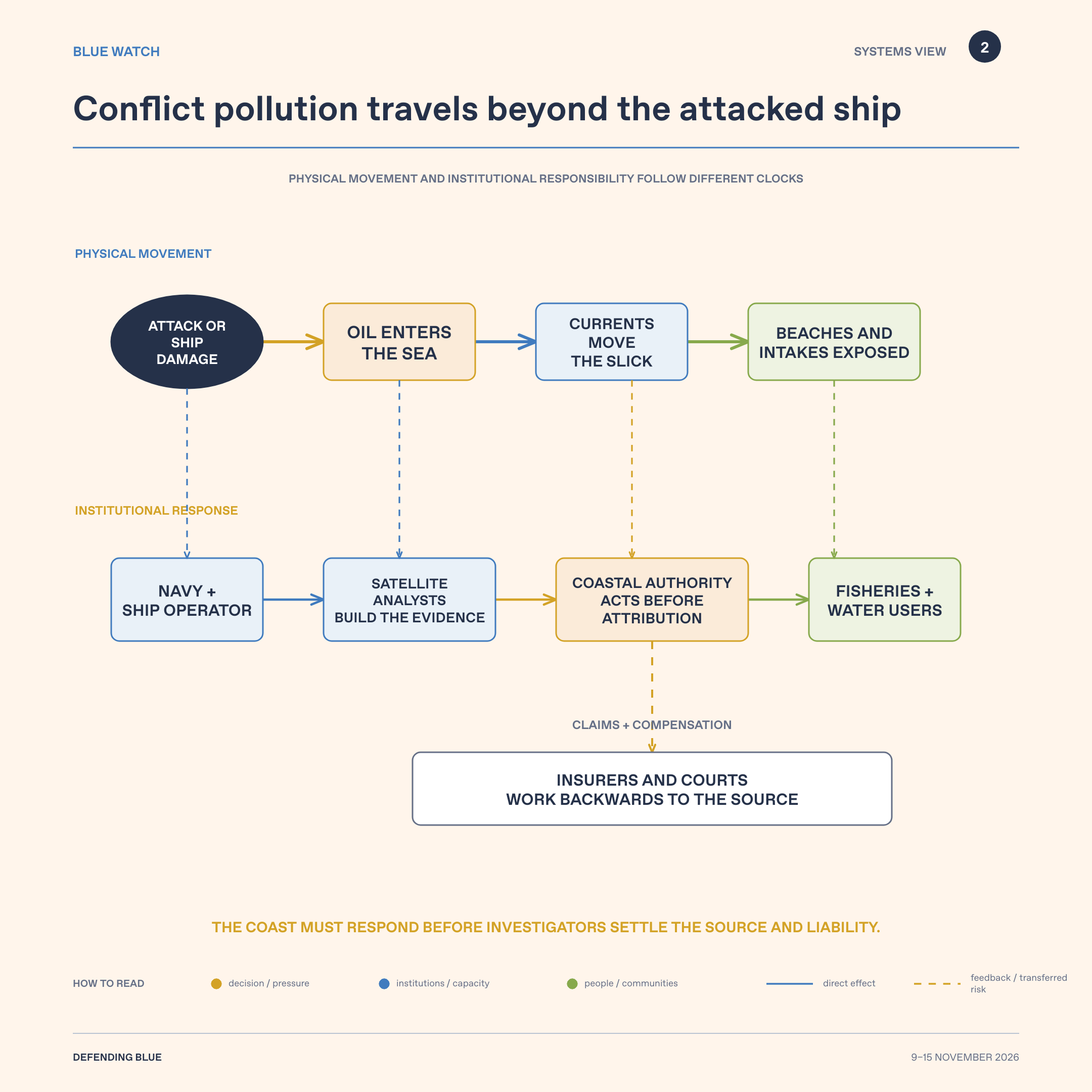
An attack on a tanker can become a coastal emergency without another shot being fired. Reporting on Greenpeace and Kpler monitoring identified 540 possible oil slicks in and around the Gulf since the conflict began. At Khor Fakkan, oil closed Al-Luluyah beach before its origin had been established. Uncertainty limits what can be said about responsibility; it does not give the municipality extra time to protect the shore.
For exposed fisheries or desalination operators, the immediate question is where pollution may travel and when it may arrive. Precaution needs different evidence from attribution or compensation, making naval and commercial information about damaged ships relevant well beyond the incident. Six West African countries’ work towards mutual assistance offers a useful counterpoint: cross-border help needs arranging before a spill makes another country’s capacity indispensable. Protecting passage and protecting the coast require connected planning, even when different authorities lead each response.
Signals from the week
Khor Fakkan closed Al-Luluyah beach after oil was detected along the coastline. The municipality did not identify its cause or announce how long the closure would last. Reuters.
IMO had confirmed 136 incidents involving commercial ships in the Gulf and wider Middle East since the conflict began. IMO.
Greenpeace and Kpler said they had identified 540 possible oil slicks since 28 February. The reported 20,000 square kilometres sums mapped footprints from different dates and does not describe one polluted area. Greenpeace and RNA.
Six West African countries technically validated a draft memorandum on cooperation and mutual assistance during marine pollution emergencies, with signature planned for 2027. IMO.
The unresolved issue
Coastal authorities may have to fund the first response long before anyone can establish liability. The practical question is who makes information and assistance available during that interval. A security effort measured mainly through ships protected or passages completed can miss damage accumulating elsewhere. Keeping trade moving and keeping an exposed coast usable require connected planning, even when different authorities remain responsible for each.
3 Forecasts force governments to distribute risk
Question: Who carries the cost of precaution when authorities have to act before they know how severe the damage will be?
The Blue Watch Read
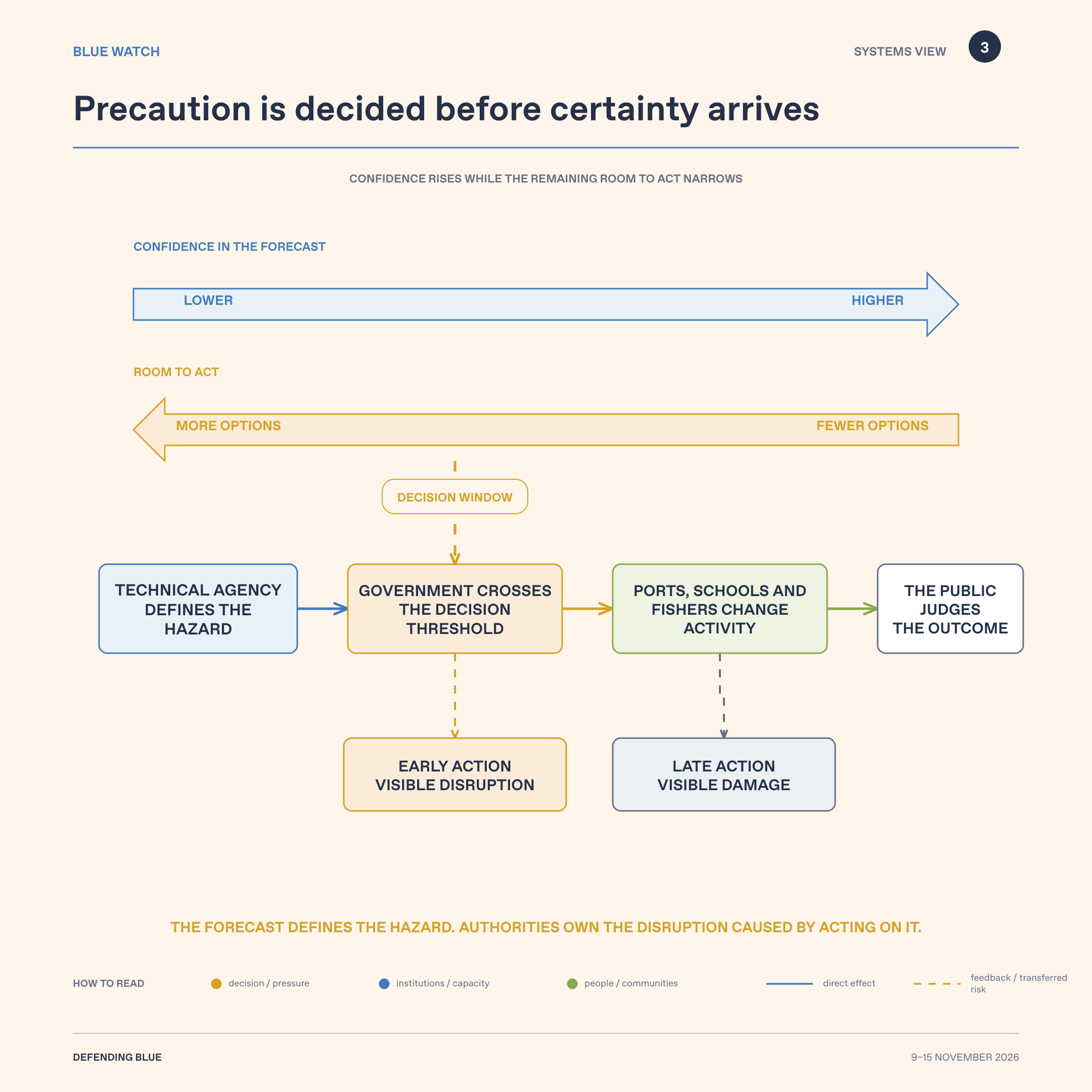
Portugal’s decision was disruptive before the weather could be. Its mainland-wide alert for 11 November closed schools and non-essential public services and restricted access to exposed areas, accepting immediate disruption to reduce possible harm. Peru faces a longer version of that choice: ENFEN expects an extraordinary coastal El Niño through February 2027, with elevated seas and abnormal waves increasing flood and erosion risks. The Navy’s wave warnings inform decisions whose resource implications extend across months; Bali’s high-tide warning makes timing critical along particular stretches of coast.
A forecast cannot decide how much disruption is proportionate, or who can afford it. Suspending work is easier to recommend than to absorb for someone paid by the day; protecting a home requires means as well as notice. Preparedness therefore depends on whether people can act on a warning, and whether authorities support those for whom compliance carries the greatest cost.
Signals from the week
Bali’s meteorological service warned that maximum tides from 8 to 11 November could disrupt port loading, coastal settlements, salt ponds and fisheries in six coastal areas. Tempo.
Portugal declared a nationwide alert for 11 November, closing schools and non-essential public services, suspending outdoor events and restricting access to exposed areas ahead of Storm Charles. Portuguese Government.
Peru’s ENFEN maintained a coastal El Niño alert, forecasting exceptional warming into February 2027 and heightened erosion and flood risk where elevated seas coincide with abnormal waves. ENFEN.
The unresolved issue
A less damaging outcome cannot, by itself, prove either that restrictions were excessive or that they prevented the worst. Authorities need to explain their decisions against the forecast available at the time and examine who could comply, at what cost. That is also an investment in the next warning: public trust becomes part of emergency capacity when protection depends on people changing their behaviour before danger is visible.
4 Allied navies can share systems before they share urgency
Question: What can closer naval integration achieve if governments disagree about how soon they must be ready?
The Blue Watch Read
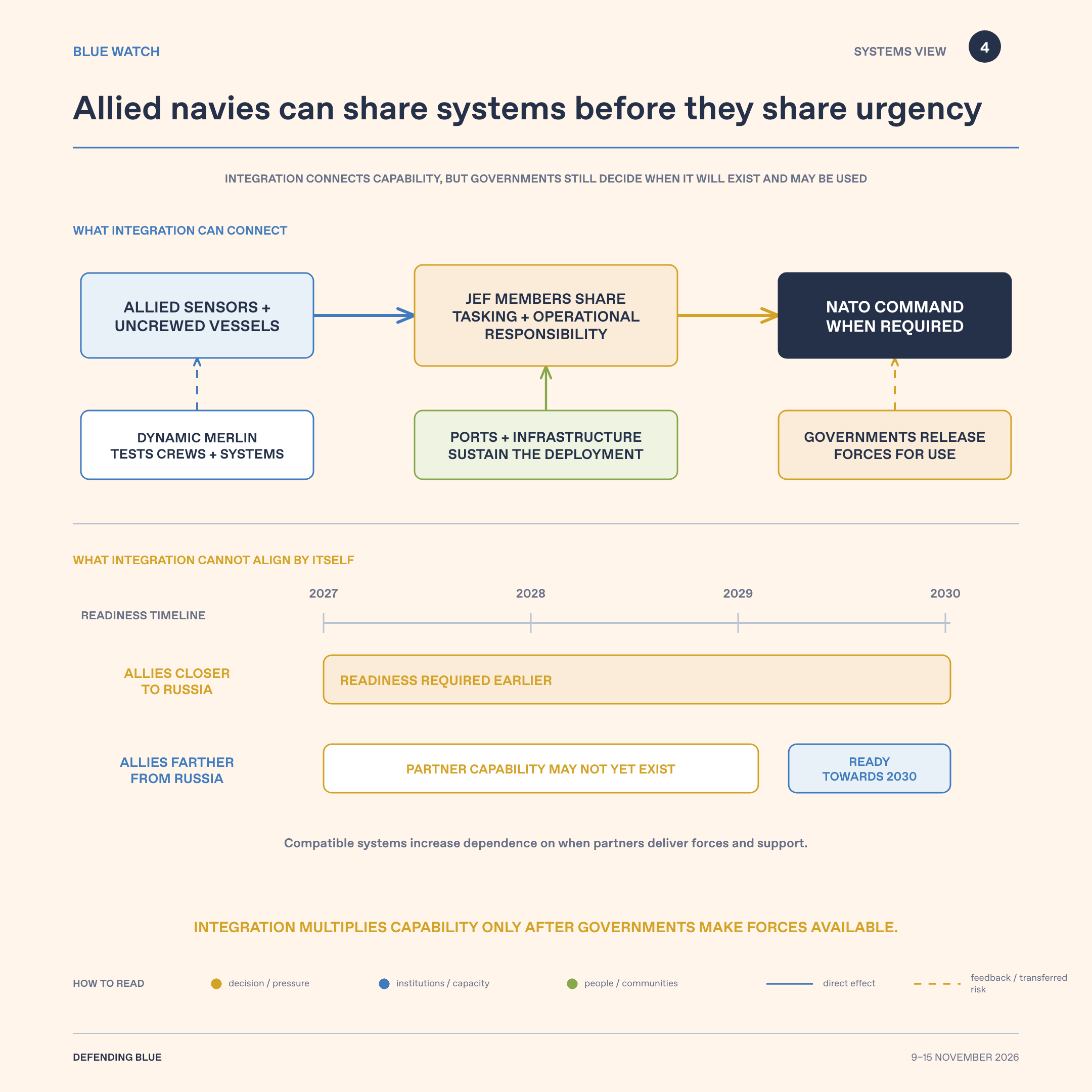
Northern Europe is improving its ability to fight together while still debating how much time it has to prepare. The Northern Navies Initiative envisages Joint Expeditionary Force (JEF) members directing allied sensors and uncrewed vessels, transferring operational responsibility and moving into NATO command when required. That could make scarce assets more useful across borders, while increasing each navy’s dependence on what its partners can supply when needed.
However, at Euronaval, Katja Lindskov Jacobsen described allied threat clocks shifting from 2027 towards 2030 as distance from Russia increases. That difference shapes today’s choices: a procurement timetable acceptable to one government may leave another exposed during the years it considers most dangerous. Dynamic Merlin’s overlapping submarine and drone scenarios test crews’ ability to respond, but compatible systems cannot remove a gap in available forces. Closer integration therefore also requires agreement on the readiness partners owe each other, and when that readiness must exist.
Signals from the week
Dynamic Merlin brought NATO ships, submarines and maritime patrol aircraft together off Sweden for anti-submarine warfare training that included unannounced drone attacks. NATO.
JEF naval chiefs signed the Northern Navies Initiative framework, advancing a process launched through a Statement of Intent in April. UK Government.
The Finnish Defence Forces detected a strike on a Russian warship in the Gulf of Finland. Ukraine said it had attacked the Naro-Fominsk, while the extent of the damage remained unverified. Janes.
The United Kingdom and Norway’s Atlantic Future Forum statement welcomed the Northern Navies framework and, separately, called for whole-of-society resilience across government, industry and civil society. Co-hosts’ statement.
The unresolved issue
The framework’s value will depend on the forces governments make available and the circumstances in which they permit their use. Shared logistics can sustain a deployment but they cannot supply political permission to begin it. The question also reaches civilian ports and infrastructure operators, whose capacity supports naval persistence. If their contribution is part of deterrence, it needs preparation and funding on the same timetable as the fleet.
5 Rescue capacity is also built ashore
Question: What does the duty to save lives require of the places and people receiving them?
The Blue Watch Read
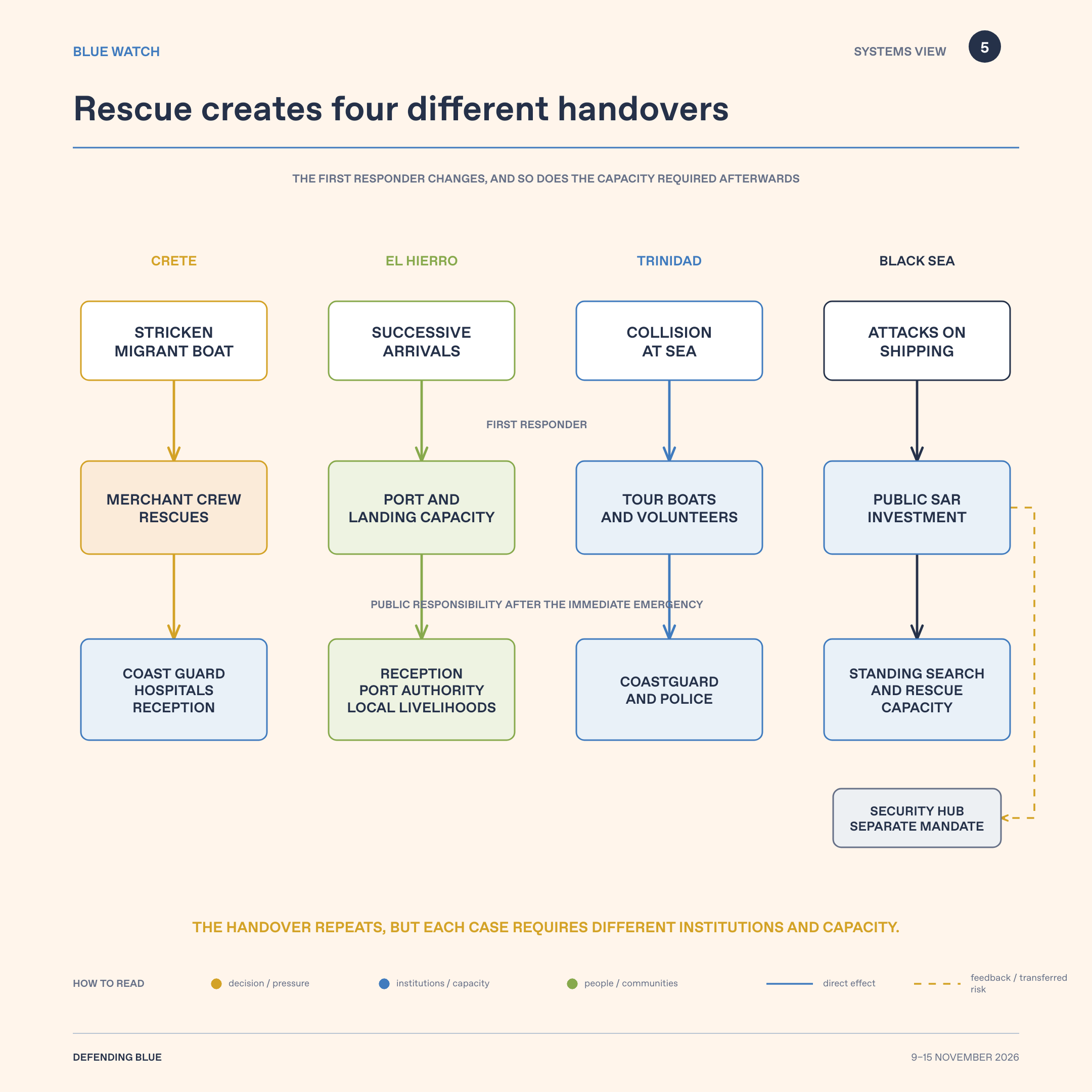
South of Crete, a container-ship crew spotted a stricken migrant boat. Eighteen people were rescued and 13 were found dead; one survivor later died in hospital. Medical care and reception had to follow the rescue. At El Hierro, about 1,400 arrivals over one weekend exposed another constraint: empty cayucos accumulated after a port crane broke down, complicating further rescues and local fishing and diving activity. Ordinary port equipment had become part of lifesaving capacity.
The Commission’s pledge of €10 million each for Romanian and Bulgarian search and rescue recognises that keeping a threatened route usable includes responding when protection fails. Off Trinidad, volunteers joined state agencies searching after a collision. These different emergencies expose how much response capacity depends on support beyond the rescue vessel. Funding that support in advance protects both those in distress and the communities receiving them; relying on local improvisation leaves the next operation dependent on whatever capacity remains.
Signals from the week
A Moroccan-flagged container ship found a stricken migrant boat south of Crete. Eighteen people were rescued and 13 were found dead. One of those rescued later died in hospital. The National.
El Hierro received about 1,400 people over the weekend. Empty cayucos accumulated at La Restinga after the port crane broke, obstructing new rescues and local fishing and diving activity. RTVC.
The European Commission announced €10 million each for Romanian and Bulgarian search-and-rescue capacity and €50 million to accelerate the Black Sea Maritime Security Hub. Its staffing and governance remain unspecified. European Commission and EU Perspectives.
Coastguard, police, civilian tour-boat crews and the volunteer Hunters Search and Rescue Team continued looking for people missing after a collision off Trinidad. Associated Press.
The unresolved issue
The duty to assist does not tell a port how to absorb repeated arrivals or give a volunteer crew the resources of a standing service. Those responsibilities need sustained public support. Counting rescue vessels while overlooking landing capacity leaves part of the operation out of the calculation. It can also allow an avoidable dispute over local resources to obscure the obligation to protect people in distress.
What the week leaves unresolved
Across these stories, the first actor rarely finishes the job. Surveys and satellite detections pass evidence to political or environmental authorities. Forecasts ask governments to act before certainty, while naval exercises can expose readiness gaps without deciding when allies should respond. A merchant crew may save lives, but ports, hospitals and reception authorities inherit the emergency. What remains unresolved is whether the evidence, authority and resources needed to continue the work are already in place when responsibility changes hands.