

The security perimeter is expanding
Five questions that connect Pacific security, oilfields and wind farms, ports under weather pressure, grain routes reshaped by war and the people who keep maritime systems moving.
WHAT CONNECTS THE WEEK
The maritime security perimeter is widening. Pacific leaders are treating climate, fisheries, missile tests, energy dependence and humanitarian response as parts of one regional agenda, while the United States is treating foreign oil, offshore infrastructure, naval readiness and sealift as elements of national power. War and weather are also moving routes, costs and risk across oceans, with the people aboard ships often becoming the point at which distant policy choices turn physical.
This broader definition reflects how the maritime system actually works. Ports serve commerce and operations; civilian data inform enforcement and strategy; merchant-mariner training supports sealift; and naval activity changes commercial behaviour. However, every addition to the security perimeter draws on finite ships, budgets, infrastructure, information and people. The five stories below therefore ask the same question from different places.
QUESTION: As more activity is defined as maritime security, who decides what receives protection, and which risks are transferred elsewhere?
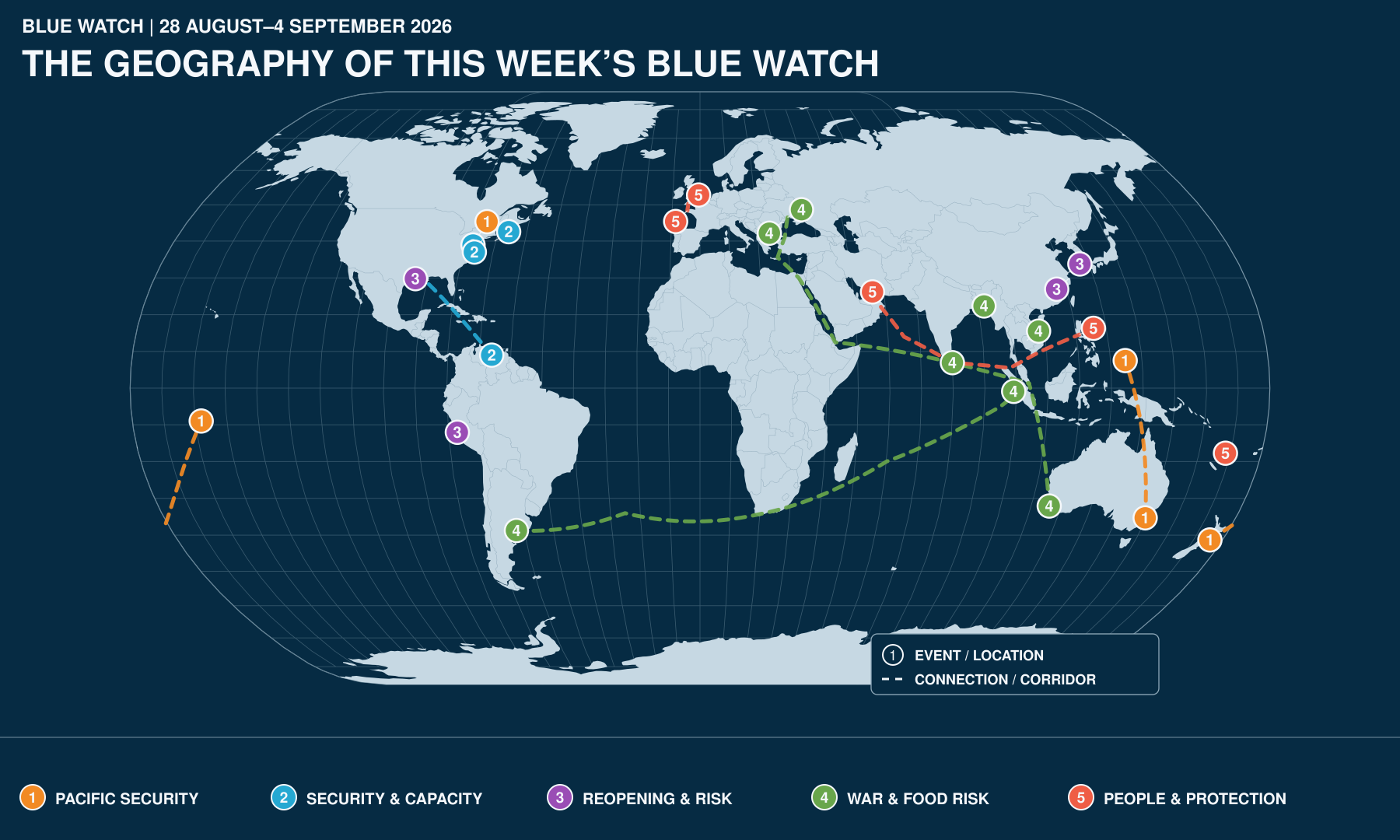
Disclaimer: the map is AI-generated - some dots or routes may not be very precise, but have been retained to show complex links or re-rerouting
1. Pacific security is becoming one system
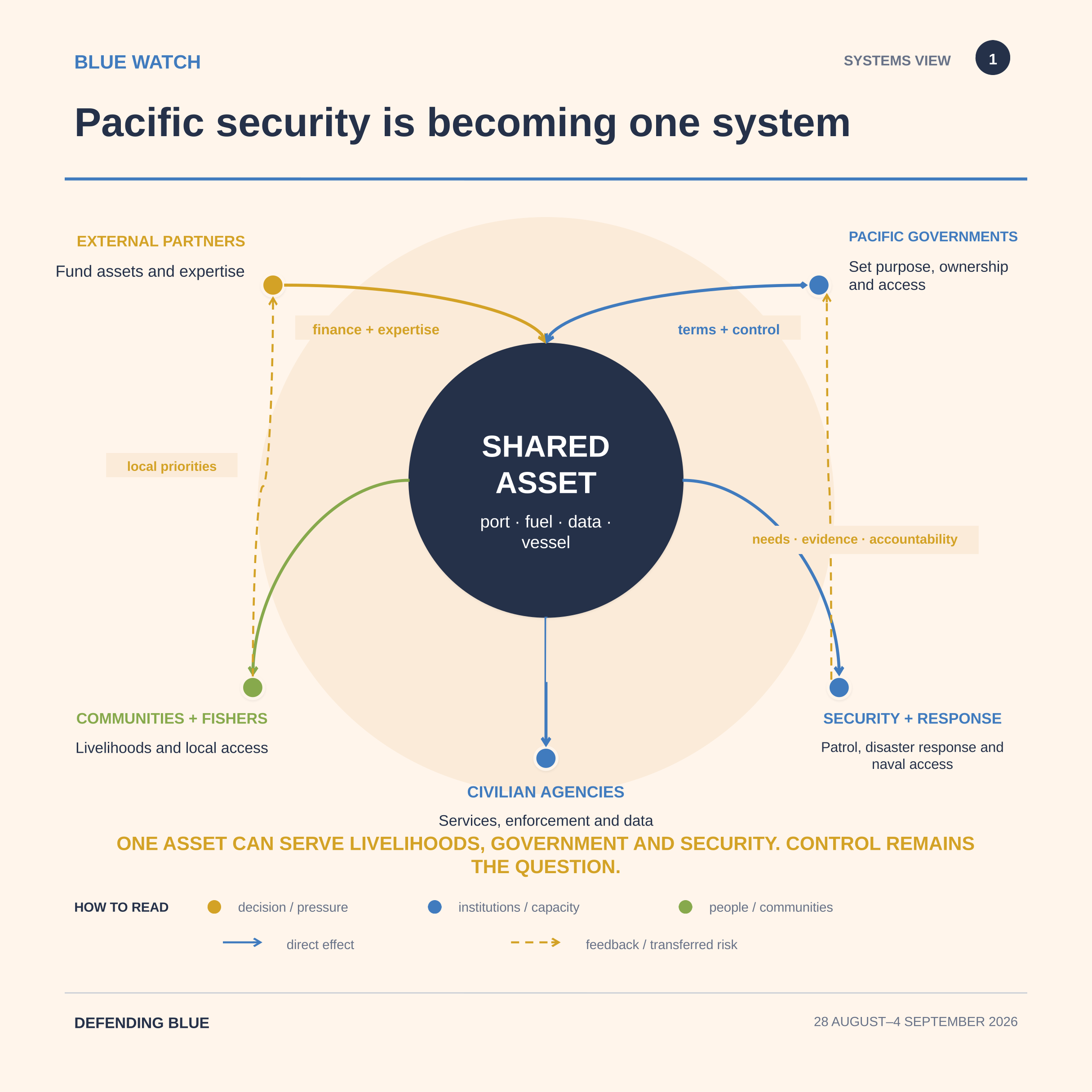
Question: Can an integrated, Pacific-defined security agenda remain Pacific-led when delivery depends on external finance, assets and expertise?
The Blue Watch Read
The Pacific Islands Forum ended with an explicitly interconnected set of decisions spanning climate, policing, transnational crime, humanitarian response, fisheries, energy, oceans and strategic stability. For island states, a fuel shortage can restrict fishing and patrol activity at the same time; a port upgrade can improve ordinary access, disaster response and strategic reach; and a shared maritime picture can support both fisheries enforcement and military awareness.
The implementation problem is that leaders can define security regionally while many of the ships, surveillance systems, construction contracts and funding streams needed to deliver it come from outside. Australia and the United States announced a combined US$580 million in support during the Forum, while the United States and New Zealand will fund an upgrade to the port at Omoka on Penrhyn. These initiatives may strengthen resilience, but their wider effect will be shaped by the arrangements through which civilian services, patrol forces and external partners share the resulting capacity.
Signals from the week
• Forum leaders endorsed a regional peace and security action plan, humanitarian-response arrangements and a 24-hour notification expectation for intercontinental ballistic-missile tests, while proposals including Waqa Moana and an Ocean of Peace treaty require further consultation. Pacific Islands Forum outcomes.
• Leaders also endorsed the Vakamanu Regional Pacific Fisheries Strategy and called for Pacific rights, sovereignty and capacity to remain central in decisions about high-seas fishing and deep-sea minerals. Ocean and fisheries outcomes.
• Australia and the United States pledged US$580 million for regional support, including energy resilience, fuel storage, grid stability, surveillance and law-enforcement training. Reuters.
• The Omoka port upgrade is presented as a safety and services project, although it also sits alongside fisheries, possible seabed-mining activity and renewed strategic competition around the Cook Islands. Reuters.
Unresolved issue
Political endorsement does not settle who controls implementation. External finance does not automatically mean external ownership, but the terms of delivery matter: who selects suppliers, owns surveillance data, decides when assets are deployed and pays to maintain them after the initial funding ends? The same port or information system may support fishing communities, disaster response, law enforcement and naval access, which means control can shift through routine operational arrangements rather than a formal security agreement. The unresolved issue is whether a Pacific-defined agenda can remain coherent and locally governed when different partners fund different parts of the system.
2. National security is expanding faster than capacity
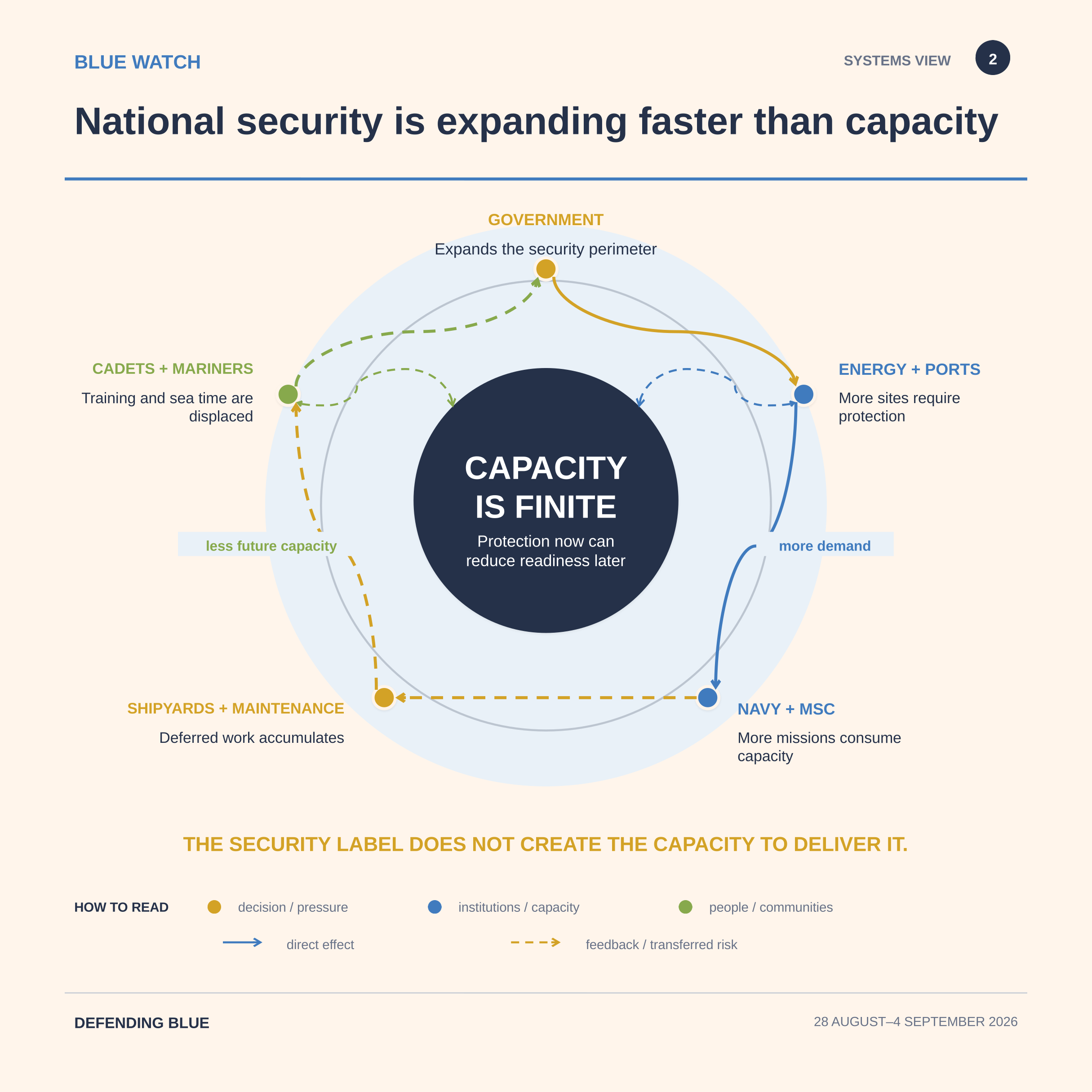
Question: If oilfields, wind leases, submarines, sealift and sailors all sit inside the security perimeter, what gets protected first?
The Blue Watch read
The United States is widening the range of maritime activity treated as a national-security concern. The administration has paused offshore-wind leases on security grounds and framed a long-term Venezuelan oil agreement around strategic supply, military use and control. Those choices place energy assets, seabed space, ports and shipping routes inside the security perimeter, even when they are commercially operated. Yet designating more infrastructure as strategic does not create the capacity to protect or sustain it. GAO found that maintenance delays and idle time cost the attack-submarine fleet more than 15,000 operational days over ten years, while the cost of operations against Iran has forced the Navy to move money between accounts and defer some non-emergency shore maintenance. Sailors are still being paid, but the same pressure is visible in sealift: the training ship Empire State VII is being reassigned to an urgent classified mission because no other suitable vessel was available, potentially disrupting cadet sea time and credentialling.
SIGNALS FROM THE WEEK
• The White House agreement gives the United States extensive control over Venezuelan oil concessions and reserves a share for the Strategic Petroleum Reserve, military use and other sensitive needs. It presents this as a long-term supply-security project, rather than evidence of an immediate replacement for Middle Eastern oil. White House fact sheet.
• The Department of the Interior paused offshore-wind leases while citing national-security risks, adding uncertainty for developers, ports, supply chains and coastal communities. Department of the Interior.
• GAO calculated more than 15,000 lost operational days and US$3.4 billion in costs from attack-submarine maintenance delays and idle time over a decade. GAO.
• The Navy says payroll obligations are being met, although war costs have led to internal reallocations and deferred maintenance. The Guardian.
• Empire State VII is being diverted from maritime training to a 170-day classified mission requested by Military Sealift Command, with no other suitable ship reportedly available. gCaptain.
Unresolved issue
The security label can mobilise money and authority, but it does not reveal the opportunity cost. When operations draw money from maintenance and a training ship from the cadet pipeline, the system meets a present need by borrowing from future readiness. Civilian energy decisions can meanwhile create new patrol, escort, infrastructure-protection and environmental-response demands, while pauses or cancellations move capital, expertise and ecological pressure elsewhere. What remains unresolved is whether these cross-system costs are assessed together, or whether each national-security claim is judged inside its own institutional silo.
3. Reopening moves the risk
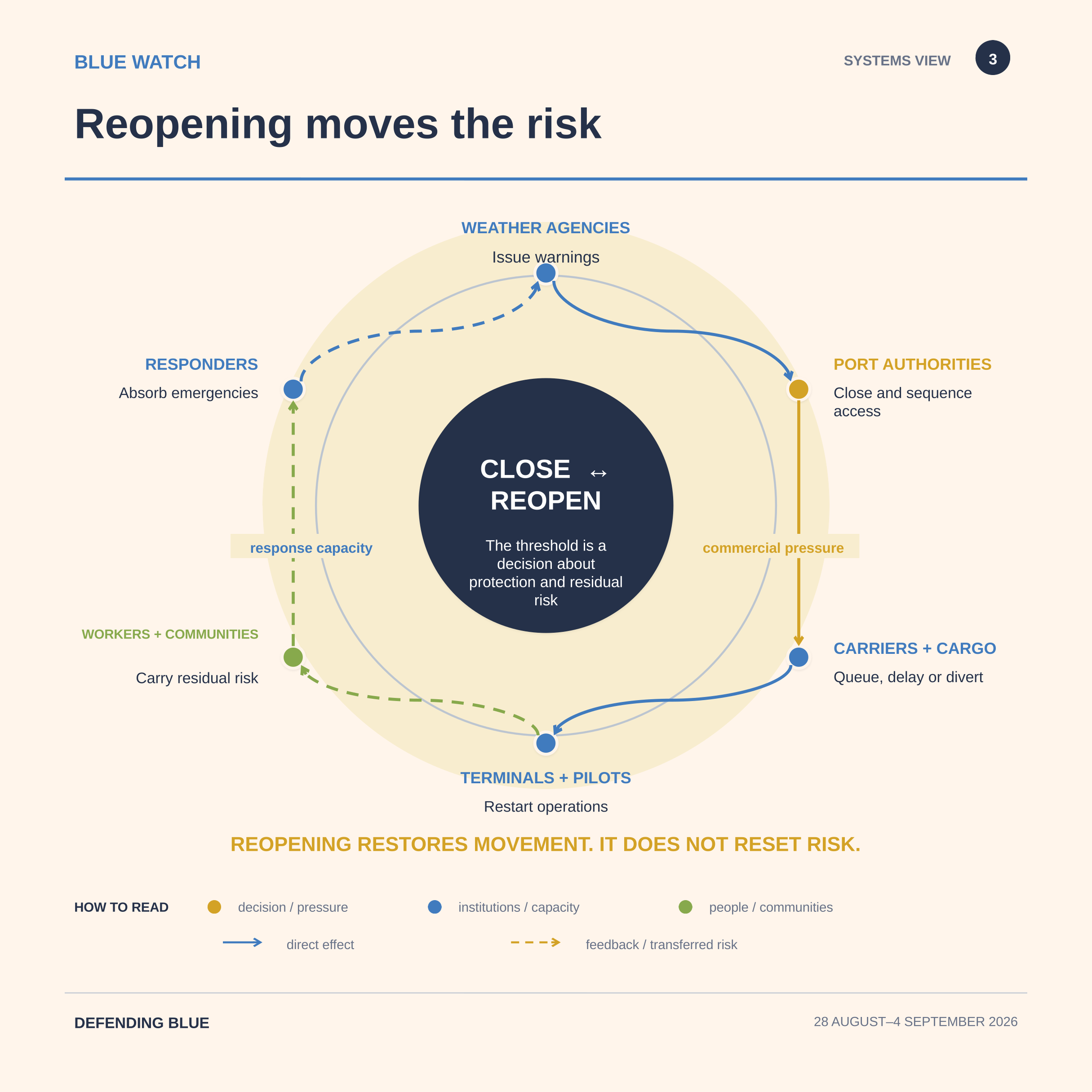
Question: Who decides when a port is safe enough to reopen, and who inherits the disruption that remains?
The Blue Watch read
A port closure is a protection decision. It moves vessels to anchorages, stops cargo handling and limits the exposure of workers, pilots and infrastructure. Reopening is another decision, although it is often described as a return to normal. In reality, terminals may restart while queues, vessel bunching, equipment shortages and damaged inland connections continue to move risk through the system. East China ports began reopening after Typhoon Saudel, but the accumulated backlog did not disappear with the warning level. Peru has introduced a port-continuity plan as El Niño intensifies, while Tropical Storm Edouard showed how landfall, power loss, port access, roads and emergency response become one operational problem. These decisions join meteorological agencies, port authorities, operators, pilots, coastguards and local government, with navies sometimes providing airlift, survey work, hospital capacity or logistics when civilian capacity is exceeded. Those responses, in turn, depend on commercial ports, tugs, fuel stores and communications.
Signals from the week
• WMO assessed a near-100 per cent chance that El Niño will persist through February 2027 and warned that it may become exceptionally strong, increasing pressure on national forecasting and early-action systems. Reuters.
• Peru says 1.2 million people are at risk, while its National Port Authority has set preventive, response and recovery arrangements intended to keep the port system functioning. Reuters and port-continuity plan.
• Shanghai, Ningbo and other East China ports began resuming operations after Saudel, although operational recovery and schedule recovery remained different things. Kuehne+Nagel update.
• Edouard made landfall near Johnson Bayou, Louisiana, bringing heavy rain, strong winds and power disruption. NOAA.
Unresolved issue
Warnings identify a threat, but they do not allocate the cost of acting on it. Closure protects workers, vessels and infrastructure by imposing delay on carriers, cargo owners and communities; reopening restores movement by asking those same actors to accept a degree of residual risk. The difficult point is the threshold between the two. Who decides that wind, surge, access routes and emergency cover are adequate, whose information counts, and can an operator refuse without carrying the commercial penalty alone? Preparedness therefore depends on agreed authority and risk-sharing before the warning arrives, rather than a forecast followed by improvised negotiation.
4. War moves food risk across oceans
Question: When one route becomes dangerous, who absorbs the cost and exposure created by the alternative?
The Blue Watch read
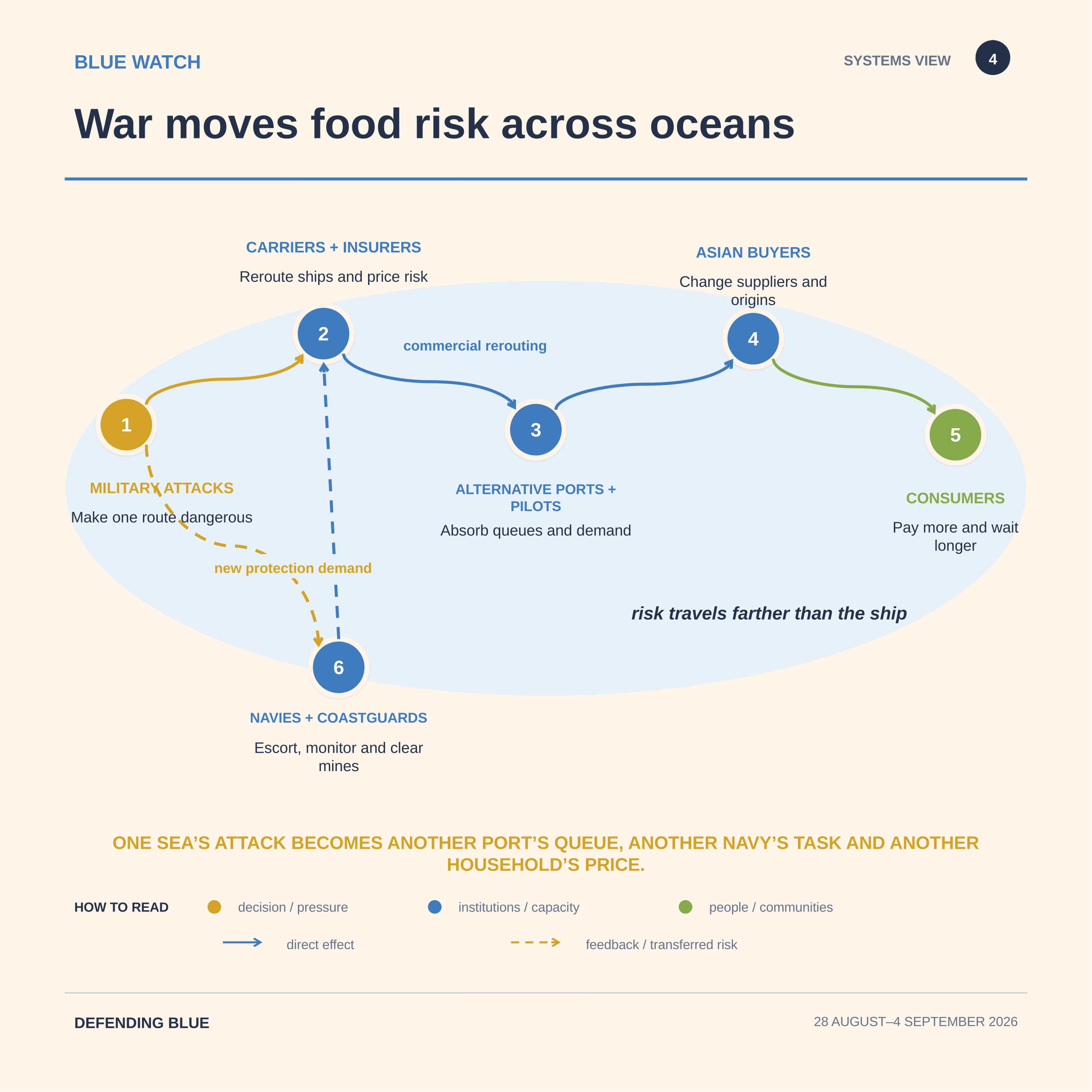
Attacks on Black Sea vessels and export infrastructure are changing decisions far beyond the theatre of war. Importers in six Asian countries have bought at least 500,000 tonnes of Australian and Argentine wheat to replace delayed Russian and Ukrainian cargoes, paying a substantial origin premium. The ships may sail from safer loading ports, but the change affects voyage length, freight demand, inventory planning and food prices across the Indian and Pacific oceans. Within the Black Sea, pressure is concentrating around the alternatives that remain. Queues have grown at Ukrainian Danube ports, where lower capacity and pilot shortages restrict how quickly cargo can move, while commercial ships are adopting improvised anti-drone measures. Military attacks alter commercial routes; the resulting traffic patterns then create fresh requirements for escort, mine awareness, air defence, surveillance and rescue. This is the civil-naval feedback loop in unusually clear form.
Signals from the week
• Buyers in Indonesia, Bangladesh, Vietnam, Malaysia, Thailand and Sri Lanka purchased at least 500,000 tonnes of Australian and Argentine wheat after Black Sea delays, at prices roughly US$30–70 per tonne above Black Sea cargoes. Reuters.
• Around 80 vessels were reportedly waiting to enter Ukrainian Danube ports, where pilot availability and lower terminal capacity constrain throughput. Reuters.
• Ships in the Black Sea are adding improvised anti-drone protection, while some vessels have received coastguard escort on the approach to the Bosphorus. Reuters.
• Russia is also moving more grain towards Baltic outlets as Black Sea trade is disrupted, demonstrating that rerouting redistributes infrastructure demand rather than removing it. Reuters.
Unresolved issue
Alternative routes reduce dependence on one corridor, but they create new concentrations of cost, traffic and strategic value. Buyers may secure wheat by changing origin, yet pay more and place additional demand on distant ports and shipping capacity. Mine-clearance, patrol and escort forces may help keep a corridor open, but they cannot restore terminal throughput, supply pilots or absorb the higher food price at destination. The unresolved issue is whether ports, security forces, insurers, carriers and importers can adapt as one system, or whether each transfer of risk is discovered only when it becomes somebody else’s shortage or exposure.
5. Protection depends on who the system sees
Question: When a route is declared open or an industry is called resilient, what evidence shows that the people aboard are actually protected?
The Blue Watch read
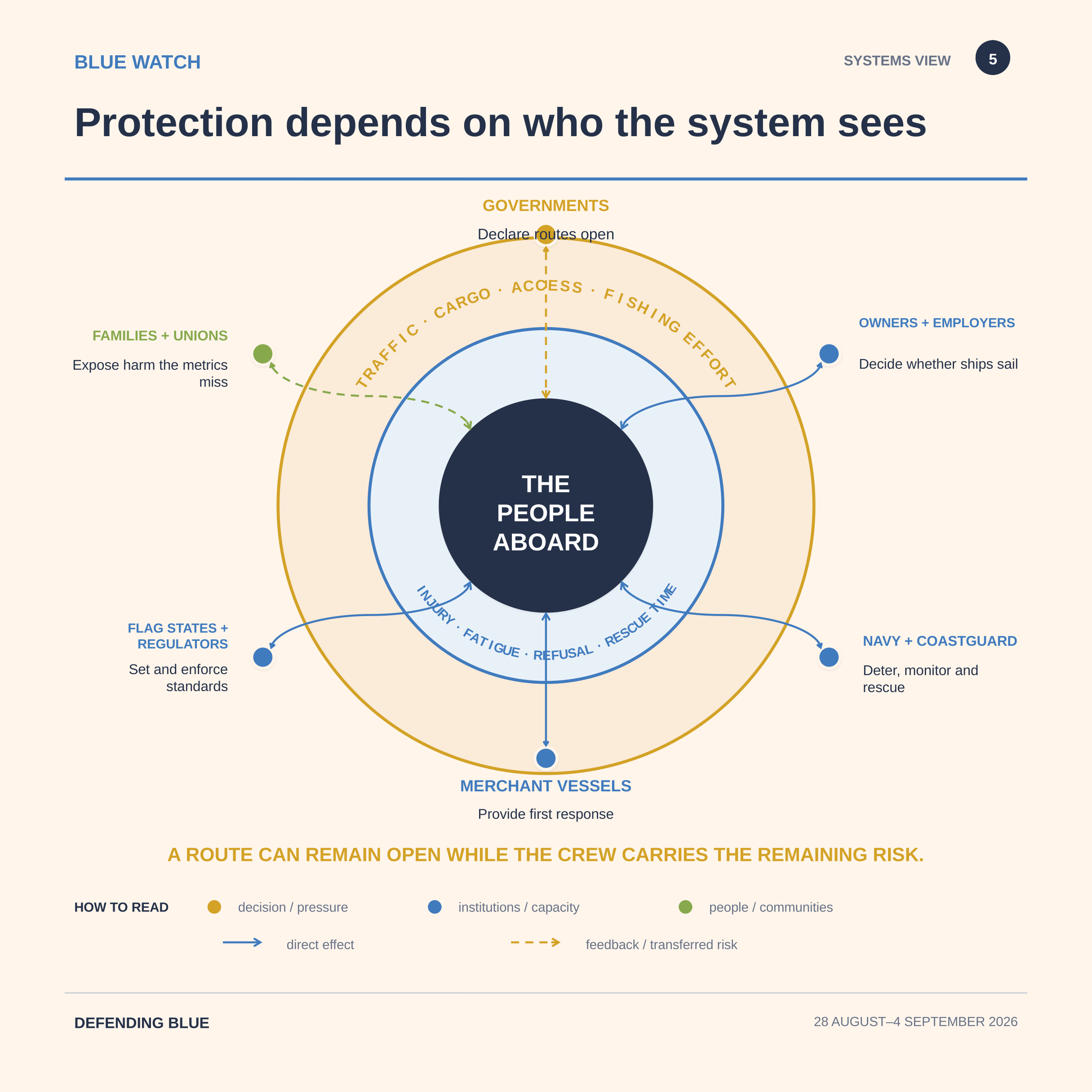
Maritime security is often measured through flows: vessels transiting, cargo delivered, ports reopened and fishing effort sustained. Those indicators can improve while the people carrying the risk remain exposed. Two tankers carrying Saudi oil were struck near the Strait of Hormuz this week, and two Filipino seafarers aboard the Sidr were subsequently confirmed killed. The deaths sharpen the distance between a route being technically navigable and a crew being secure enough to use it. The same question appears in less militarised settings. Vanuatu has begun consultations on regional fishing-crew labour standards due to take effect in 2028, making working conditions part of fisheries governance rather than leaving them to individual vessels. Off Plymouth, the sinking of the French trawler Maranello triggered a response involving a merchant vessel, British rescue assets and a French Navy Falcon 50. Three people were rescued; after extensive searches found no trace of the other two crew members, the operation was suspended.
Signals from the week
• The Saudi-flagged Sidr and Liberian-flagged Senegal Prosperity were struck near Khasab, Oman, while carrying Saudi crude. Two Filipino seafarers aboard the Sidr were later confirmed killed. Reuters.
• Observed commodity-vessel traffic through Hormuz remained far below both the recent average and pre-war levels, despite continued efforts to move oil and gas through alternative arrangements. Reuters.
• Vanuatu held consultations on the FFA minimum terms and the WCPFC crew-labour measure that takes effect on 1 January 2028. Pacific Islands Forum Fisheries Agency.
• After the Maranello sank in the UK search-and-rescue region, the merchant vessel Stradale rescued three people. The search for the remaining two crew members was later suspended without finding them. French Atlantic Maritime Prefecture and UK follow-up.
Unresolved issue
A route, fishery or port can remain operational because crews absorb risk that is poorly measured. Naval presence may deter attack, monitor traffic or provide specialised search assets, but it does not replace shipboard standards, employer duties, flag-state oversight or rescue coordination. Commercial vessels and crews also provide information, capacity and sometimes the first response. The unresolved issue is how responsibility is divided before an incident: what evidence supports a declaration of safety, who can challenge it, and what genuine choice does a seafarer have when refusing the risk may also mean losing employment?
What the week leaves unresolved
Across all five stories, widening the security perimeter does not automatically widen protection. Each decision concentrates capacity somewhere: finance behind one regional priority, maintenance behind one operation, port access behind one reopening threshold, escorts around one corridor or rescue assets around one incident. The corresponding risk does not disappear. It moves into delayed maintenance, a more expensive cargo, a different coastline, an overextended responder or a crew asked to continue.
That is what the wider maritime picture should make visible. The task is not simply to connect civilian and naval systems after disruption occurs, but to recognise in advance who will gain protection, what capacity will be consumed and where the remaining exposure is likely to land. Otherwise, an expanding definition of security may produce an expanding set of responsibilities without the authority, resources or accountability needed to meet them.