

Maritime reach is expanding faster than accountability
Five questions connect this week: how maritime systems create evidence, turn uncrewed platforms into capability, govern Arctic access, uphold common shipping rules and act before El Nino becomes loss. Each asks whether responsibility is keeping pace with reach.
WHAT CONNECTS THE WEEK
Maritime reach no longer depends only on physical proximity. Information can locate people before a crisis, technology can extend a search far below the surface, and forecasts can justify action before damage becomes visible. This changes the timing of protection. Decisions that once followed an incident increasingly have to be made while the risk is still dispersed, uncertain or unfolding somewhere else.
Yet greater reach does not produce protection by itself. It creates a longer chain between the first warning and the eventual response, and every handover can weaken the result. Naval capacity matters at the points where depth, distance or coercion exceed ordinary civilian reach. Its effect still depends on whether evidence can cross institutional boundaries and whether authority and support arrive with it. Capability has expanded faster than the rules that connect seeing, deciding and acting.
QUESTION: As maritime actors reach farther and act earlier, who owns the evidence, authority and capacity that turn reach into protection?
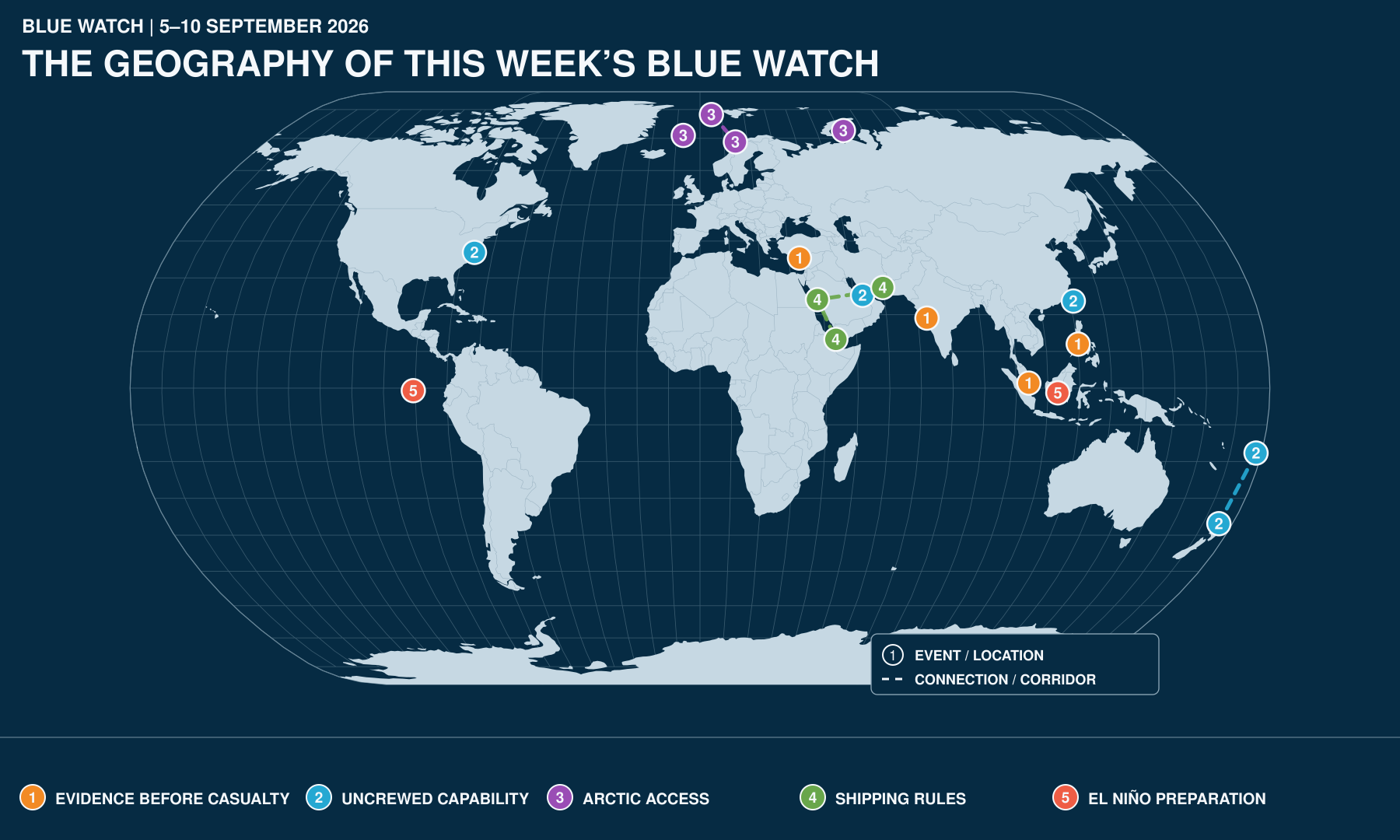
Disclaimer: the map is AI-generated - some dots or routes may not be very precise, but have been retained to show complex links or re-rerouting
1. Evidence begins before the casualty
Question: Who creates and preserves the evidence needed before and after a maritime casualty?
The Blue Watch Read
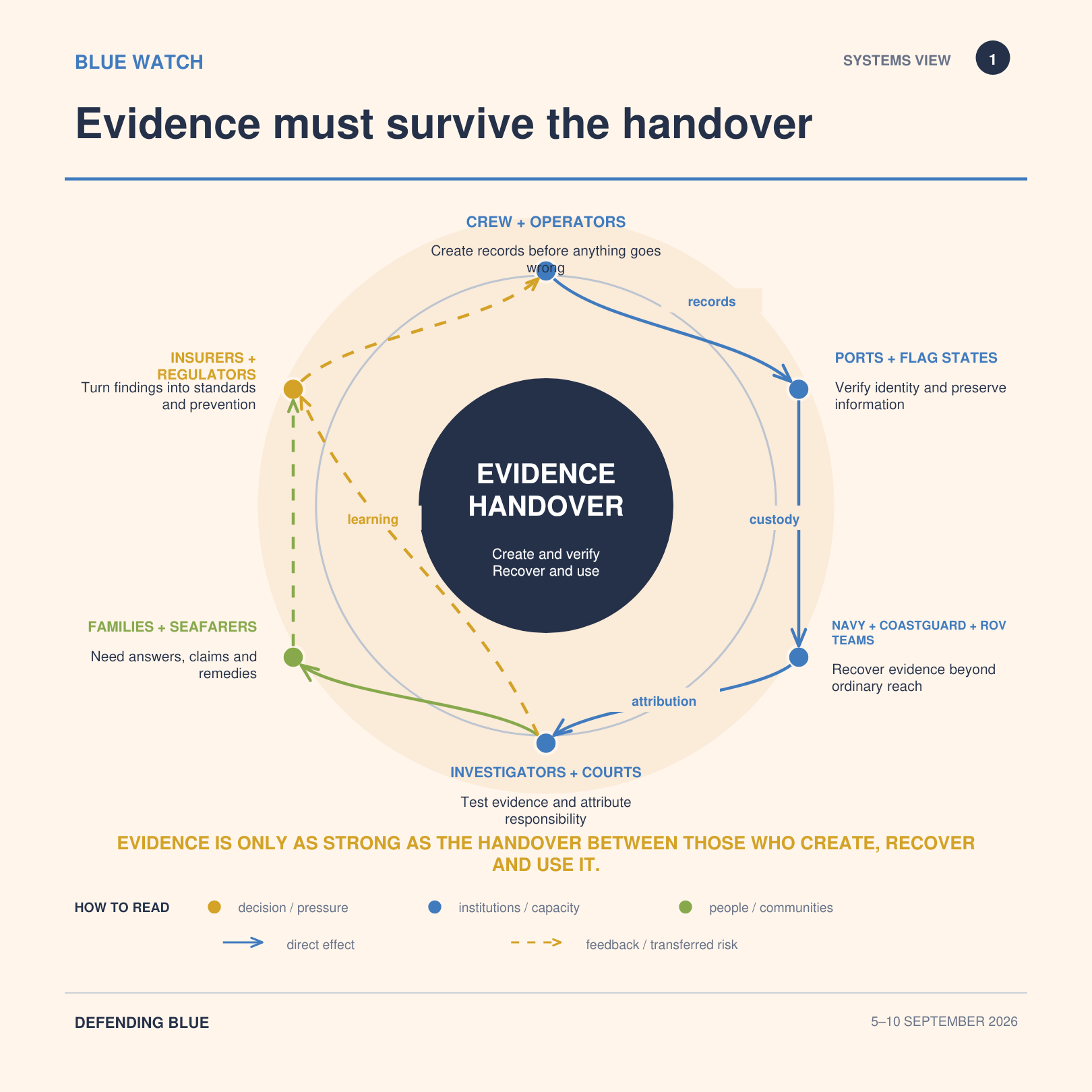
A maritime investigation begins before anything has gone wrong. Reliable crew and vessel records reduce the time between an alarm and an effective response, while false or incomplete information allows uncertainty to travel with the ship. India's e-NAVIK development and Singapore's warning against inaccurate vessel information are therefore more than administrative measures. They treat information as safety infrastructure, capable of shaping both the rescue and the accountability that follows.
Deep-water technology extends that evidential chain after a vessel sinks. The continuing work around the Filo Jet wreck shows that naval systems can recover material beyond the reach of an ordinary civil investigation. The Philippine ferry fire exposes the opposite limit: sophisticated search capacity cannot compensate for uncertainty over who was aboard or where people may have drifted. Technology changes what can be recovered. It does not make weak information reliable, nor does recovery automatically make evidence usable.
Signals from the week
• India launched a seafarer-tracking module on e-NAVIK and asked operators to update vessels carrying Indian crew in designated high-risk areas. DGMA Circular No. 56 of 2026.
• Singapore warned owners and port agents that arrival and clearance information must accurately identify vessel registration, ownership, cargo and trading history. Maritime and Port Authority of Singapore.
• A U.S. Coast Guard review found that waterway risk-assessment tools were underused and that the relevant programme faced an estimated 31 per cent staffing deficit. gCaptain on the Coast Guard review.
• Turkish naval teams continued deep-water work around the Filo Jet wreck, while a fire aboard the Philippine ferry MV June Aster left at least five people dead and 86 missing as this edition closed. Reuters on Filo Jet and AP on June Aster.
Unresolved issue
The unresolved issue is when operational information becomes accountable evidence. A record may be good enough to direct a search yet still be challenged in court; material recovered from depth may clarify a casualty yet remain inaccessible to families or investigators. The handover therefore needs agreed standards before the emergency begins. Without them, the ability to find more evidence may deepen the dispute over what can be trusted, disclosed and used, particularly when recovery continues after its immediate rescue value has ended.
2. Uncrewed capability still depends on a crewed system
Question: What turns an uncrewed platform into an operational capability rather than an isolated asset?
The Blue Watch Read
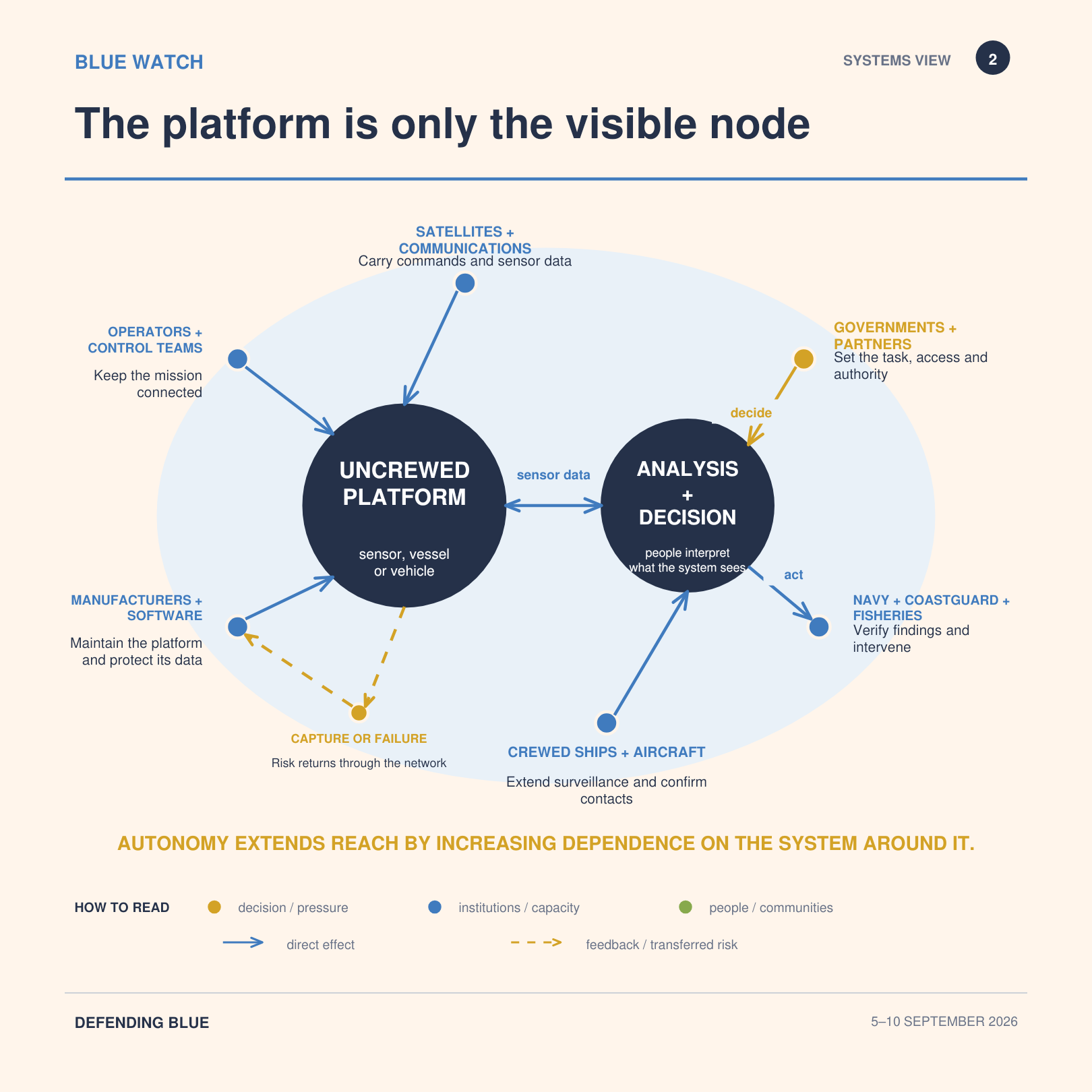
The week's headlines make uncrewed capability look like a platform race. The more consequential contest is over integration. Fleet numbers say little about whether vehicles can remain connected, be sustained at distance or produce information that leads to action. The U.S. refuelling trial tackles one of those dependencies, while the Fiji deployment tests the harder transition from persistent surveillance to useful enforcement. The platform is therefore only the most visible part of the capability.
Removing people from the vehicle does not remove human judgement or organisational dependence. It shifts the vulnerability towards communications, software and the decisions made beyond the platform. This is why the same architecture can support fisheries protection and military surveillance while producing very different consequences. The loss of a vehicle may be tactically minor, but it can still expose data, weaken trust between partners or reveal how the network operates. Autonomy expands reach by making the platform more dependent on everything around it.
Signals from the week
• Taiwan's cabinet proposed NT$145.7 billion in additional 2026 defence spending, including more than 40,000 coastal attack drones and an initial batch of over 100 small uncrewed attack boats. The proposal still requires legislative action. Reuters.
• A U.S. Navy trial repeatedly captured, refuelled and released a remotely controlled T38 surface vessel, transferring about 400 gallons through a towed robotic connector. It did not demonstrate an autonomous rendezvous. USNI News.
• At Fiji's request, the jointly owned Royal New Zealand Navy and Customs vessels Tahi and Rua completed a four-week deployment in Fiji's exclusive economic zone and surveilled 145 vessels from control and analysis centres in New Zealand. NZDF and New Zealand Customs.
• Crewed P-8A and MC-12K aircraft also photographed vessels across Fiji, Papua New Guinea, Solomon Islands, Tonga and adjacent high seas, underlining that persistent sensing still depends on a wider reconnaissance and enforcement network. NZDF and New Zealand Customs.
• Iran recovered an Anduril Dive-LD autonomous underwater vehicle near the entrance to Hormuz. U.S. officials said it had malfunctioned and carried no sensitive or classified payload, claims that cannot be independently tested while the vehicle is in Iranian hands. Reuters.
Unresolved issue
Integration creates capability by distributing it, but responsibility does not yet travel as easily as data. That matters most when a system operating for one partner produces information that another is expected to use. The unresolved issue is where responsibility settles when the network fails or the information proves wrong. Unless ownership and decision authority are agreed in advance, a shared uncrewed system can widen surveillance without producing either effective enforcement or clear accountability.
3. Arctic access is being tested above and below water
Question: Who controls access and infrastructure in an Arctic becoming operational?
The Blue Watch Read
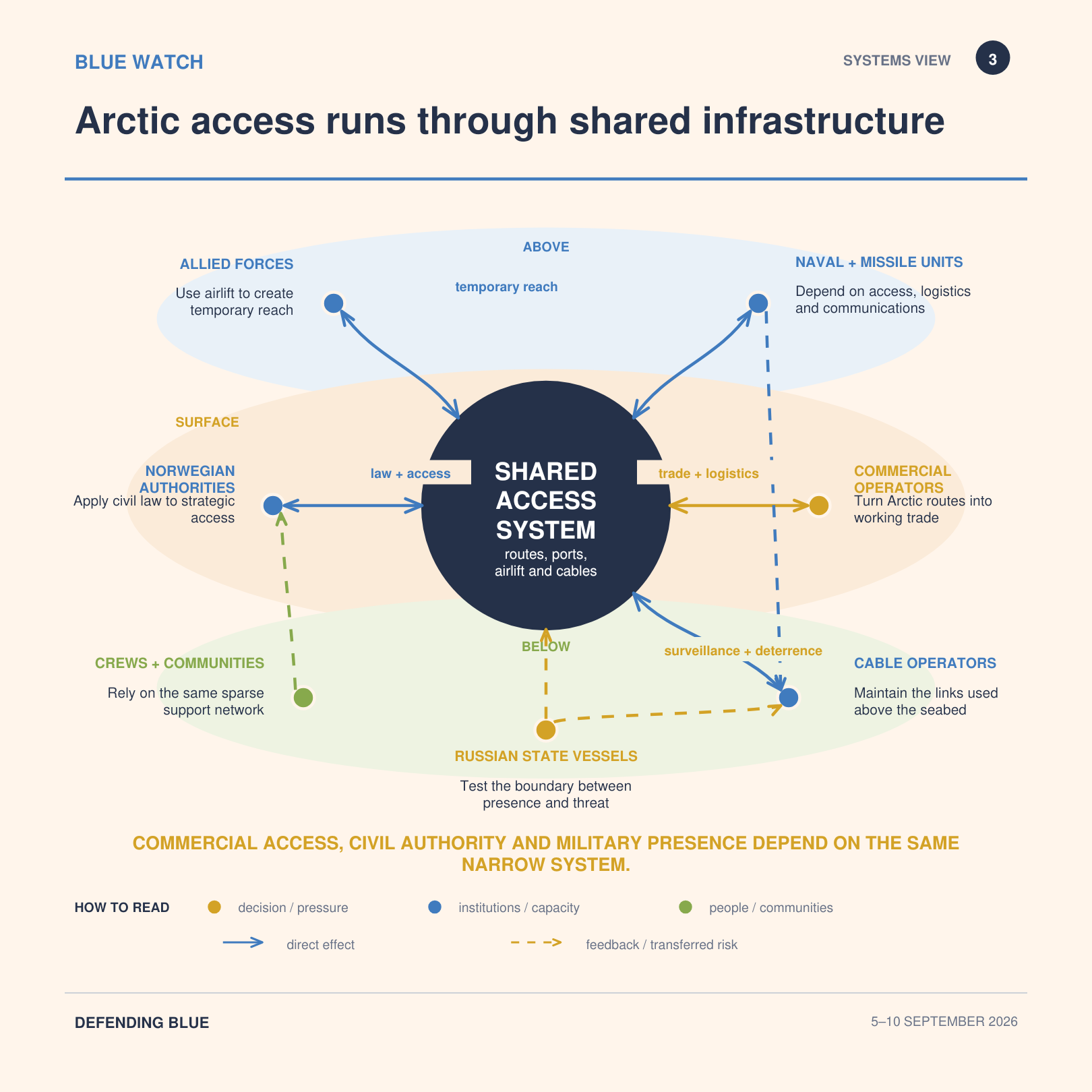
The Arctic stories do not amount to one coordinated escalation. They show something more structural: access is becoming a source of leverage because so much activity depends on a small number of routes and facilities. The first Vostok Oil cargo changes the balance by turning a planned export system into a working one. The reported encounter near Svalbard's cables changes it again by bringing activity below the seabed into the region's security calculations. Legal, commercial and military pressure can therefore interact even when the events themselves are unrelated.
That scarcity makes the civil and naval systems unusually difficult to separate. Infrastructure built for ordinary access can acquire strategic value, while measures intended to protect it can constrain the traffic it was designed to support. Naval presence can strengthen deterrence and underwater awareness, but it cannot remove the dependence on civilian law, communications and logistics. In the Arctic, security is increasingly exercised through the same infrastructure whose openness states are trying to preserve.
Signals from the week
• Norway assisted 69 Russian citizens home after Professor Molchanov was seized in Svalbard at Naftogaz's request to enforce a US$4.22 billion arbitration award. Russia plans to appeal. Reuters.
• Vostok Oil began its first loading at the new Sever Bay terminal onto the ice-class tanker Valentin Pikul, turning a long-planned Arctic export route into an operating system. The Barents Observer.
• Operation Atlantic City moved a StrikeMaster vehicle carrying the Naval Strike Missile concept to Jan Mayen by RAF A400M and integrated Norwegian, British and U.S. forces. The exercise did not include a live firing or permanent deployment. U.S. military release.
• Reuters reported that Western forces confronted Russian GUGI vessels near Svalbard in spring 2026 while they simulated deploying technology intended to disable subsea cables. The account relies on two anonymous officials; no cable was damaged. Reuters.
Unresolved issue
The unresolved issue is the threshold at which access becomes coercive. Existing legal frameworks can classify a seizure, a commercial voyage or a military deployment separately, but pressure may emerge through their combined effect on the same narrow system. Cable protection makes that difficulty acute because waiting for damage defeats the purpose of protection, while acting on ambiguous underwater activity risks treating legitimate access as hostile. Arctic states still need a basis for early action that remains reviewable and does not quietly erode civilian access.
4. Common shipping rules are under structural pressure
Question: Who upholds common shipping rules when belligerents impose rival systems of passage?
The Blue Watch Read
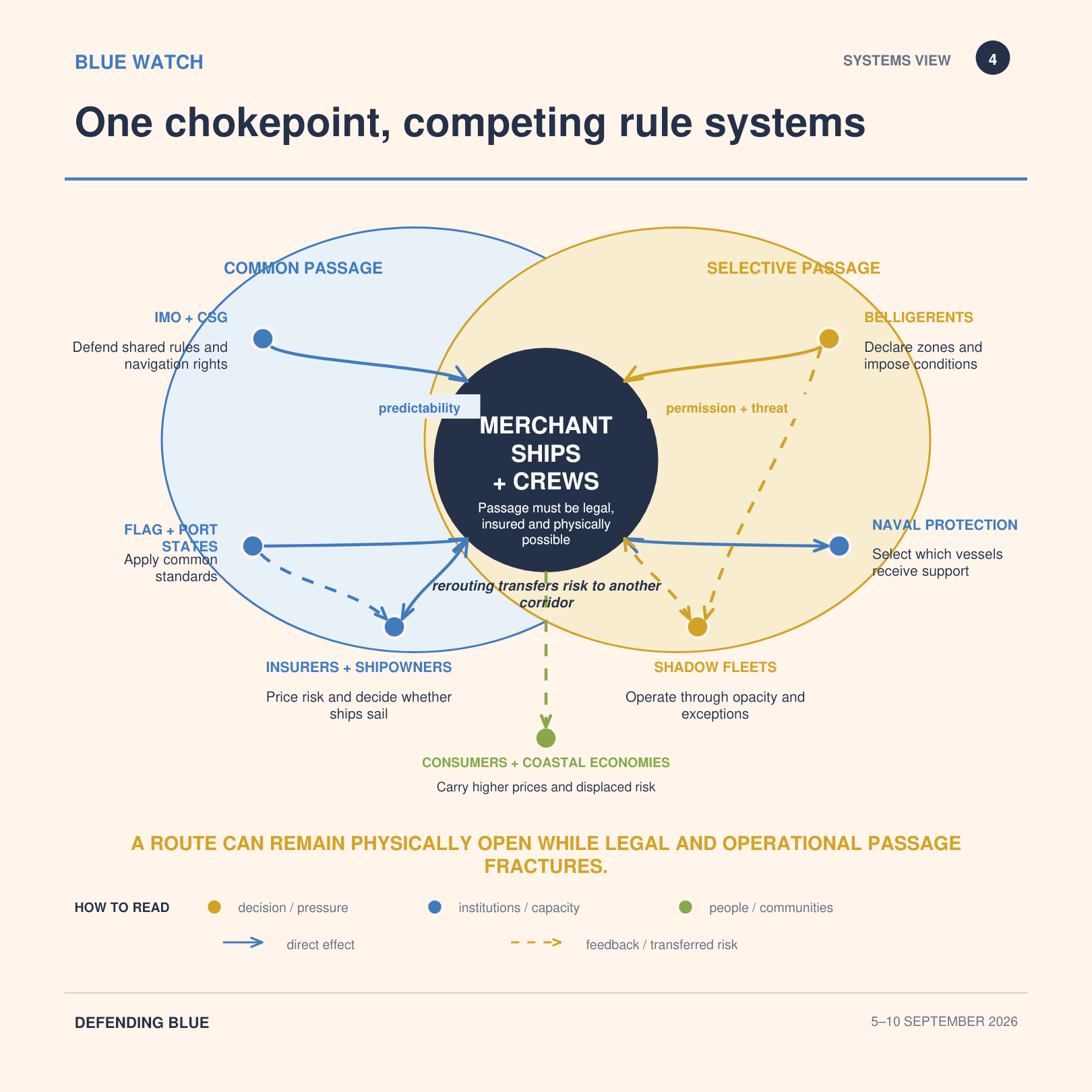
The Consultative Shipping Group's warning is important because it identifies more than an increase in attacks. The common basis on which commercial shipping operates is being replaced by rival systems of permission and threat. In the Gulf, a route may remain physically open while its legal and operational status becomes uncertain. Ships are then forced to navigate claims of authority that were designed by belligerents rather than agreed for common passage.
Naval protection can keep selected vessels moving, but selection is itself a form of maritime governance. If safe passage depends on an escort, a vessel's nationality or acceptance by an armed group, the rule is no longer common. Rerouting does not solve that pressure. Traffic displaced from Hormuz towards the Red Sea encounters a different system of coercion around Bab el-Mandeb. Risk moves with the route, while the neutral operating basis remains absent.
Signals from the week
• The Consultative Shipping Group warned that recent attacks are not isolated shocks but evidence of a structural shift, with rule-following trade increasingly operating beside shadow fleets and coercive rerouting. Wall Street Journal.
• Iran said it would announce a new exclusion or restricted-navigation zone near Hormuz after U.S. forces struck Iranian tankers. Coordinates, procedures and the legal basis had not been published as this edition closed. Reuters via gCaptain.
• Iran claimed attacks on 10 ships after the United States struck five more Iranian oil carriers. The New Andros was hit in Iraqi waters while carrying about two million barrels of fuel oil; its 22 crew were safe and Iraq reported no leak. Reuters.
• Observed vessel traffic through Hormuz fell to seven transits on Wednesday, and no LNG tanker exited, while Houthi forces seized Mocha and excluded Saudi vessels from their assurances of safe passage near Bab el-Mandeb. Reuters via gCaptain on Hormuz and Reuters via gCaptain on Yemen.
Unresolved issue
The unresolved issue is how to defend a common rule without turning it into another belligerent guarantee. The CSG can name the structural pressure, but diagnosis alone gives a ship no credible basis for passage. Selective naval protection may reduce immediate danger while confirming that access now depends on political alignment. What must follow is a form of collective action that restores predictability for neutral shipping rather than adding one more competing instruction.
5. El Nino preparation is becoming ecosystem triage
Question: Which thresholds should trigger conservation, fisheries and livelihood protection before El Nino arrives?
The Blue Watch Read
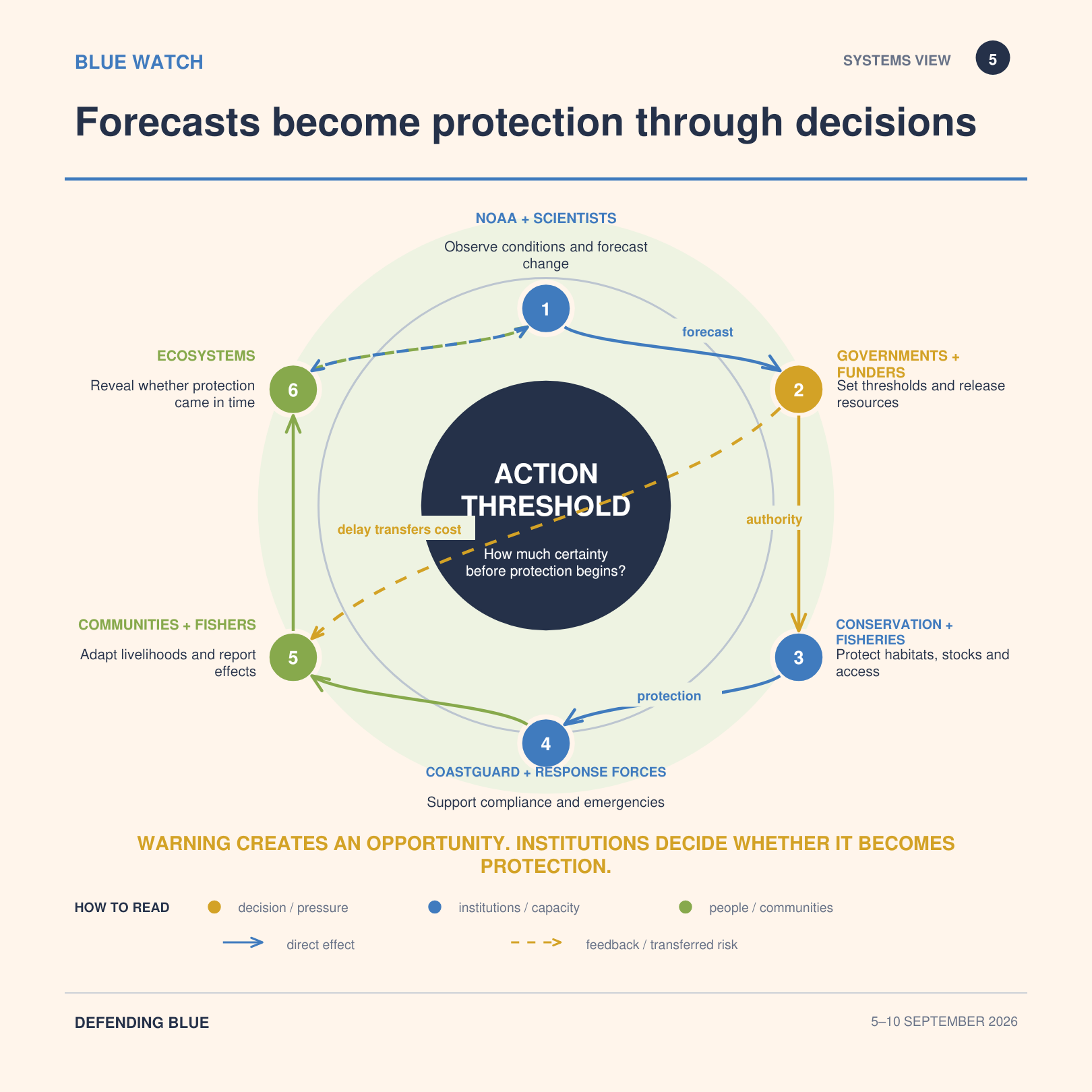
The most important El Nino decision may be the one taken before a visible emergency. In the Galapagos, the forecast is already changing behaviour because warming can weaken the food web before its full effects appear in wildlife or catches. Preparatory conservation therefore treats probability as a reason to act, rather than waiting for ecological damage to provide certainty. That choice brings the cost of protection forward, when its benefits are still difficult to see and its necessity can still be contested.
The same logic will shape fisheries and livelihood decisions if conditions deteriorate. Thresholds are what turn an ocean forecast into a legitimate restriction or an offer of support. The naval relevance is conditional but important: transport and disaster-response capacity should reinforce a civilian plan when local systems are exceeded, not define the plan after the emergency has arrived. Preparation is therefore a question of when authority and resources begin to move, not simply how accurately the ocean can be forecast.
Signals from the week
• NOAA assessed a greater than 90 per cent chance of a very strong El Nino during the Northern Hemisphere autumn and winter, and a 75 per cent chance of historic strength in October-December. NOAA Climate Prediction Center.
• Galapagos waters may reach about 2.2 degrees Celsius above normal, disrupting plankton, fish and dependent wildlife. AP.
• Conservation teams are removing invasive plants, collecting endemic seeds and expanding nurseries before the heaviest impacts. AP.
• In Indonesia, respiratory infections linked to current fires more than doubled in a week, smoke crossed borders and foreign military helicopters joined water-bombing operations. Reuters.
Unresolved issue
The unresolved issue is how much certainty should be required before precaution becomes obligation. Acting early can protect an ecosystem while imposing an immediate cost on communities; waiting can make the eventual intervention harsher and less effective. Scientific thresholds alone cannot settle that choice. They need to be tied to authority and funded support, so that precaution does not simply transfer the cost of uncertainty to those whose livelihoods depend on the sea. Otherwise, better forecasting will describe the coming loss without changing who bears it.
What the week leaves unresolved
Across the five stories, maritime reach is expanding through better information, greater endurance and earlier warning. The weakness appears when that reach crosses an institutional or legal boundary. Evidence can be recovered without becoming usable, surveillance can widen without producing enforcement, and naval presence can protect movement without restoring a common rule. A stronger forecast creates the same problem in advance: it identifies the risk before responsibility for acting on it has been settled.
What the week leaves unresolved is the design of the handover. Responsibility needs to attach before information changes hands and before exceptional protection becomes necessary. Otherwise, each new capability extends the system's reach while leaving the consequences to be negotiated during the crisis. The civil and naval parts of maritime protection already operate as one system in practice. Their rules still treat cooperation as an exception arranged after the need appears.