

Decisions at sea rarely stay where they begin
Five questions connect this week: who inherits the risks created by a new maritime corridor, who decides when ambiguous behaviour warrants a collective response, who decides whether a hacked ship is safe to enter port, who makes passage safe when authority is divided, and who turns political commitments into operational capability? Each follows the consequences of a maritime decision beyond the actor or institution that made it.
WHAT CONNECTS THE WEEK
The five stories begin with different decisions: opening a new canal, responding to ambiguous behaviour in the Baltic, boarding a cyber-compromised tanker, organising passage through contested choke points, and converting political commitments into usable capability. Their connection lies in what happens next. A shorter trade route redirects cargo, investment and ecological pressure. A cyber investigation becomes a port-entry decision. A naval protection window becomes a commercial timetable for owners, insurers, masters and crews.
No single actor controls any of these chains. Navies and coastguards may supply protection, surveillance, boarding teams or emergency capacity, while civilian authorities determine legal access and companies decide whether a route remains viable. Insurers price the residual danger; port operators and communities absorb new traffic; seafarers carry decisions made far from the bridge. Following those handovers reveals where protection works, where risk is transferred and where responsibility begins to thin out.
QUESTION: When authority is divided across a maritime system, who is responsible for the consequences produced between institutions?
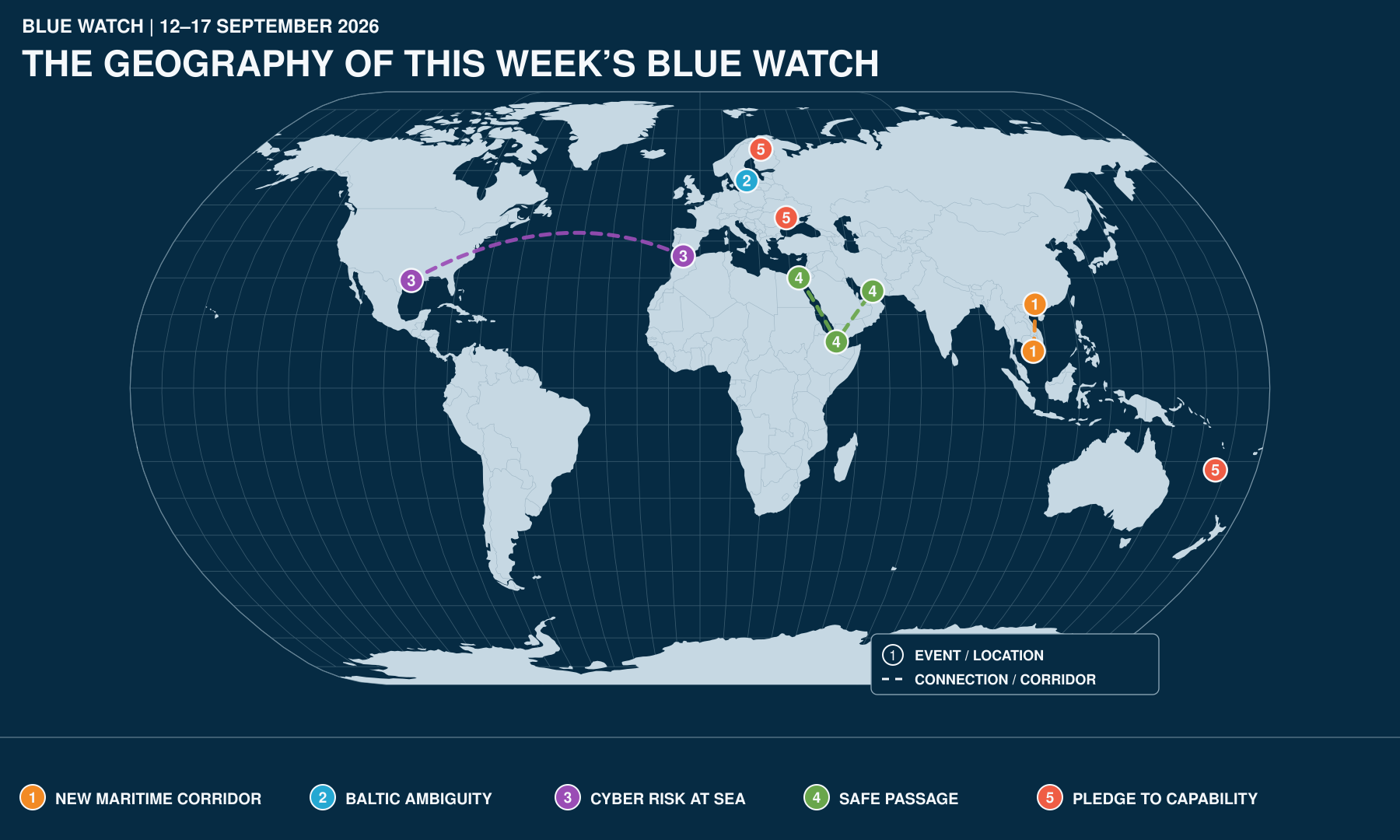
Disclaimer: the map is AI-generated - some dots or routes may not be very precise, but have been retained to show complex links or re-rerouting
1. A shorter route creates a new corridor of responsibility
Question: Who inherits the risks created by a new maritime corridor?
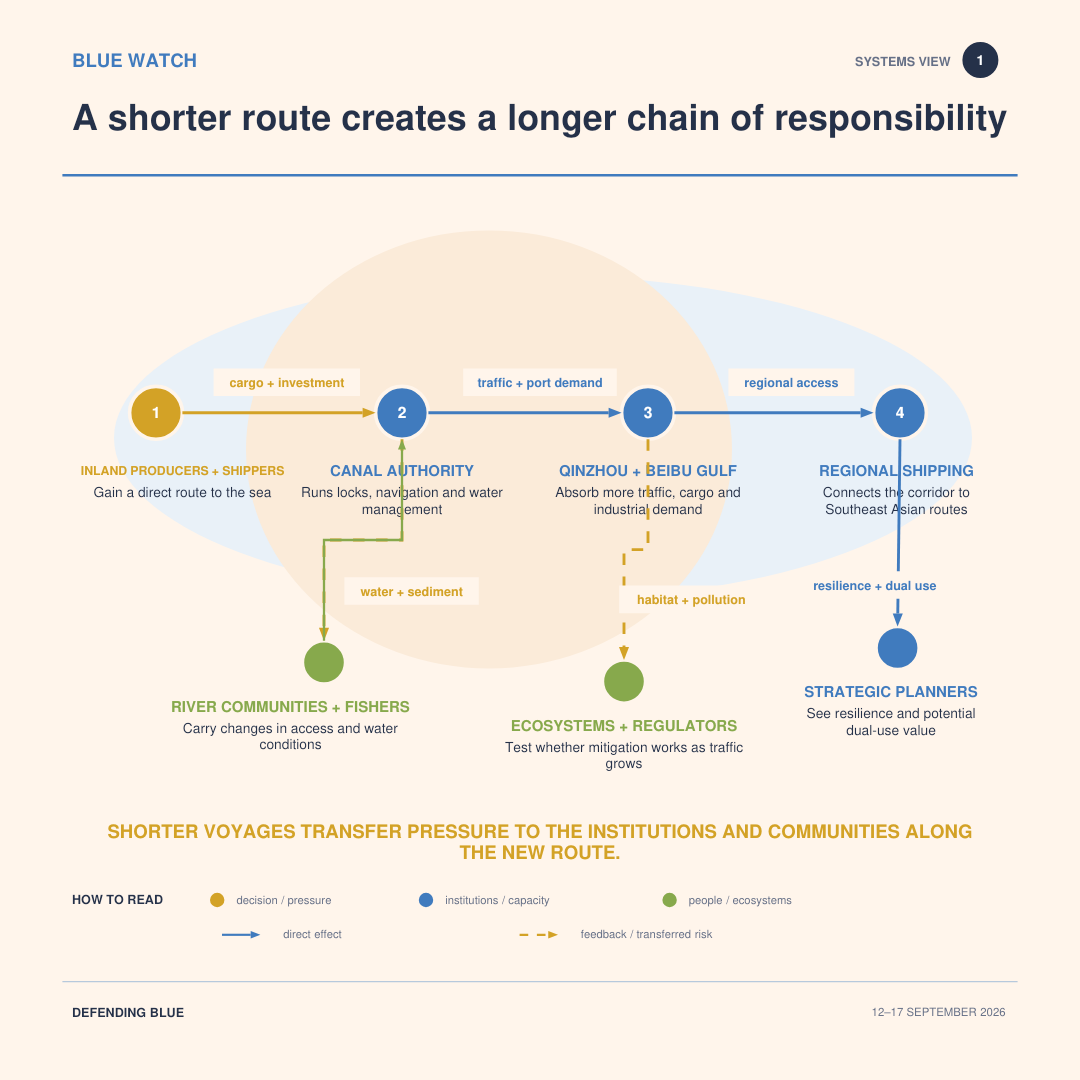
The Blue Watch Read
China's Pinglu Canal now links Guangxi's inland waterways directly to the Beibu Gulf. The 134.2-kilometre route can take vessels of up to 5,000 tonnes and may cut some journeys by more than 560 kilometres. Around thirty ships used it on opening day, with services towards Vietnam and Hainan. The commercial promise is straightforward: shorter journeys, lower costs and a stronger route into Southeast Asian trade.
The consequences spread beyond the canal. More cargo could bring investment to Qinzhou and the Beibu Gulf, alongside heavier traffic, industrial expansion and greater accident and pollution exposure. River communities, fishers and ecosystems will test whether fish passages, wildlife crossings and navigation rules can keep pace. Strategically, the canal adds supply-chain resilience and potential dual-use value. Operational responsibility sits with transport authorities, ports, regulators and the communities living along the corridor.
Signals from the week
• China opened the 134.2-kilometre Pinglu Canal on 16 September, creating a direct river-to-sea connection between Guangxi's inland waterways and the Beibu Gulf. El País.
• Around thirty cargo vessels used the canal on its first day, while routes began between Nanning and Can Tho in Vietnam and between Nanning and Hainan. El País.
• Official estimates of an 18-30% reduction in logistics costs remain forecasts; the commercial test will depend on cargo volumes, connecting services, port capacity and the full door-to-door cost. El País.
• Research cited ahead of the opening identified habitat fragmentation and losses to wildlife migration corridors, while the project incorporated a dedicated wildlife bridge and fish passage as mitigation measures. Dialogue Earth.
UNRESOLVED ISSUE: The unresolved issue is how the canal's benefits and costs will be measured once promotional forecasts meet operating reality. Freight savings, traffic and port growth can be counted quickly; changes to water, sediment, fisheries, habitat and community access emerge across different jurisdictions and over longer periods. A credible first-year baseline would need to follow both sides of that ledger and identify which authority must respond when pressure appears beyond the canal itself. Otherwise, the route's efficiency will be visible while the costs transferred to the connected river and coastal system remain dispersed.
2. Ambiguity is becoming an operational weapon in the Baltic
Question: Who decides when maritime harassment becomes a security incident?
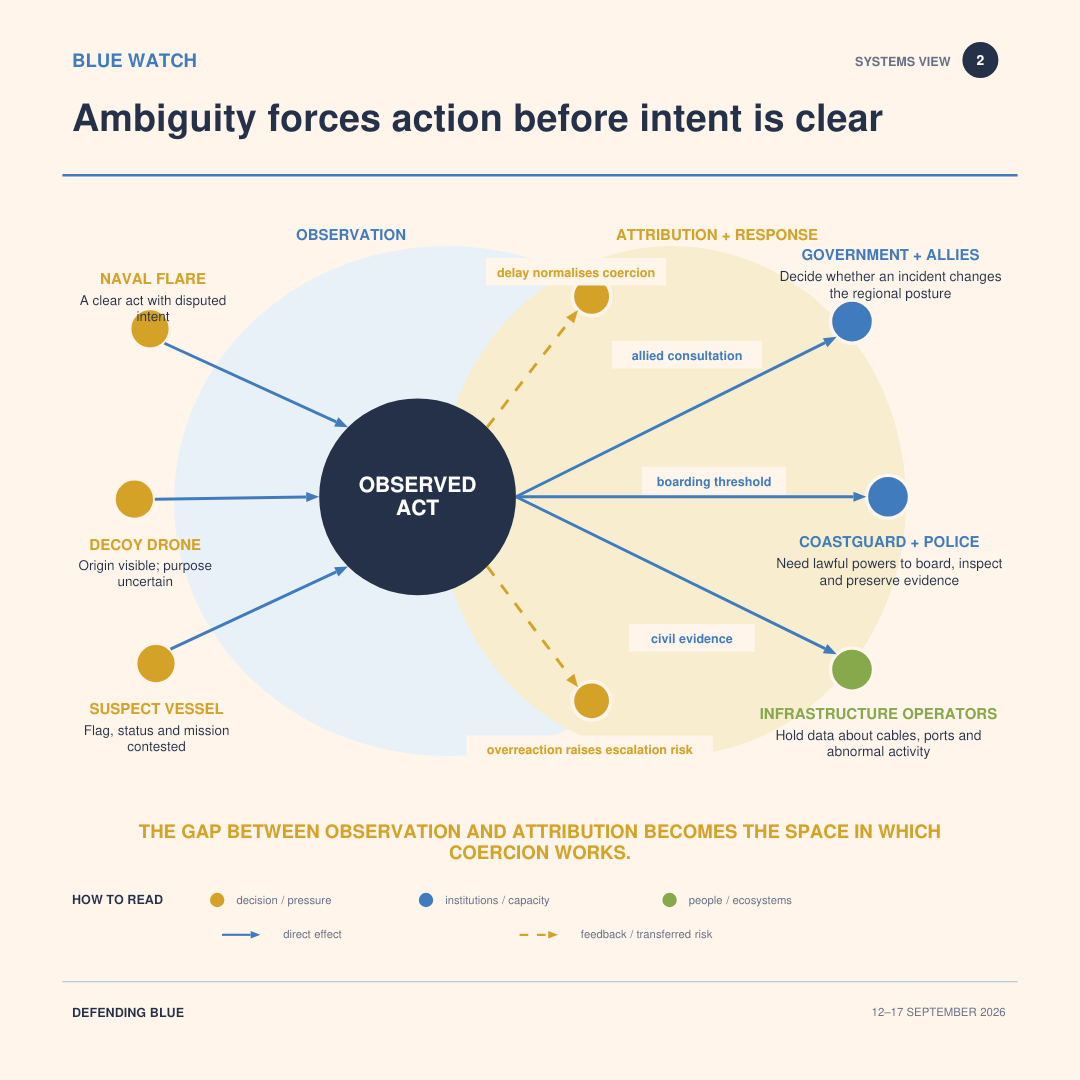
The Blue Watch Read
A flare fired towards a helicopter lasts seconds, but the judgement it demands can occupy commanders and governments for days. Denmark had to assess the danger posed by a Russian frigate before intent or even the full account was clear. Poland faced the same problem when a Russian-made decoy drone appeared near its Baltic coast. The objects were visible; their purpose remained contestable, forcing a response before attribution was secure.
Finland's boarding exercise points to the institutional answer. Coastguard, police and armed forces trained together as Helsinki considered stronger powers against stateless or falsely flagged vessels and uncrewed underwater systems. Military sensors may detect suspicious activity, but police powers enable a boarding and civilian operators may hold evidence of threats to subsea infrastructure. Hesitation can normalise coercion. Overreaction can produce the escalation that ambiguity was designed to provoke.
Signals from the week
• Denmark said a Russian frigate fired two flares towards a Danish military helicopter without prior radio contact, describing the act as risky and aggressive. Reuters.
• Polish authorities investigated a Russian-made decoy drone found near the Baltic coast as NATO states assessed a series of drone and maritime incidents around the region. Associated Press.
• Finland practised boarding and controlling suspect vessels at sea as it considered stronger powers against stateless, falsely flagged and potentially sabotage-linked platforms. Reuters.
Unresolved issue
The unresolved issue is the threshold for collective response. States need room to intervene before a cable is cut, a vessel is struck or an aircraft is endangered, but operators also need a defensible basis for interception, boarding or allied consultation. A common protocol could weigh proximity, failures to communicate, repeated manoeuvres, flag status and activity near protected infrastructure. Making that assessment reviewable would help allies respond consistently and deny an adversary the opportunity to probe the gaps between national judgements.
3. A cyberattack can turn a voyage into a boarding operation
Question: Who decides whether a hacked ship is safe to enter port?
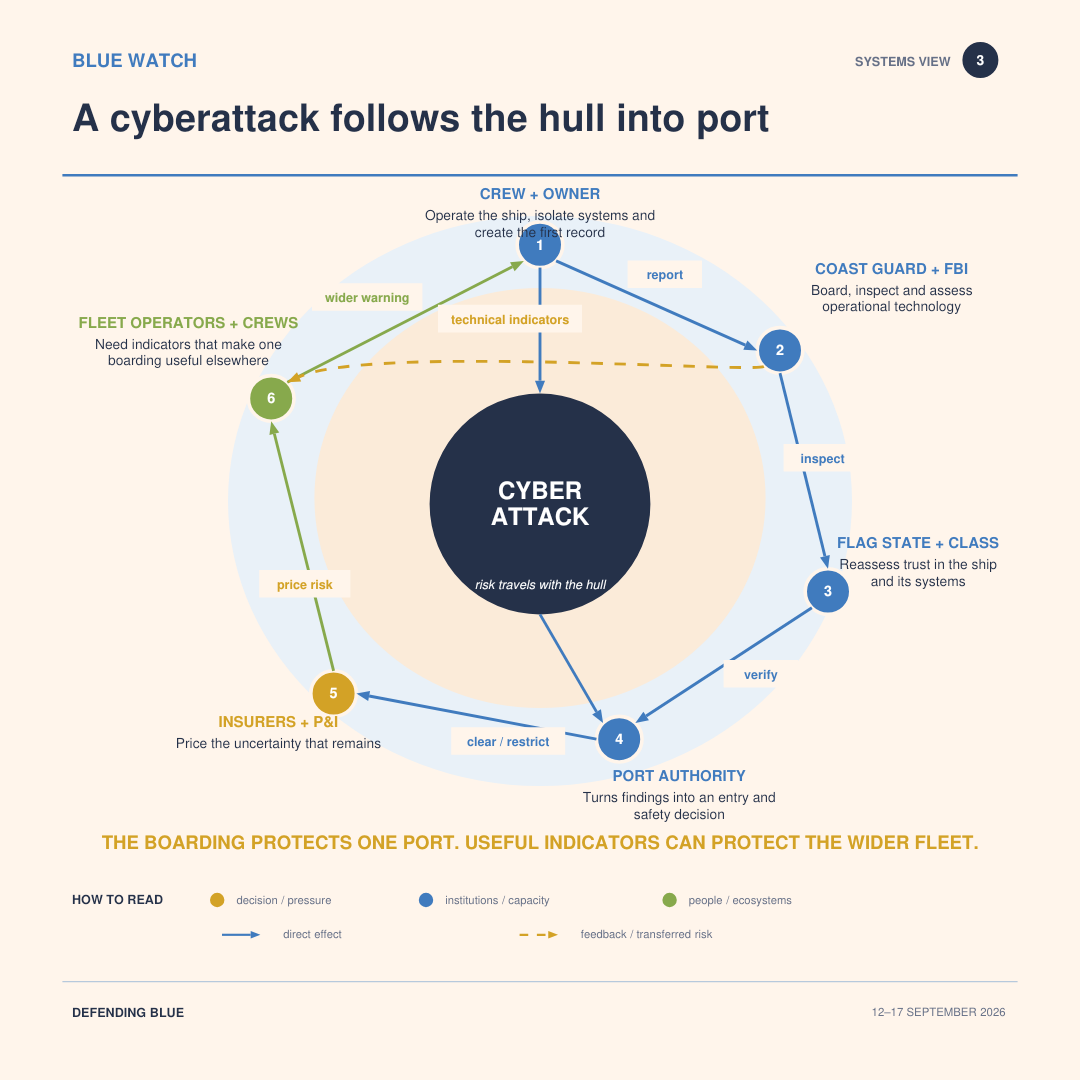
The Blue Watch Read
A compromised network may remain invisible until a ship nears port. In August, U.S. Coast Guard and FBI teams boarded two foreign-flagged tankers after indications that cyberattacks had affected their networks; the operations were disclosed this week. The vessels remained stable, with no reported injury or environmental damage. Investigators still had to decide whether their information and operational systems could be trusted as they approached the United States carrying hazardous cargo.
That decision quickly exceeds the ship. The crew and owner must contain the compromise and preserve evidence before flag and class can reassess seaworthiness and the port can decide whether entry remains safe. The Coast Guard and FBI combine maritime safety and law-enforcement responsibilities, while insurers price the remaining uncertainty. Naval intelligence may reveal a wider state-linked campaign, but the immediate risk sits with a commercial vessel, its crew and the civilian port ahead.
Signals from the week
• The U.S. Coast Guard confirmed that its personnel and FBI agents boarded a foreign-flagged tanker bound for Texas after indications that overseas actors had compromised its network. Reuters.
• A subsequent joint account established that two U.S.-bound tankers were boarded on 21 and 24 August so that a multi-agency team could assess their information and operational technology systems. Associated Press.
• Authorities reported no operational disruption, vessel instability, danger to crews or environmental impact, but did not identify the attacker or publish technical indicators that other operators could use. Reuters.
Unresolved issue
The unresolved issue is who has the authority to declare the vessel safe once a cyber incident crosses from the ship's network into navigation, cargo handling and port entry. Investigators may need to withhold details while an inquiry is active, but other crews and operators need enough information to protect similar systems. A credible response would connect confidential reporting, technical verification, flag and class decisions, port-entry conditions and protection for crews who disclose a problem. Without that chain, one ship may be cleared while the vulnerability that brought investigators aboard remains active elsewhere in the fleet.
4. Safe passage is being assembled by many hands
Question: Who makes passage safe when authority is divided?
The Blue Watch Read
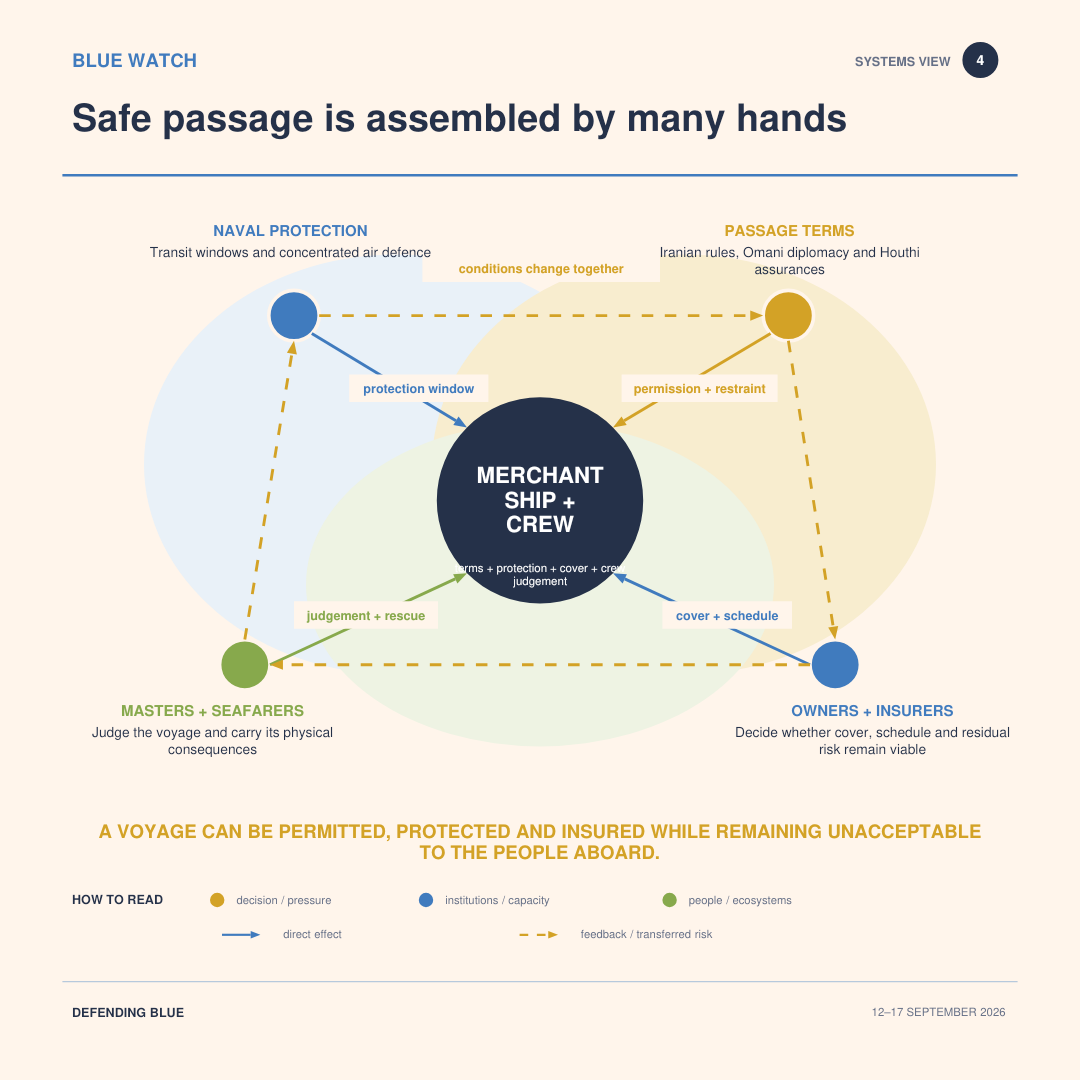
A ship crossing Hormuz or returning to the Red Sea now moves through arrangements controlled by different actors. The United States recommends transit windows so limited air-defence capacity can be concentrated around merchant traffic. Iran claims authority over passage, Oman brokers talks and reported U.S.-Houthi contacts offer selective assurances. None settles the voyage alone; together they shape when a ship may sail, under whose terms and what protection it can expect.
Owners still decide whether the voyage is viable. Insurers set the conditions of cover, carriers choose between Suez and the Cape, and masters judge the protection available to their ship. Seafarers carry the consequences with the least influence. Safe passage has become a chain of permissions, military support and commercial judgement. A vessel may be tolerated by one authority, protected by another and still unacceptable to those expected to sail it.
Signals from the week
• The United States reportedly asked tankers to use fixed daily windows for Hormuz transits as air-defence support became more limited and costly. Financial Times, reported by UOL.
• Iran's Strait Authority added 77 vessels to its sanctions list and urged insurers, P&I clubs and classification societies to withdraw services from them, extending its claimed passage rules into the commercial support system. Reuters.
• An Iran-Oman understanding created a framework for further talks without immediately reopening Hormuz. Reuters.
• Maersk and Hapag-Lloyd announced that four more services would return to the Suez route, while making continued use conditional on stability in the Middle East. Reuters.
• U.S. and Houthi representatives reportedly met in Muscat, where Houthi delegates offered assurances for ships unconnected to Saudi Arabia; the account relied on anonymous sources. The Guardian.
• India proposed a BRICS Seafarers’ Emergency Support Network to coordinate assistance to crews affected by war and disruption; the network has not yet been established. The Indian Express.
• The United States sanctioned an Iranian cryptocurrency exchange that it alleges processed payments for safe passage through Hormuz, adding a contested financial route to the military, regulatory and diplomatic arrangements governing access. Reuters.
Unresolved issue
The unresolved issue is how these routes to safety can be reconciled. A naval window allocates protection without creating legal immunity or insurer acceptance. An armed group's assurance may reduce danger for some ships while excluding others; a carrier's return to Suez creates commitments that masters and crews inherit. A credible framework therefore needs transparent eligibility, shared threat information, insurer acceptance, rescue provision and a protected role for the judgement of masters and crews. Navies can defend a transit, but they cannot supply every part of that agreement.
5. Declarations acquire meaning when someone can act
Question: Who turns maritime commitments into operational capability?
The Blue Watch Read
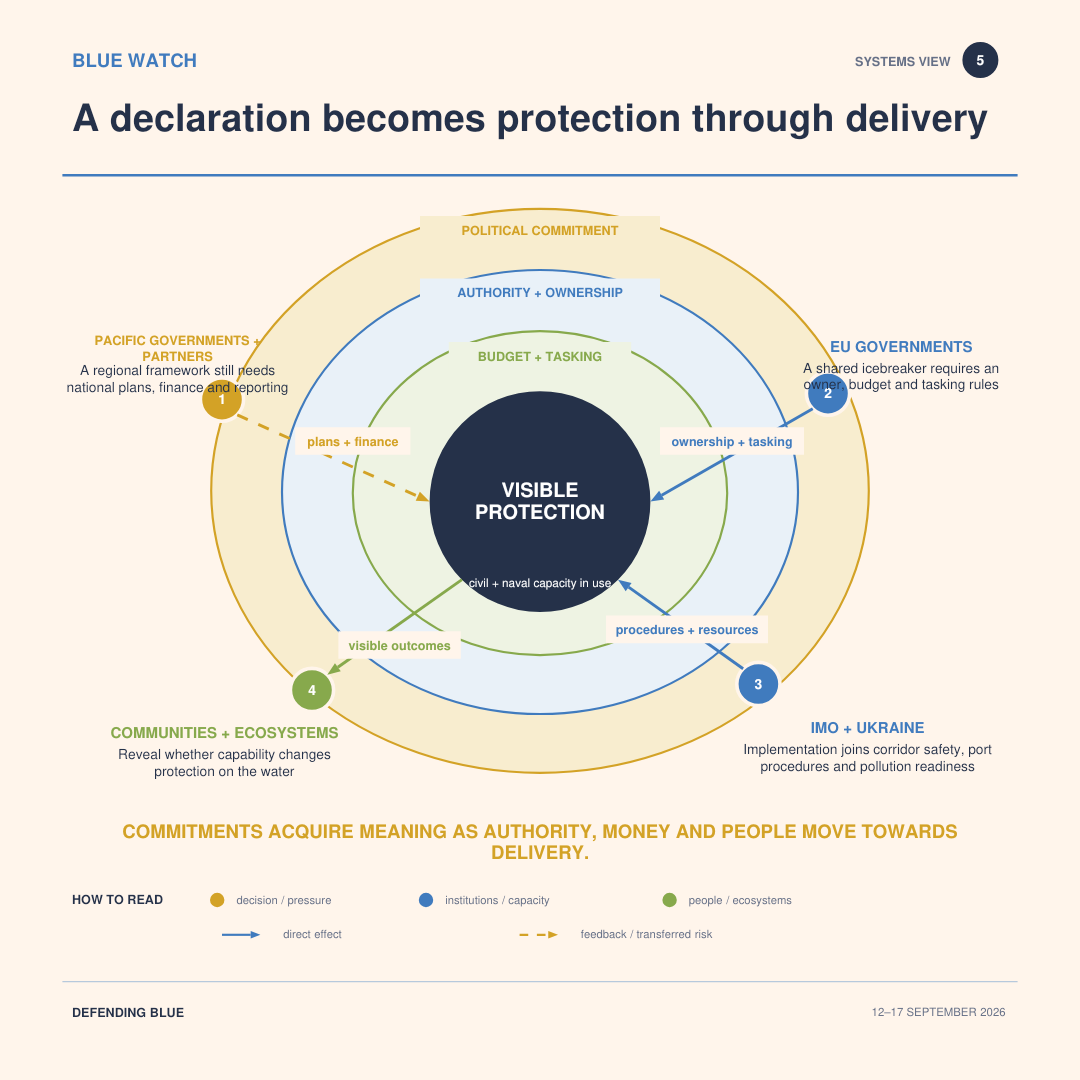
Declarations identify priorities; institutions deliver them. Pacific governments left their regional nature conference with a new framework whose value now depends on national plans, finance and decisions communities can see. In the Arctic, calls for a stronger European role became more concrete when Finland raised jointly owned icebreakers. A shared vessel would create real access while forcing governments to settle ownership, tasking and mission priority.
The IMO's work with Ukraine shows the next stage. Its implementation phase connects the Special Maritime Corridor with port procedures, safety and pollution preparedness. Navies and coastguards can provide hydrography, surveillance, logistics and emergency response when civilian capacity is stretched. That contribution lasts only if civilian institutions define the purpose, fund it and remain accountable. Otherwise, military capability becomes the default answer to commitments that governments have not equipped anyone else to fulfil.
Signals from the week
• The Pacific Islands nature conference closed on 11 September with a declaration and regional framework committing governments and partners to stronger conservation action. SPREP.
• Twelve EU member states called for a more strategic and proactive European role in the Arctic, linking security, connectivity, resilience and investment. Reuters.
• European leaders meeting in Finland backed investment in Arctic capability, including discussion of jointly owned icebreakers rather than nationally duplicated fleets. Helsinki Times.
• The IMO and Ukraine moved into a new implementation phase covering maritime safety, port procedures, pollution preparedness and support for the Special Maritime Corridor. International Maritime Organization.
Unresolved issue
The unresolved issue is how to preserve accountability once delivery is spread across donors, programmes and shared assets. A declaration needs an owner, a budget, a timetable and a public measure of progress. A jointly operated vessel also needs rules for crewing, maintenance, release and competing demands. These choices will determine whether communities receive lasting protection or whether a visible new asset absorbs the available attention while the staff, local enforcement and pollution preparedness around it remain underfunded.
What the week leaves unresolved
The five questions do not lead to one institutional answer. A cyber-compromised ship must pass from investigators to flag, class and port authorities. A new canal connects inland development to a coastal environment governed by different institutions. Safe passage is being constructed from military windows, regulatory claims, diplomatic understandings, commercial schedules and crew decisions. In the Baltic, military warning must connect with police powers and allied consultation, while political declarations elsewhere still need budgets, tasking rules and implementing bodies.
What remains unresolved is how responsibility survives those handovers. Each actor may make a defensible decision inside its own remit while the combined system still leaves a gap: a ship cleared without fleet-wide cyber warning, a successful corridor whose ecological costs sit outside its freight calculations, or a protected transit whose crew had little influence over the risk. Accountability depends on visible transfers of responsibility, common evidence, clear thresholds for action and a route through which affected people can question the decision. The system becomes accountable when no actor can treat the consequences beyond its boundary as somebody else's problem.