

Policy is reaching the water before capacity catches up
Five questions connect this week: what happens when decisions taken on land reach the water and become somebody else’s operational problem? A government can deter a crossing, negotiate military access, approve a new fuel or finance better observation. Each creates work elsewhere in the maritime system, often without moving the authority, people or equipment needed to carry it out.
WHAT CONNECTS THE WEEK
Maritime policy keeps expanding what institutions are expected to manage at sea. Governments may set the objective, but delivery passes through organisations with different mandates, resources and thresholds for action. By the time the consequences reach the water, responsibility has often been divided among public authorities, commercial operators, rescue organisations, scientific networks and military forces.
The connection lies in the handover between them. Naval forces can provide protection, access, surveillance or emergency reach, yet their contribution depends on civilian evidence, law, infrastructure and political choices about which risk takes priority. The system works when responsibility, information and capacity move together. When they separate, the burden falls on whichever actor is closest to the event, whether or not that actor was equipped or authorised to carry it.
QUESTION: When policy reaches the water, do responsibility, information and capacity arrive with it?
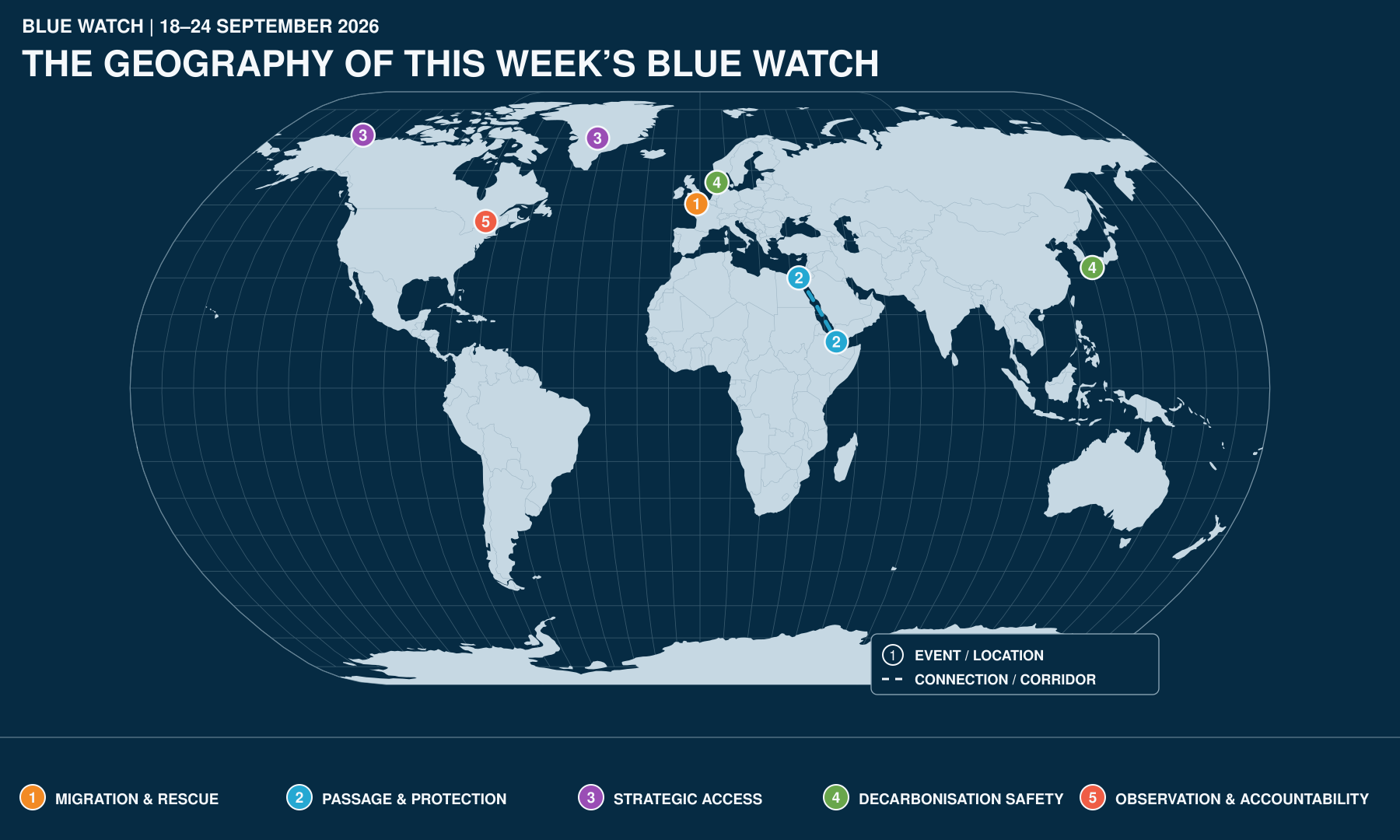
Disclaimer: the map is AI-generated - some dots or routes may not be very precise, but have been retained to show complex links or re-rerouting
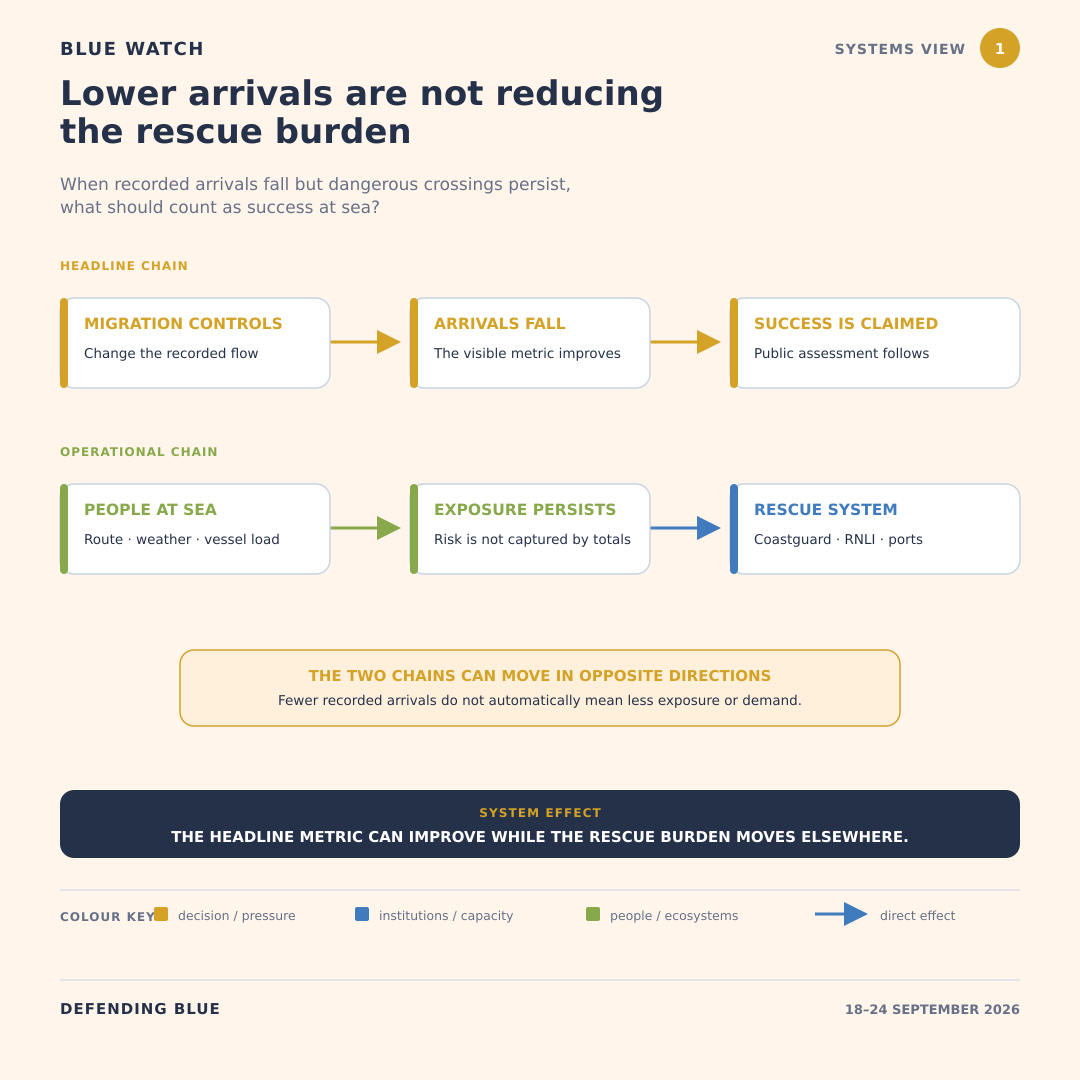
1. Lower arrivals are not reducing the rescue burden
Question: When recorded arrivals fall but dangerous crossings persist, what should count as success at sea?
The Blue Watch Read
Recorded sea arrivals to Europe were lower than a year earlier while reported deaths and disappearances were higher, according to the latest IOM figures available at the start of the week. Those figures do not show that tighter controls caused either change, and they should not be made to carry that conclusion. They do show why arrivals alone are an incomplete measure of maritime risk. In the Channel, a dinghy reached Folkestone without interception on 21 September; the following day, two RNLI lifeboats were tasked to another boat that had reportedly been at sea for around 36 hours.
The operational burden falls on organisations judged by outcomes they cannot fully control. HM Coastguard coordinates the response, Border Security Command and the RNLI provide assets, and French services monitor some passages before responsibility crosses the Channel. A longer voyage or late detection expands the area to be watched, delays assessment of medical needs and places rescuers inside an increasingly hostile political argument. While one incident cannot establish a new route pattern, it can still show how lower overall arrivals may coexist with individual voyages that are longer, harder to intercept and more demanding to resolve.
Signals from the week
Five people reached Folkestone in a small dinghy without interception, the first such undetected Channel landing reported in a year. The Times.
Two RNLI lifeboats were tasked by HM Coastguard to a boat reportedly at sea for around 36 hours; the RNLI said a Border Security Command cutter was launched shortly afterwards. RNLI.
A South Sudanese man was jailed for piloting an overloaded Channel boat carrying 165 people; prosecutors said he later helped steer another vessel carrying 230. Reuters.
The unresolved issue
Maritime law is clearest once a vessel is in distress; policy performance is far less clear before that point. A falling arrival count can be presented as success while rescue services continue to confront overloaded boats, long voyages and occasional failures of interception. A credible measure therefore has to include exposure: time at sea, route length, vessel loading, detection, distress, deaths and the availability of response assets. Otherwise the institution that arrives last in the policy chain is left to absorb the risk while having the least influence over how it was produced.
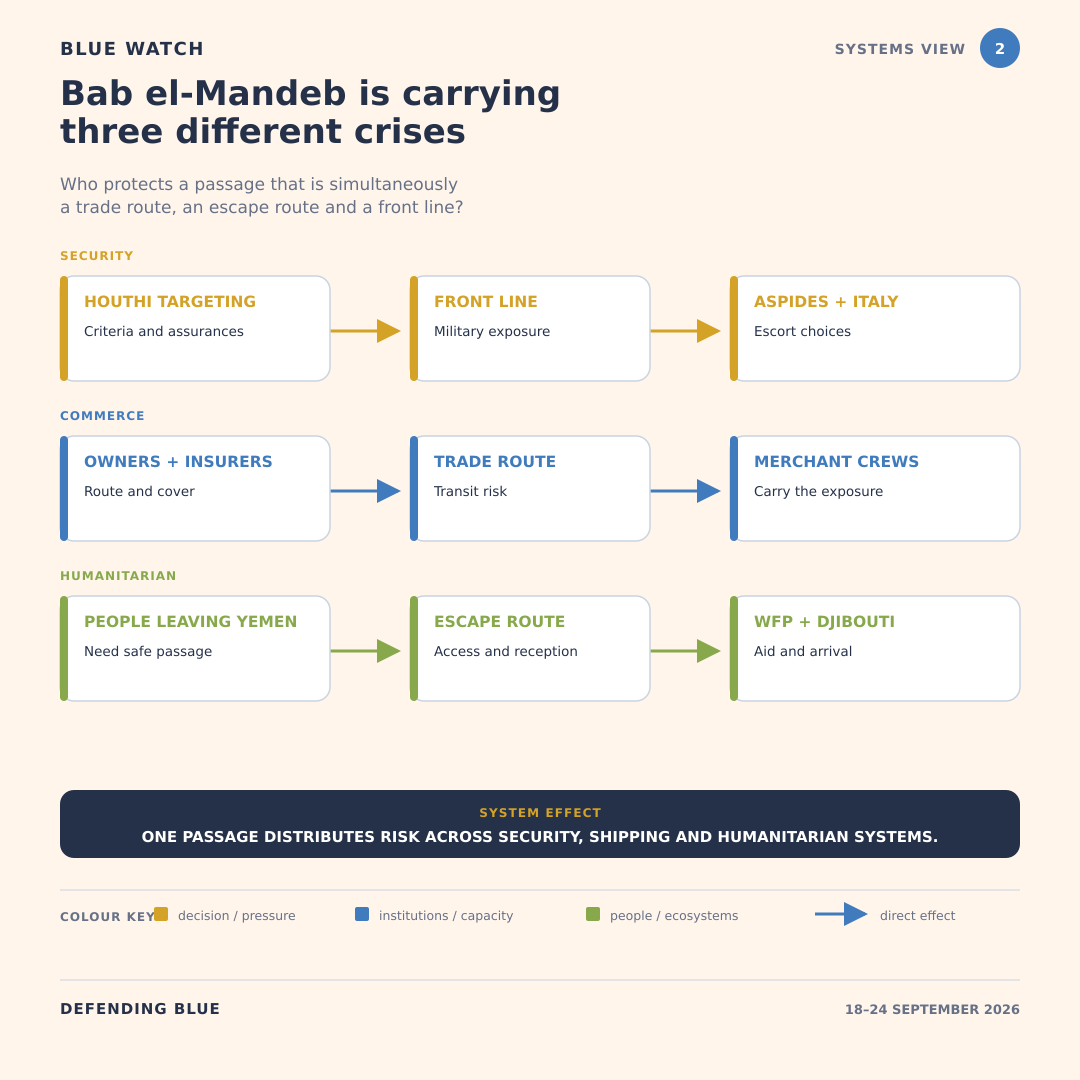
2. Bab el-Mandeb is carrying three different crises
Question: Who protects a passage that is simultaneously a trade route, an escape route and a front line?
The Blue Watch Read
Bab el-Mandeb now concentrates forms of movement that are usually governed separately: commercial ships pass through a global trade route; food imports enter a country sliding deeper into hunger; Yemenis cross towards Djibouti to escape fighting along the same coast. Houthi advances and attacks can alter all three at once. A decision to escort a merchant vessel changes naval tasking, then travels into insurance, port calls and the space available for humanitarian movement.
The response is being assembled through overlapping arrangements. Operation Aspides, the EU’s defensive naval mission launched in 2024 to protect merchant shipping and freedom of navigation across the Red Sea and adjoining waters, has six warships and says it needs more than ten. A senior Houthi official has said vessels unconnected to Saudi interests would not be targeted, and US Vice-President JD Vance has confirmed direct contact with the group. These are political assurances rather than rules that a master or insurer can apply with confidence. Flag, ownership, charter, cargo and crew may point towards different national connections. Safe passage has therefore become a classification problem backed by scarce hulls, and each classification determines which seafarers receive protection and which risks remain unassigned.
Signals from the week
WFP said it had assisted 45,000 newly displaced people and was preparing to support an additional 1.5 million if the conflict intensified; more than 125,000 people had been displaced. WFP.
More than 2,400 people had crossed from Yemen to Djibouti, while WFP warned that Yemen imports around 90 per cent of its food. WFP.
EU foreign-policy chief Kaja Kallas said Aspides had six warships but needed more than ten to meet demand for protection. Reuters.
Italy said it was preparing to deploy additional ships to protect national commercial traffic through the Red Sea. Reuters.
A senior Houthi official said ships unconnected to Saudi interests would not be targeted; JD Vance separately confirmed direct US contact with the group. Associated Press; Vance remarks.
The unresolved issue
Who defines the vessel being protected? A flag state can claim jurisdiction, an owner carries commercial interest, charterers and cargo connect the voyage to other economies, and crews may have no relationship to any of them. Naval missions need rules that can be applied quickly; insurers and masters need assurances they can trust; humanitarian agencies need routes that remain usable when merchant protection tightens. Those systems have to be reconciled before each transit. Otherwise the passage may remain open on a map while access becomes conditional on nationality tests that maritime commerce was never designed to satisfy.
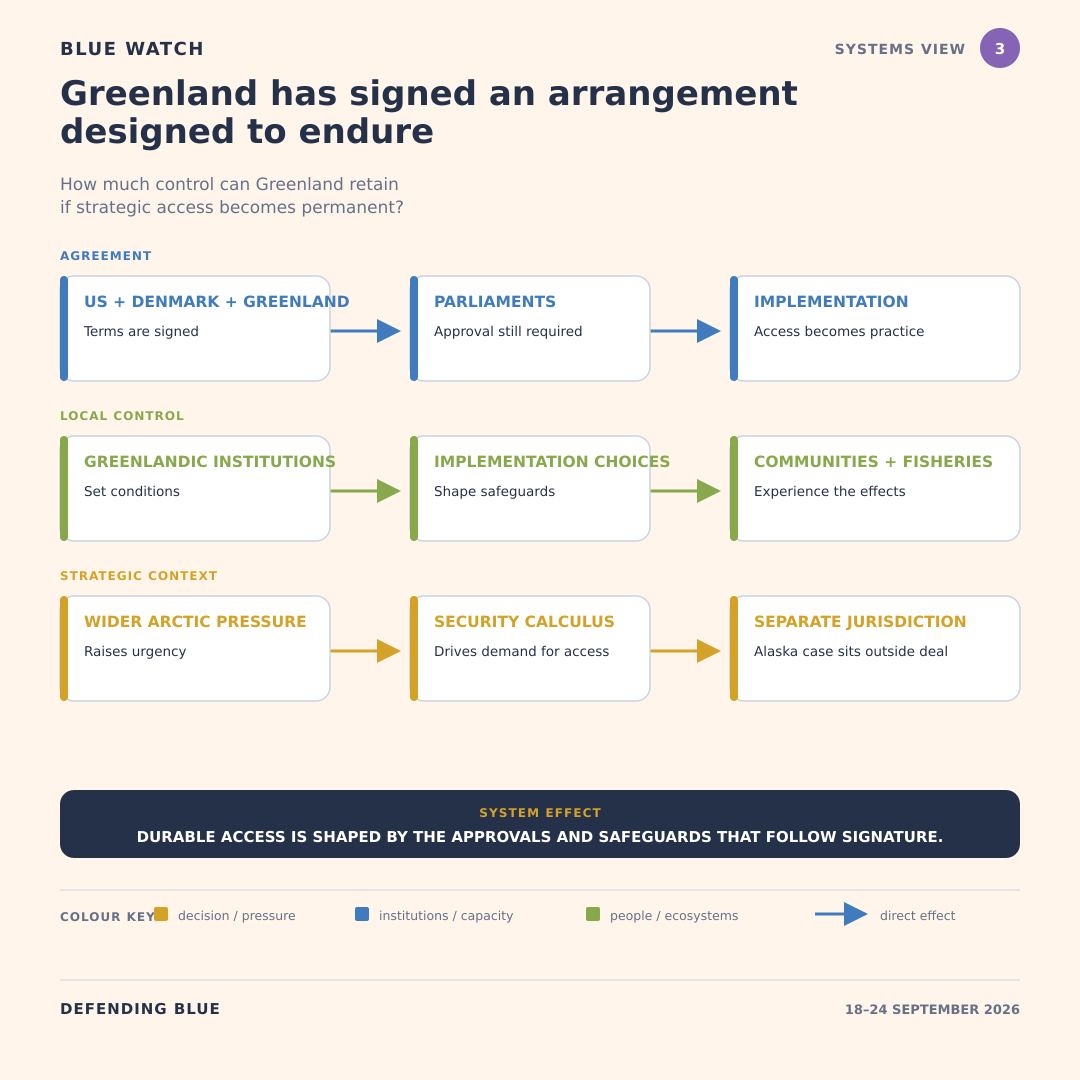
3. Greenland has entered a security arrangement designed to endure
Question: How much control can a territory retain when strategic access becomes permanent?
The Blue Watch Read
The United States, Denmark and Greenland have signed an agreement designed to preserve sovereignty while creating access rights intended to outlast the present political bargain. If approved, it would expand US activity at Pituffik, permit new defence areas at Narsarsuaq and Mestersvig, accelerate consideration of unmanned installations and expressly allow undersea movement by US public vessels in Greenland’s territorial waters. It is not yet in force: Danish and Greenlandic parliamentary procedures must be completed first. Ratification is therefore the final formal point at which political consent precedes an agreement with no end date.
If approved, that durability would give the agreement strategic value while extending its consequences into civilian life. Defence areas sit alongside fishing, hunting, investment, environmental protection and local contracting. Chinese research vessels operating in international waters off Alaska illustrate the wider difficulty of distinguishing scientific, resource and potentially military activity in the Arctic. They help explain the strategic pressure surrounding the agreement; they do not fall under Greenland’s new investment or basing provisions. The test is whether Greenland’s formal role remains effective when security urgency and local priorities diverge.
Signals from the week
The United States, Denmark and Greenland signed the agreement; it will enter into force only after Danish and Greenlandic parliamentary procedures are completed, and it contains no expiry date. Official agreement.
If approved, the agreement would expand activity at Pituffik, allow defence areas at Narsarsuaq and Mestersvig, accelerate consideration of unmanned installations and permit undersea movement by US public vessels. Official agreement.
The US Coast Guard said it was monitoring four Chinese research vessels operating in international waters off Alaska. Reuters.
The unresolved issue
The agreement provides consultation, mutual consent and a Permanent Committee, but those safeguards will operate within a marked asymmetry: Washington brings strategic demand and resources; Copenhagen retains constitutional responsibilities; Nuuk carries many local effects. Future disputes may concern where an unmanned installation sits, what information an undersea operation shares, how investment screening is applied within Greenland or who pays for environmental damage. Signature records consent to the framework; it cannot settle every later decision. The unresolved issue is how Greenland could withhold, revise or condition implementation in practice if the agreement enters into force.
4. Decarbonisation is becoming a maritime safety system
Question: Who carries the safety burden when maritime decarbonisation becomes operational?
The Blue Watch Read
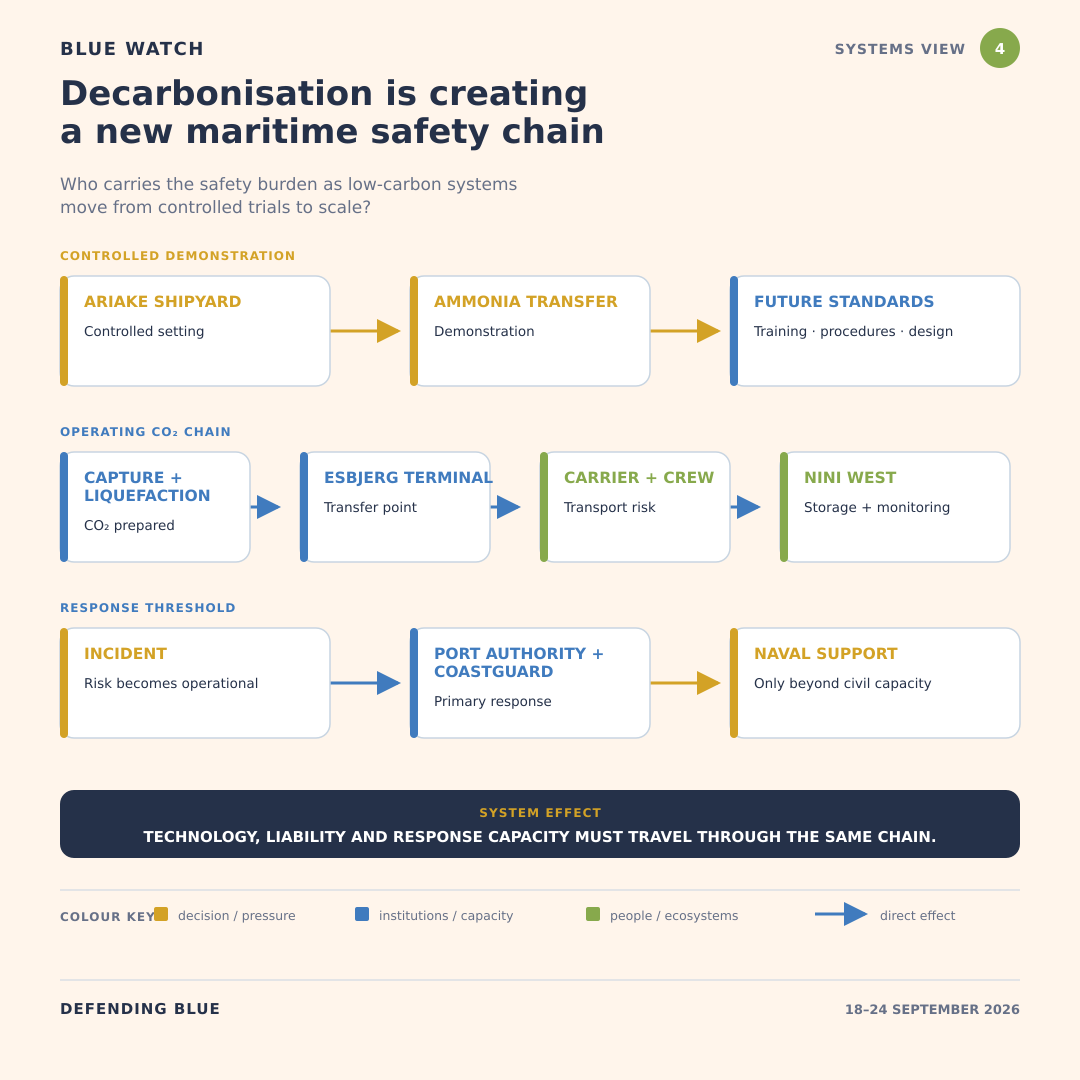
Maritime decarbonisation is advancing at different speeds. On the eve of this reporting window, NYK and its partners carried out what the company described as the first ship-to-ship ammonia bunkering into an ammonia-fuelled vessel. It took place alongside a quay at Ariake Shipyard and involved a newbuild due for delivery in November: a controlled demonstration, not a commercial bunkering operation. On 18 September, Greensand entered full-scale operation in Denmark, connecting capture, liquefaction, port handling, ship transport and injection beneath the North Sea. One tested procedures before deployment; the other placed an entire transport and storage chain into service.
As these systems develop, each technical handover becomes a public-safety responsibility: ports need procedures and exclusion zones; crews need training; regulators and emergency services need compatible plans before an accident occurs. Monitoring continues after CO₂ leaves the ship and enters the reservoir. Coastguards and port authorities sit closest to the first response, while naval capacity may matter when an incident exceeds civilian reach. Neither can compensate for a chain whose responsibilities were left inside separate project contracts.
Signals from the week
Greensand Future opened what its developers describe as the EU’s first full-scale CO₂ storage site, with an initial capacity of up to 400,000 tonnes a year. Greensand Future.
The operating chain links liquefied biogenic CO₂, the Port of Esbjerg, the purpose-built carrier Carbon Destroyer 1 and injection into the Nini West reservoir, 250 kilometres offshore and around 1,800 metres below the seabed. European Commission.
The unresolved issue
The chain now stretches from the emitting plant to a port, a purpose-built carrier and a reservoir beneath the seabed. Liability can pass between capture operator, terminal, shipowner, storage operator and the state responsible for the waters or seabed. A leak, exposure or monitoring failure may reveal that each participant met its own standard while the handover between them remained weak. The unresolved issue is who owns the risk at each transfer and who must maintain response capacity for a rare, highly technical and potentially cross-border event. The answer has to include seafarer protection and public emergency services before volumes grow.
5. Observation is making routine pollution harder to ignore
Question: Who must act once ocean observation makes routine harm visible?
The Blue Watch Read
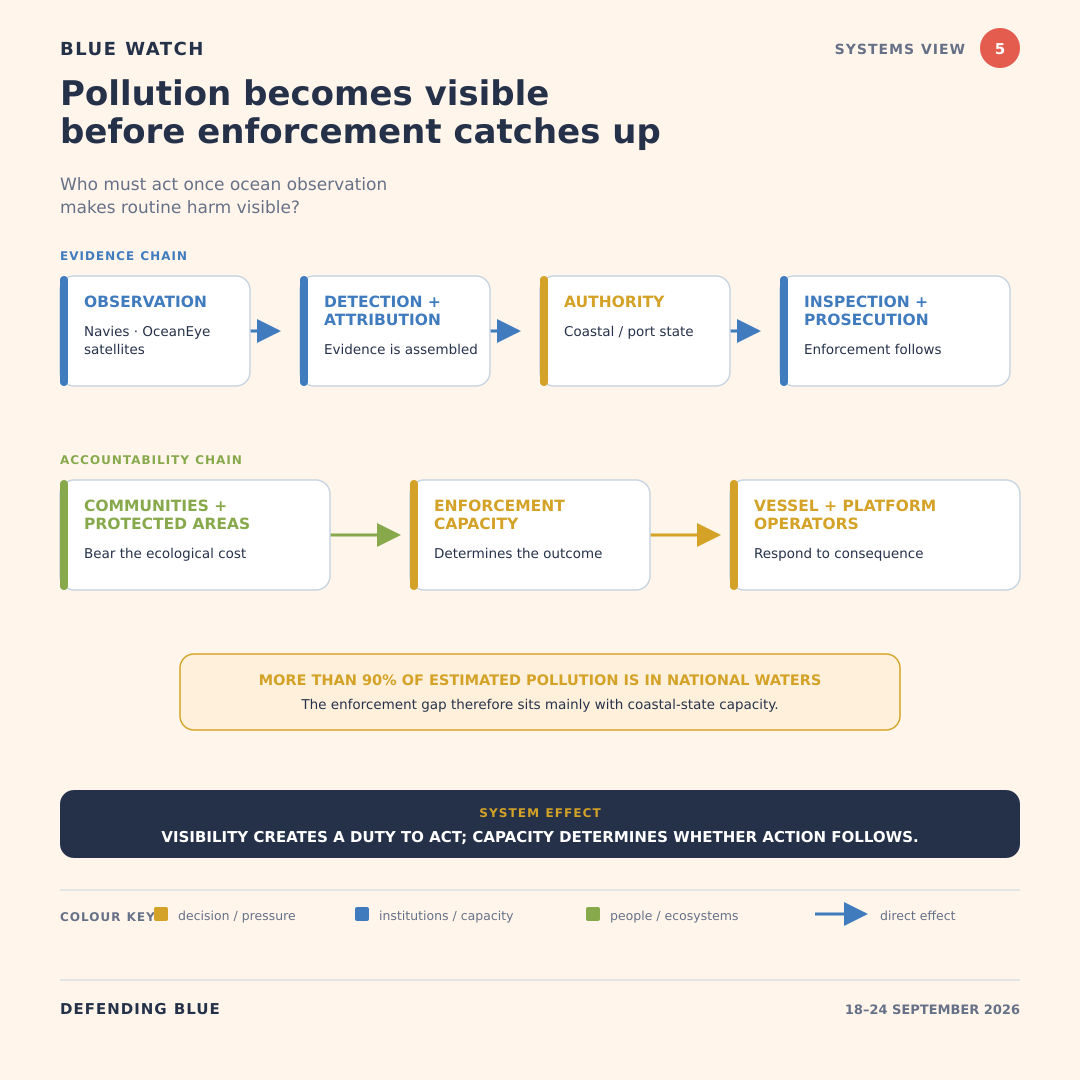
Ocean observation is often described as a way to close a knowledge gap. This week’s developments show that visibility can move the problem rather than settle it. The EU and Canada helped secure €211 million in financial and in-kind pledges for global observation, including research vessels, sensors, drones and data-processing facilities. SkyTruth’s satellite analysis estimated that vessels and offshore platforms leave oil slicks across 1.58 million square kilometres of ocean each year. More than 90 per cent of that estimated pollution lies within national waters, including protected areas.
That finding changes the enforcement question. The largest gap is not jurisdiction on the high seas but the willingness and capacity of coastal states to convert repeated detections into inspections, evidence and penalties. Limited high-seas coverage still matters, yet most observed harm occurs where some authority already exists. A scientific platform can connect slicks to vessel movements and identify repeat polluters, but it cannot compel a port state, flag state or environmental regulator to act. Navies may contribute imagery or access where civilian surveillance is weak, but accountability still depends on evidence moving into institutions authorised to use it.
Signals from the week
The EU and Canada announced approximately €211 million in financial and in-kind pledges for OceanEye, including vessels, sensors, drones and data facilities. WMO.
SkyTruth estimated that chronic oil slicks from vessels and offshore infrastructure cover about 1.58 million square kilometres each year; vessels account for roughly 81 per cent and infrastructure 18 per cent. SkyTruth.
More than 90 per cent of the estimated pollution was inside national waters. The analysis identified repeat vessel and infrastructure polluters while also acknowledging significant high-seas observation gaps. SkyTruth.
The unresolved issue
What standard turns a satellite detection into an investigation, and which authority acts when the polluter’s flag, owner and operator differ from the coastal state whose waters are affected? Better observation lowers the cost of discovery, but persistent enforcement requires analysts, inspectors, access to vessel records and prosecutors willing to build cumulative cases from small releases. The unresolved issue is therefore less about finding a legal actor than ensuring that coastal and port states have the capacity and incentives to use the evidence already reaching them.
What the week leaves unresolved
The five stories leave the same practical difficulty in different forms: maritime responsibility is divided, while the event that tests it is continuous. A migrant boat does not pause at an operational handover. A threat to shipping does not respect the boundary between trade and humanitarian access. CO₂, surveillance data and military access move through chains that no single actor controls. Each participant may fulfil its own mandate and the system can still fail between them.
What remains unresolved is how capacity should follow those connections. Governments can write duties into policy and agreements, but ships, trained people, data access and emergency authority cannot be summoned at the moment of need. Priorities therefore become selective: one route is watched, one class of ship protected, one installation approved, one pollutant detected. The next step is to decide in advance who leads at each handover, what resources move with that duty and how the actors who bear the consequences can challenge the allocation.