

Access is being rationed
Five questions connecting selective passage through Hormuz, constrained alternatives, contested resources, maritime disaster response and the growing risks faced by fishers.
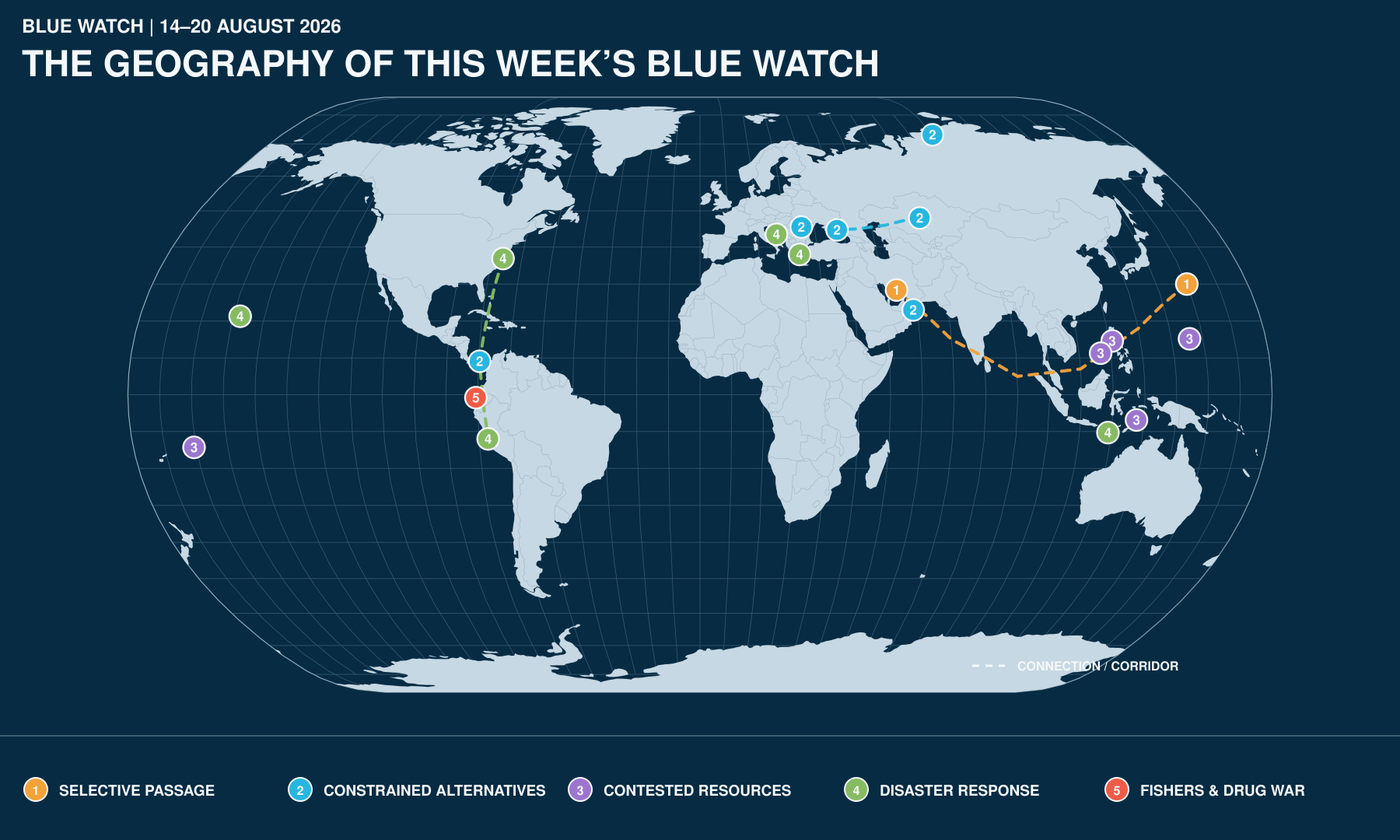
Disclaimer: the map is AI-generated - some dots or routes may not be very precise, but have been retained to show complex links or re-rerouting
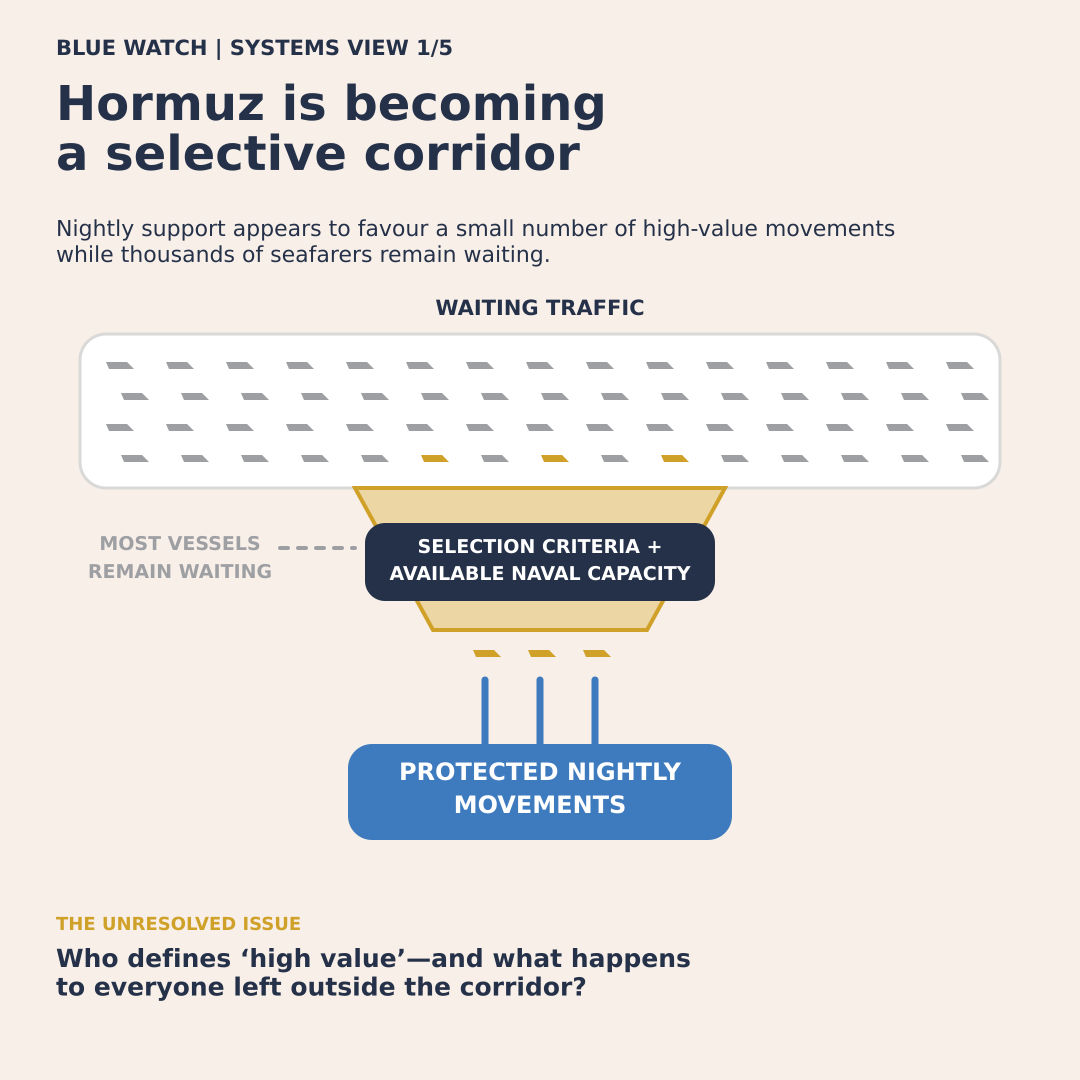
1. Hormuz is becoming a selective corridor
Question: Who decides which vessels are important enough to protect?
The Blue Watch read
Commercial traffic through Hormuz remains far below its pre-war level, despite months of naval operations and negotiations over passage.
Some oil is nevertheless moving. US officials told Axios that American forces are supporting 15 to 20 tanker movements through the southern channel at night, helping empty vessels enter the Gulf and loaded tankers leave. The operation appears to be sustaining a controlled flow of oil rather than reopening the Strait for general commercial traffic.
The operation’s selection criteria have not been disclosed. Priority may depend on the cargo, destination, ownership or operational risk, but the available reporting does not provide an answer. Shipowners, insurers and crews therefore face a corridor where military protection exists without a generally accessible passage regime.
The operation is also consuming naval capacity elsewhere. The Japan-based George Washington is moving towards the Middle East to relieve Abraham Lincoln, whose extended deployment has raised concerns about conditions and crew endurance. This will temporarily remove the only forward-deployed US carrier from the western Pacific. Other American and allied forces remain in the region, but one of Washington’s clearest instruments of reassurance is being transferred to sustain operations around Hormuz.
Signals from the week
US forces are reportedly helping 15 to 20 tankers pass through Hormuz at night, using ships and aircraft to support movements through the southern channel. The criteria used to select protected voyages have not been disclosed.
Recent attacks struck several merchant vessels, and one seafarer was killed aboard the Minoan Dignity. Traffic remains a fraction of the level recorded before the war.
The United States is moving George Washington from the western Pacific towards the Middle East to relieve the long-deployed Abraham Lincoln. The move creates a temporary Pacific carrier gap and will eventually transfer maintenance demands to another ship and crew.
At least 6,000 seafarers aboard some 400 vessels remained stranded in and around the Strait of Hormuz as of 24 July, according to OHCHR citing IMO; the organisation cautioned that the estimate was not exhaustive.
The unresolved issue
A passage regime built around selected night movements may carry enough oil to influence prices, while leaving the underlying access problem unresolved.
Shipowners, insurers and crews still lack a generally accepted security arrangement. Gulf exporters and major importing states have strong incentives to secure individual voyages, but vessels carrying less strategically important or lower-margin cargo may be unable to obtain the same protection. Seafarers may also have little influence over decisions made by governments, charterers and owners.
The operation therefore needs scrutiny from several directions. Naval authorities should explain the broad basis on which voyages are supported without disclosing operational details that would endanger them. Flag states, unions and shipowners need clear arrangements for crew consent, insurance and compensation. Coastal states must be involved in traffic management, casualty response and pollution preparedness.
The carrier rotation raises a parallel question about who carries the military cost. Sustaining the Hormuz mission protects energy flows and allows an exhausted crew to return home, but it moves pressure onto George Washington, its sailors and US commitments in Asia. Eleven carriers do not provide eleven immediately available ships: maintenance, training and recovery cycles mean that only a small number can be deployed continuously. Extended operations today can therefore reduce readiness months or years later.
The practical test is whether the protected passage system can become transparent and broadly usable enough to restore commercial confidence, or whether Hormuz will remain a corridor where access depends on strategic importance and military discretion.
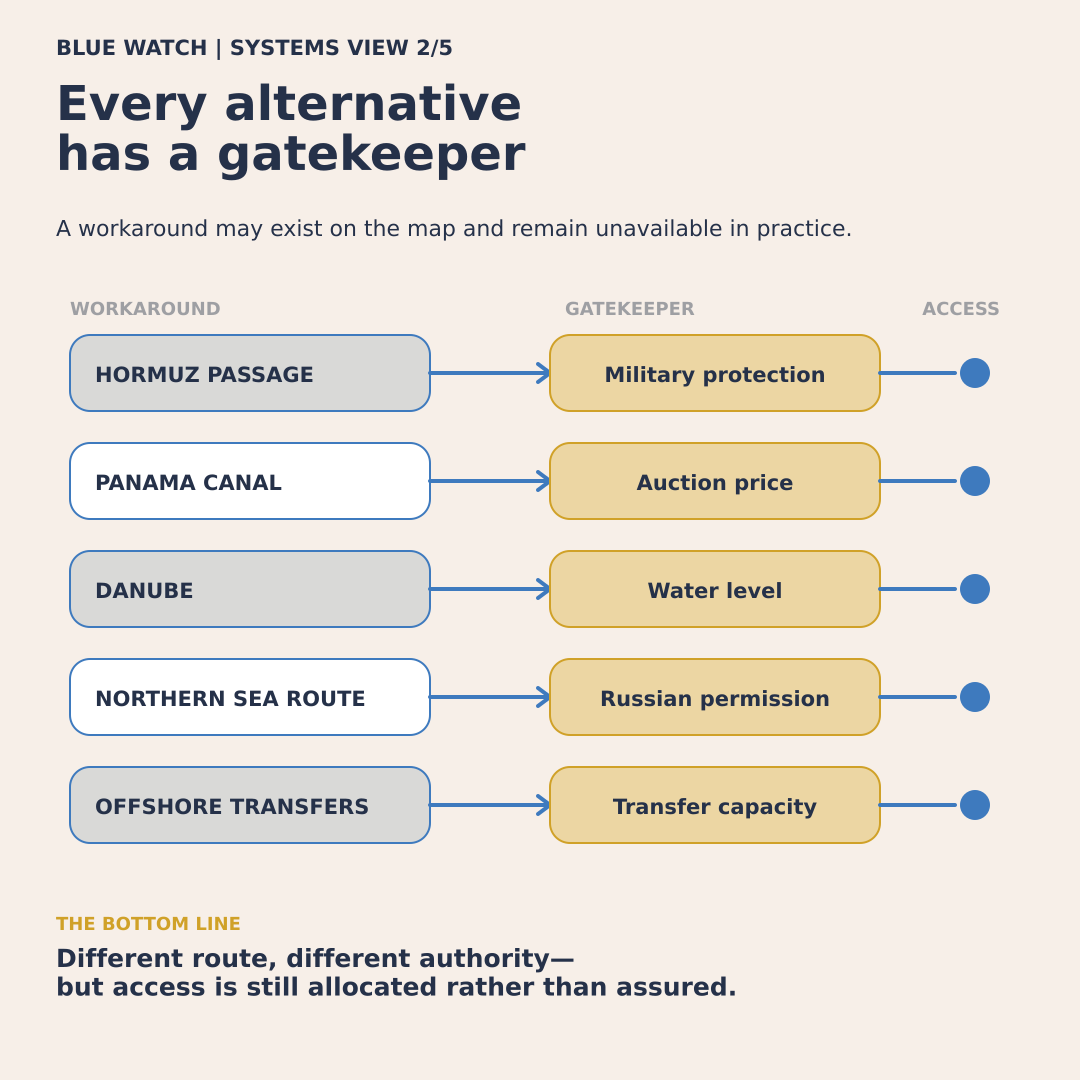
2. Every alternative has a gatekeeper
Question: What happens when the routes around a crisis are also scarce, expensive or politically controlled?
The Blue Watch read
Avoiding a threatened route requires access to another one. This week, several alternatives were constrained by price, climate or political authority.
At the Panama Canal, vessels without suitable reservations can bid for scarce transit opportunities. August auction prices have reached exceptional levels, allowing cargo able to absorb the premium to buy greater certainty while others wait or divert.
The Danube presents a physical limit. Record-low water levels have restricted navigation and contributed to the shutdown or reduction of nuclear generation in Romania and Hungary. Emergency engineering has protected some electricity production, but it cannot restore the river for every competing use.
China has reduced its exposure to Hormuz and Bab el-Mandeb by positioning state-owned tankers around Fujairah and Oman to collect oil outside the Gulf. This protects Chinese vessels from the most dangerous waters, but the oil must still reach the transfer area. Risk therefore moves towards feeder voyages, transfer crews and the coastal authorities responsible for security and pollution response.
The Northern Sea Route offers another option for selected Asia–Europe cargoes, although it cannot directly replace Hormuz for Gulf oil. It reduces exposure to southern chokepoints while creating dependence on Russian authority, seasonal conditions and limited Arctic support infrastructure.
Signals from the week
August Panama Canal auctions reportedly averaged around US$1.1 million for the regular locks and US$2.5 million for Neopanamax vessels. One containership paid approximately US$4 million for an earlier transit.
Record-low Danube levels forced Romania to shut its remaining operational nuclear reactor, while Hungary carried out emergency works to protect generation at Paks.
Chinese state-owned companies have positioned tankers around Fujairah and Oman to collect oil without sending those vessels through Hormuz and Bab el-Mandeb.
Between 2013 and 2025, the aggregate distance sailed by ships within the Arctic Polar Code area increased by 95%, from 6.1 million to 11.9 million nautical miles.
A drone attack interrupted loadings at Novorossiysk before operations resumed with Kazakh KEBCO crude. Russia subsequently rejected proposals for a Black Sea ceasefire.
The unresolved issue
Each alternative is governed differently. Military support shapes access through Hormuz, Panama allocates scarce priority through auctions, and Russia controls infrastructure used by both Arctic shipping and Kazakh exports. Along the Danube, governments must decide how a depleted river serves electricity, transport, agriculture, households and ecosystems.
These decisions affect the same movement of energy and essential goods, but they are rarely assessed together. A vessel avoiding one conflict zone may face a costly canal, an exposed transfer point or a longer route with higher fuel use. River disruption can reduce domestic generation while constraining the transport of replacement supplies.
Navies and coastguards may inherit the consequences without controlling the commercial decision: offshore transfers require surveillance and emergency response; Arctic voyages increase demand for rescue and environmental protection; Black Sea attacks create new risks around terminals and merchant vessels.
A viable alternative should therefore be judged across the complete journey: who controls it, who protects it, what it costs and where its risks eventually settle.
3. Energy pressure is reopening sovereignty bargains
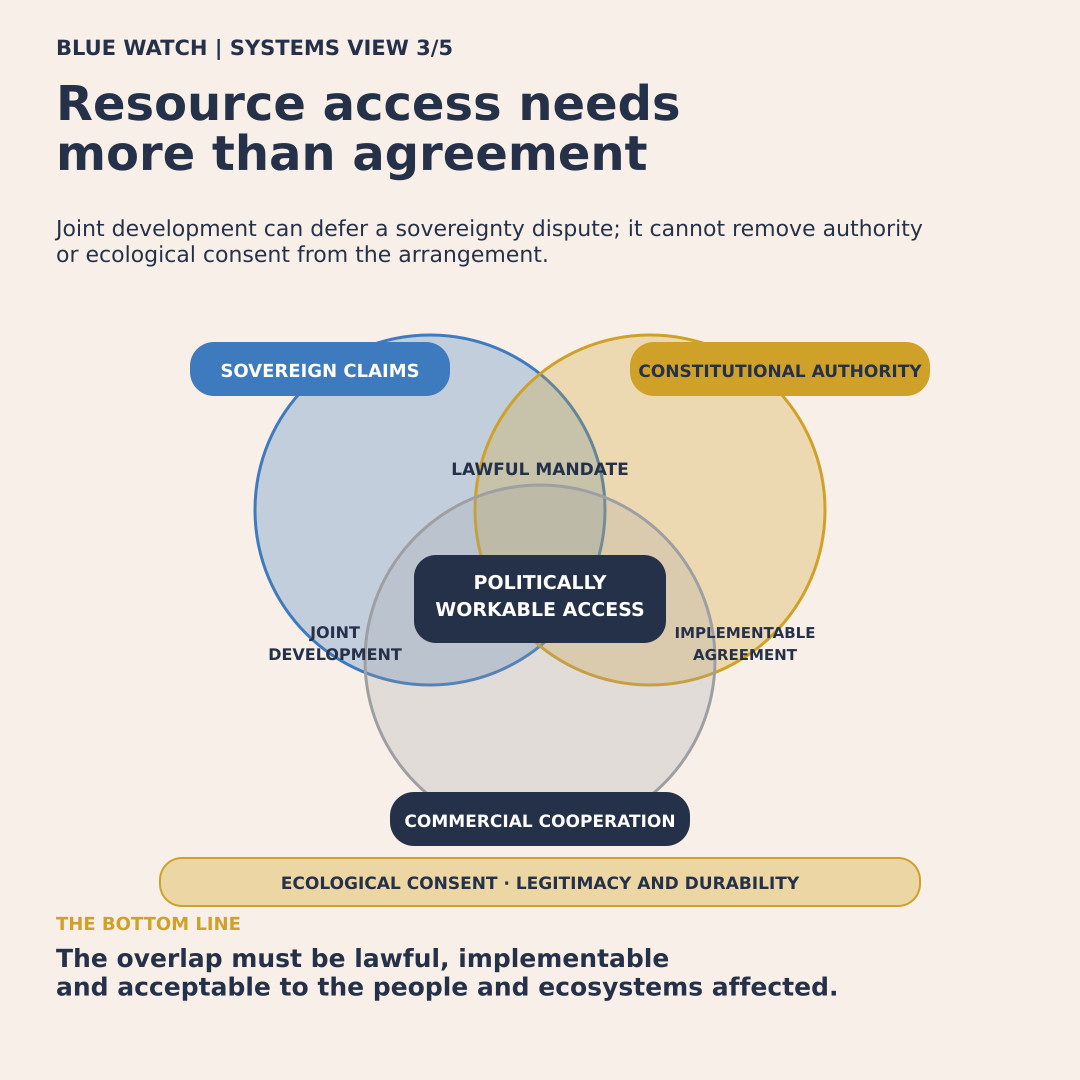
Question: Can states share a resource without weakening their claims to the waters around it?
The Blue Watch read
The Philippines and China continue to confront one another at sea while discussing possible joint oil and gas exploration.
President Ferdinand Marcos Jr described an agreement as a “distinct possibility” and linked the talks to the Philippines’ need for greater energy security. Previous negotiations failed because the parties could not reconcile their legal positions: The Philippine constitution requires the state to retain control over national resources, while cooperation with China cannot imply acceptance of Beijing’s maritime claims.
The continuing confrontations and Chinese construction on disputed features suggest compartmentalised cooperation rather than wider rapprochement. Manila and Beijing may be able to pursue one shared commercial interest while their coastguards and armed forces continue to contest the surrounding waters.
The proposed US deep-sea mining lease around American Samoa raises a related question: while Washington presents access to critical minerals as an economic and national-security priority, Pacific organisations argue that the environmental assessment is inadequate and that communities expected to carry the consequences have had too little influence over the decision.
Signals from the week
President Marcos said that joint Philippine–Chinese oil and gas exploration was a distinct possibility, with the two sides discussing possible terms.
Manila maintained that any agreement must respect Philippine sovereignty and comply with its constitutional requirements.
China continued strengthening its presence in disputed waters, including the first stage of construction at Antelope Reef.
Pacific organisations filed a lawsuit challenging the proposed deep-sea mining lease around American Samoa. The United States also proposed a future lease auction around the Northern Mariana Islands.
The unresolved issue
Joint development allows states to use a resource while postponing their sovereignty dispute. The arrangement becomes fragile when commercial cooperation could be interpreted as recognition of the other party’s claim.
The experience of Australia and Timor-Leste shows the limit of that approach. Their joint petroleum arrangements generated revenue but did not resolve questions of boundary, power and trust. Those eventually required compulsory conciliation and a permanent maritime treaty.
Any Philippine–Chinese agreement will need to preserve Manila’s legal authority while establishing how operations are supervised and protected. It must also account for environmental risk and the interests of fishing and coastal communities. Energy companies and foreign ministries cannot settle those questions alone, particularly when coastguard encounters may interrupt the work.
American Samoa presents the same imbalance in another form: Federal agencies would grant the lease, industry and defence would benefit from the minerals, and Pacific communities would experience the environmental and cultural effects. Consultation has limited value if it begins after the strategic direction has already been decided.
4. Maritime evacuation is becoming routine infrastructure
Question: Are coastal emergency plans keeping pace with the populations they may need to move?
The Blue Watch read
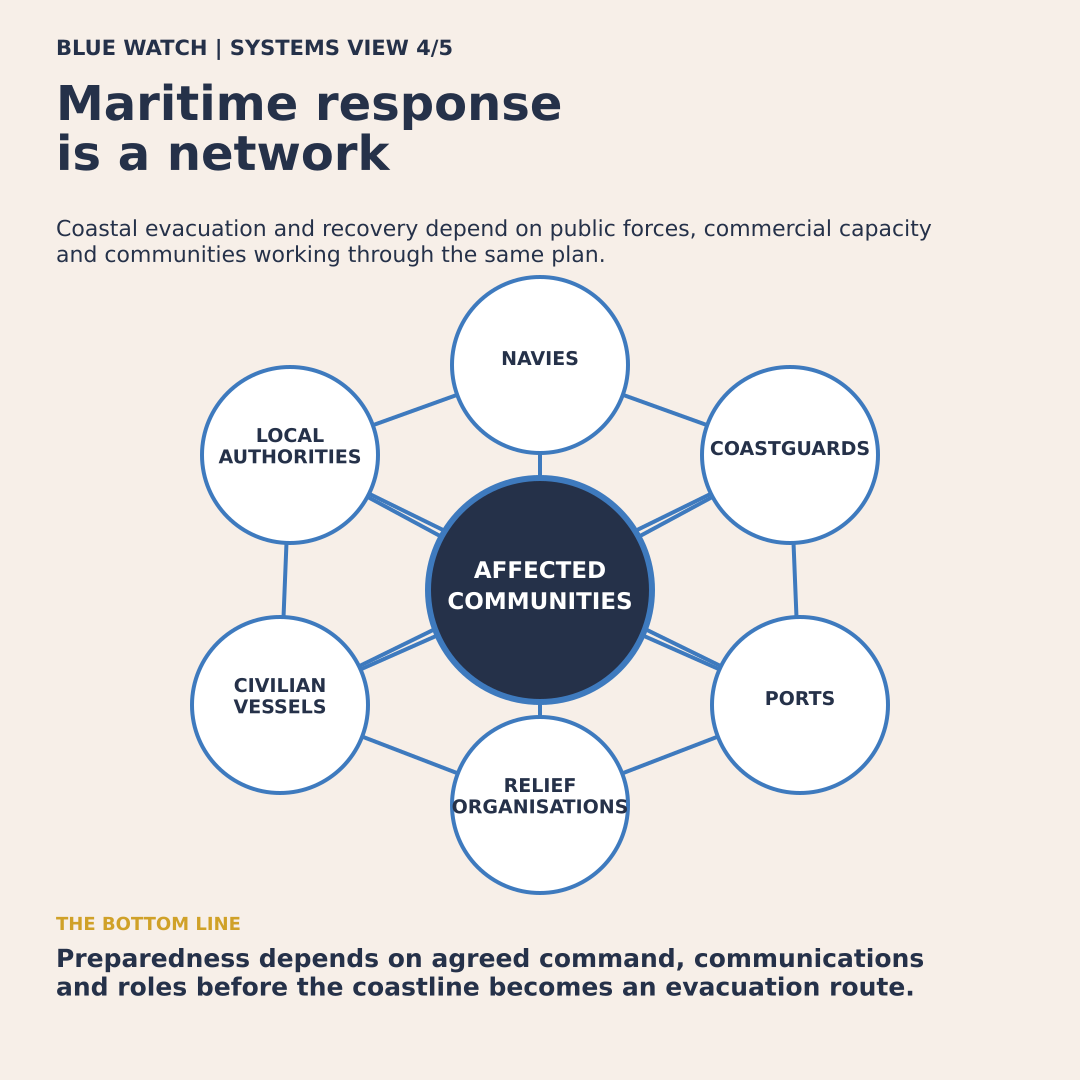
Wildfires in Greece and Croatia repeated a pattern already seen this summer in France and Italy: roads became unsafe, and the sea became an evacuation route.
In northern Greece, patrol boats, firefighting craft and fishing vessels evacuated hundreds of residents and tourists from Siviri. The operation again depended on state coordination and civilian maritime capacity available locally.
Tourism-dependent peninsulas and islands can accommodate seasonal populations much larger than their permanent infrastructure was designed to support, and visitors may not know where to assemble or how an evacuation by sea will work. Boats may also be available offshore while fire or congestion prevents people from reaching them.
Other disasters exposed the same access problem: Tropical Storm Lala damaged roads, power and communications in Hawaii, leaving remote communities isolated after commercial ports reopened'; The Flores earthquake blocked transport routes and delayed assistance; Up to 800 mm of rain fell in parts of southern South Korea between Saturday and Monday, with flooding and a deadly landslide reported in Geoje.
The planned deployment of USNS Comfort to Peru in February 2027 provides an example of anticipatory action. The US-operated hospital ship will support preparations for a potentially severe El Niño period, committing military medical and logistical capacity before the expected emergency.
Signals from the week
More than 300 people were evacuated by boat from Siviri using coastguard, firefighting and fishing vessels. Croatia also faced fires and road closures along the Dalmatian coast.
The US Coast Guard closed Hawaii’s commercial ports before Tropical Storm Lala and reopened them following safety assessments. Some remote communities remained affected by damaged land-side infrastructure.
The Flores earthquake cut off communities, with approximately 1,500 military and police personnel and ten aircraft supporting relief operations.
Geoje recorded 912 mm of rain over two days by 6 p.m. on 17 August, including 638.7 mm during the final 24-hour period.
The United States will deploy USNS Comfort to Peru as part of preparations for El Niño.
The unresolved issue
Maritime evacuation still tends to emerge as an improvised solution, despite the same combination of fire, limited roads and locally available boats appearing repeatedly.
Formal planning needs to define how public and civilian vessels are mobilised and coordinated, where evacuees gather and how those who need assistance are brought aboard safely. The operators providing boats also need clarity over liability and compensation. These arrangements require local communities and maritime businesses to be involved before an emergency, because they know which craft, landing points and routes are realistically available.
Navies and coastguards contribute command, communications and rescue capacity, but they may already be committed elsewhere. A coastal plan that assumes military assets will arrive quickly may therefore fail at the moment of greatest demand.
Remote communities face an additional problem: damage to roads and communications makes their needs harder to see, which can slow the allocation of assistance even without a deliberate decision to favour wealthier areas. Response systems need ways to prevent ease of access from becoming the main determinant of who receives help first.
The Comfort deployment raises the international version of that question: Greater transparency over how the Peru mission was selected and what it is expected to achieve would help determine whether it strengthens lasting local capacity or provides relief only while the ship is present.
5. Fishers are being squeezed by both sides of the drug war
Question: How can maritime enforcement distinguish coerced, lawful and criminal activity before using force?
The Blue Watch read
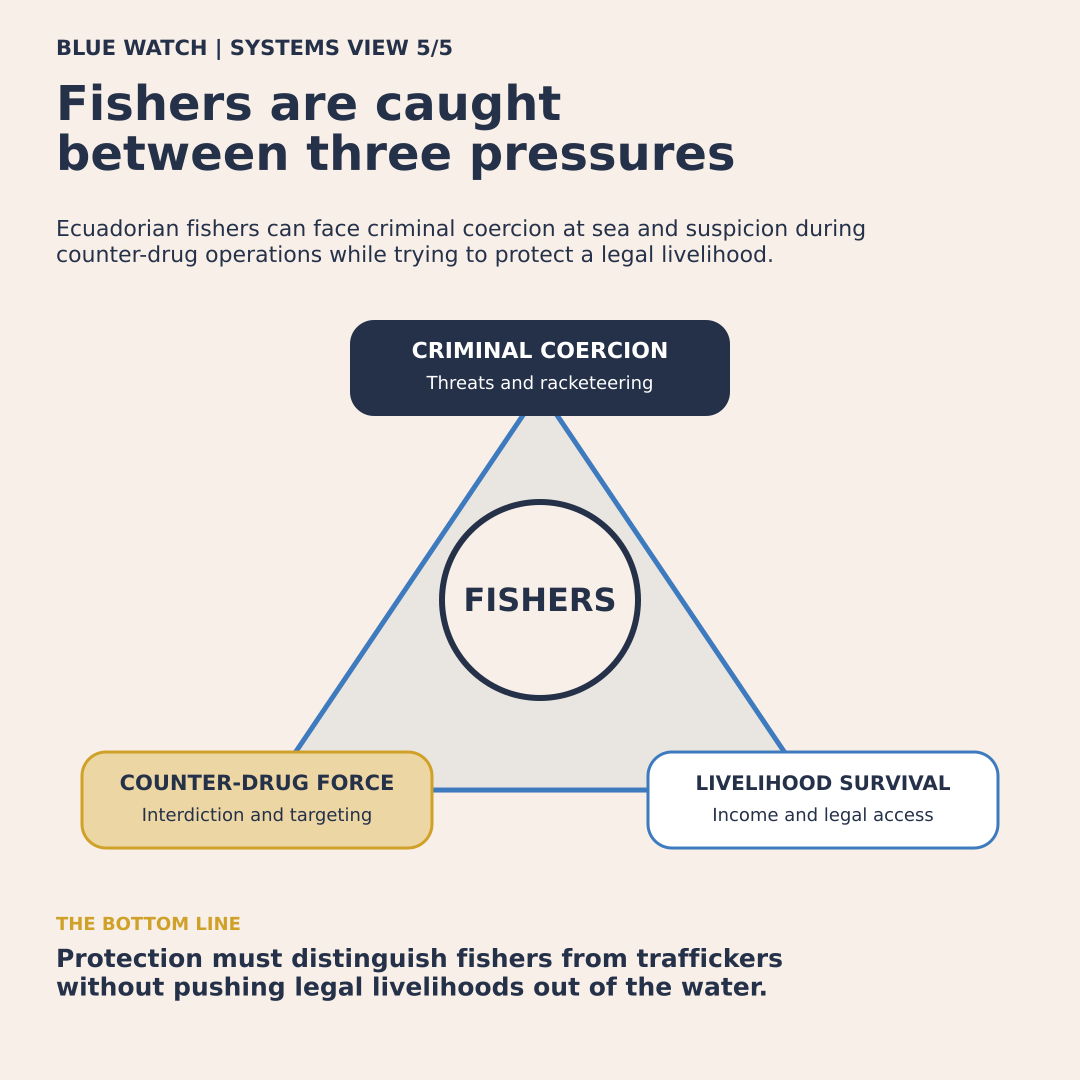
Fishers in Ecuador’s Manabí province describe pressure from criminal organisations that extort coastal businesses and recruit experienced crews to move cocaine across the eastern Pacific. Refusal can bring threats or violence, while trafficking offers income far beyond what legal fishing provides.
The same fishers now operate under the risk of a US campaign that treats suspected drug vessels as military targets. Washington says Operation Southern Spear has destroyed dozens of trafficking boats, but it has released little information about the evidence used to identify individual vessels.
Three Ecuadorian cases have raised particular concern: The Fiorella disappeared in January with eight crew members still missing, while Survivors from the Negra Francisca Duarte II and Don Maca say drones attacked their vessels before armed personnel detained them and transferred them to El Salvador - they maintain that they were fishing and carried no drugs.
A Washington Post investigation published this week attributed the attacks to a covert CIA programme. The programme remains officially opaque, and the available evidence does not establish why the three vessels were selected. Ecuadorian authorities are therefore expected to protect lawful fishing and investigate trafficking without knowing how a foreign agency is identifying or targeting vessels in the same waters.
Signals from the week
A Washington Post investigation linked the attacks on three Ecuadorian fishing vessels to a covert CIA programme.
Recent interviews describe fishers caught between cartel coercion and fear of US strikes.
No public evidence has connected the disputed crews to drug trafficking, according to a Council on Foreign Relations assessment.
Human-rights organisations have called for an investigation into possible unlawful attacks, detention and disappearance.
The unresolved issue
Fishing and trafficking use some of the same waters, skills and vessel types. That makes identification difficult, but it does not remove the requirement to establish a lawful basis for interception or lethal force.
The Ecuadorian Navy, Coast Guard and fisheries authorities need a shared process for verifying vessels and investigating disputed incidents. US agencies should provide enough information for independent oversight, while El Salvador must account for its role in receiving detained crews. Fishing organisations and human-rights bodies are essential to that process because security reporting alone cannot show how coercion and fear are affecting lawful livelihoods.
The consequences may eventually reach fisheries management if crews abandon established grounds or become more vulnerable to criminal recruitment - although that remains a risk rather than a demonstrated outcome. The immediate effects are clearer: fishers face reduced safety, disrupted work and declining trust in the authorities operating around them.
A counter-drug campaign that leaves lawful fishers afraid of criminal groups and state forces may destroy individual vessels without making the surrounding maritime system more secure.