

A hotter, more contested ocean leaves less room for error
Five questions connect this week. Each asks what happens when evidence arrives before institutions are ready to act on it. Ocean heat now demands planning beyond emergency response; marine research is being used to assert jurisdiction; and naval reach is being limited by the yards, people and infrastructure needed to sustain it. Canada and Wester Ross then test whether protection can shape economic activity while decisions are still open, rather than merely measure the damage afterwards.
WHAT CONNECTS THE WEEK
The common problem is timing. Persistent ocean heat means that decisions about aquaculture, ports and coastal infrastructure cannot wait for each new record to prove that the baseline has moved. The same problem appears in contested waters, where a research vessel may gather legitimate scientific data while its presence and escort also press a jurisdictional claim. In both cases, evidence remains incomplete at the point when action becomes necessary. Institutions therefore need rules that establish who can decide, on what threshold and with what consequences.
Sustainment, Canada and Wester Ross show what those decisions require. A fleet's paper strength matters little if ships cannot be repaired. An ocean-protection plan is weak if it cannot alter the expansion it accompanies, while citizen science has limited force until formal authority and enforcement give it effect. Together, the five stories trace whether observation reaches the institutions that control funding, skills and enforcement while there is still room to act.
QUESTION: How can institutions turn evidence into authority before pressure removes the choice to act?
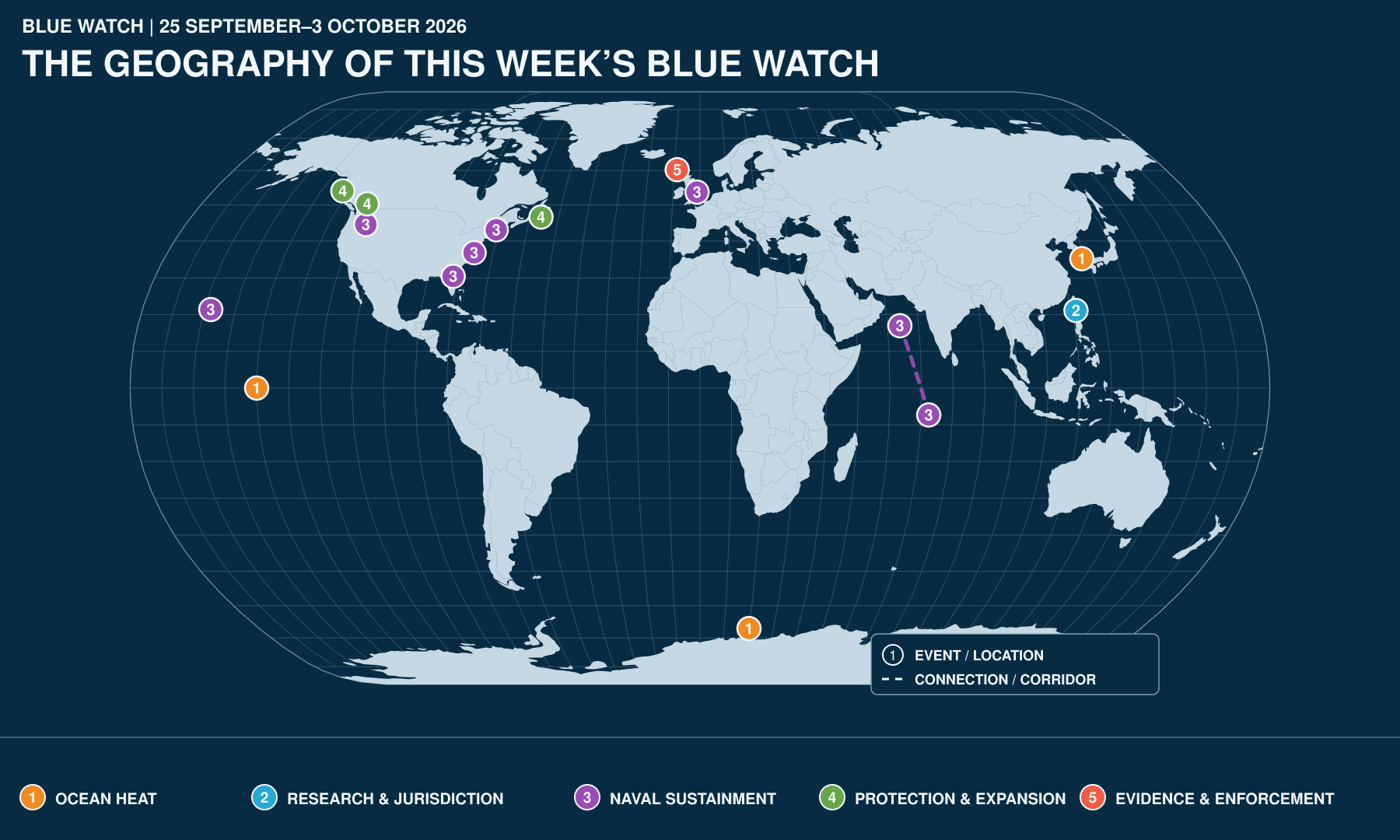
Disclaimer: the map is AI-generated - some dots or routes may not be very precise, but have been retained to show complex links or re-rerouting
1. Ocean heat is becoming an operating condition
Question: How should governments plan when ocean heat becomes an operating condition rather than an occasional emergency?
The Blue Watch Read
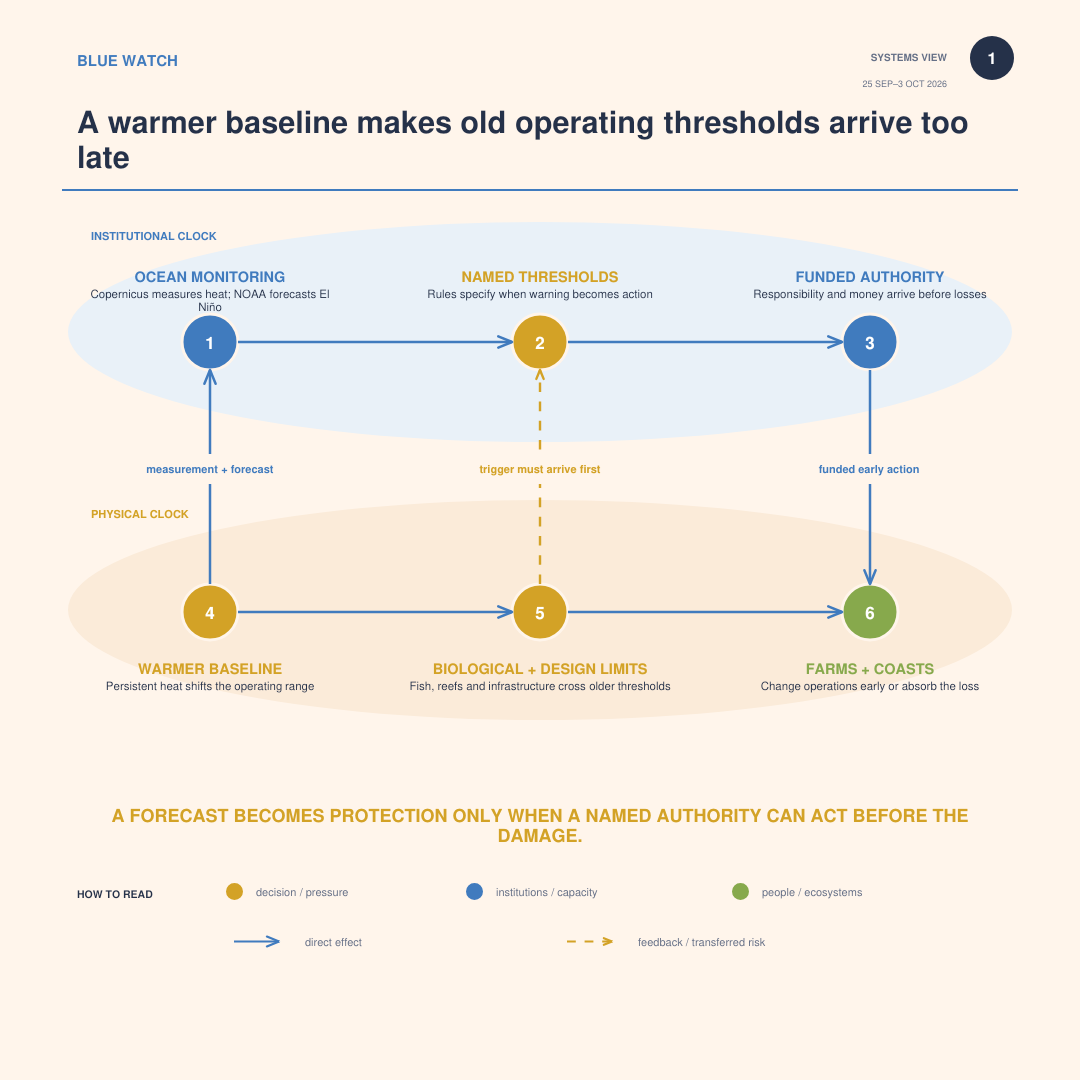
The tenth Copernicus Ocean State Report makes the shift difficult to ignore: conditions once treated as exceptional are becoming persistent. The ocean absorbed another 23 zettajoules in 2025, sea-level rise accelerated and Antarctic winter sea ice reached its third-lowest maximum. El Niño is already under way. These measures track different mechanisms, but together they show that the baseline used by planners is moving.
South Gyeongsang’s 68-day high-temperature alert shows what that means operationally. Millions of farmed fish and abalone died, leaving 425 farms with losses approaching 27.7 billion won, while bleaching-level heat stress has affected 84 per cent of the world’s coral reefs since January 2023. Coral bleaching and changing fisheries show that the burden does not stay within aquaculture. Governments and industries can no longer treat each loss as an exceptional season. Stocking rules, insurance, infrastructure standards and emergency triggers need to reflect a warmer range of conditions, with forecasts linked to decisions before the water crosses thresholds that older plans assumed would remain rare.
Signals from the week
• Ocean heat content has accelerated since 1960, with a record additional 23 zettajoules absorbed in 2025. Global mean sea level rose by 3.8 ± 0.3 millimetres a year between 1999 and 2025, accelerating to 4.2 ± 0.3 millimetres between 2012 and 2025. Copernicus Ocean State Report 10.
• Antarctic sea ice reached a maximum of 17.59 million square kilometres on 14 September, the third-lowest winter maximum on record. The four lowest maxima have all occurred in the past four years. The Guardian.
• NOAA's experimental SPEAR ensemble shows high confidence that the El Niño already under way will peak at historically strong levels later this autumn or in early winter; the Climate Prediction Center puts the chance of a very strong event above 90 per cent. NOAA Geophysical Fluid Dynamics Laboratory.
• When South Gyeongsang's 68-day high-temperature alert ended, provincial figures put losses at 425 farms and 27.69 billion won, including almost seven million farmed fish and more than 1.4 million abalone. Seoul Shinmun.
• Between January 2023 and September 2025, 84 per cent of the world's coral reefs experienced bleaching-level heat stress, while the 2024 Mediterranean and Black Sea marine heatwaves broke records for intensity and duration. The Guardian.
The unresolved issue
The missing element is a set of operational triggers. A forecast can show that heat is likely, but a fish farmer still needs to know when to reduce stocking, move cages or stop feeding, and who will absorb the loss. Port and coastal planners face the same lag over longer periods: a design standard based on historical ranges can remain formally compliant after it has become physically inadequate. The unresolved issue is who translates a moving ocean baseline into binding decisions. Thresholds need to be tied to data, funding and a named authority, with room to revise them as the science changes. Without that chain, better observation will produce earlier warnings without producing earlier protection.
2. Marine research is becoming an instrument of jurisdiction
Question: Who has authority over the knowledge gathered in contested waters?
The Blue Watch Read
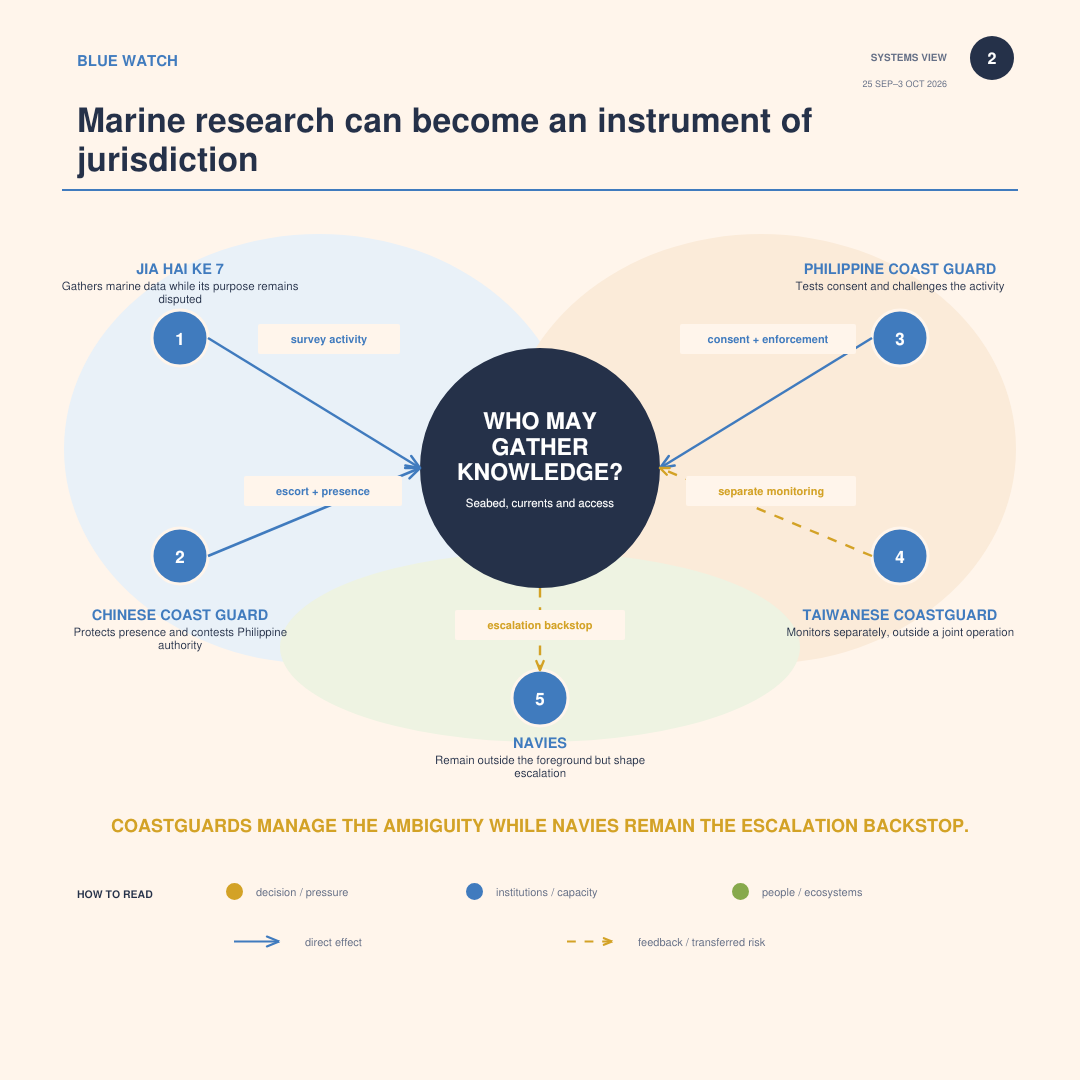
The Philippine Coast Guard sent BRP Teresa Magbanua, its largest vessel, and an aircraft after JIA HAI KE 7 spent four days about 37 nautical miles north-west of Itbayat. Manila said the privately owned Chinese ship was conducting marine research in the Philippine exclusive economic zone without consent and had spoofed its position; China said it was operating normally in waters under Chinese jurisdiction. By 3 October, the ship had moved north with two China Coast Guard escorts, while three Taiwanese coastguard vessels monitored separately.
The encounter concerns more than coastguard presence. Scientific work produces knowledge about the seabed, currents and access, so questions of consent and evidence form part of the jurisdictional dispute. The escorts did not establish the survey’s purpose, and Taiwan was not operating jointly with the Philippines, but the confrontation still became a multi-state law-enforcement encounter. Coastguards managed the ambiguity while navies remained the escalation backstop, allowing marine research to press a claim of authority without becoming an overt military operation.
Signals from the week
• The Philippine Coast Guard located JIA HAI KE 7 about 37.8 nautical miles north-west of Itbayat on 28 September. It said the vessel had not responded to radio challenges, was loitering in a pattern consistent with research and had transmitted a physically impossible AIS track. Philippine Coast Guard.
• BRP Teresa Magbanua closed to within 100 yards, launched a rigid-hull inflatable boat and continued monitoring after the survey ship left its loitering position. A China Coast Guard vessel challenged the Philippine operation. Reuters.
• By 3 October, JIA HAI KE 7 had moved north towards the outer limit of the Philippine EEZ with two China Coast Guard escorts. Three Taiwanese coastguard vessels were also in the area on separate monitoring missions. Taipei Times.
• China's embassy said the vessel was operating normally in waters under Chinese jurisdiction and described the Philippine action as harassment. Reuters.
The unresolved issue
The immediate gap concerns evidence and classification. The Philippines needs a reviewable basis for determining when a vessel has moved from passage to research, particularly when it alleges location spoofing or activity without consent. Researchers and operators need predictable notification requirements and a way to show what equipment is deployed and what data is being collected. The larger challenge is to contest the activity without allowing uncertainty to dictate escalation. Preserved tracking data, advance notice and a shared incident record would make competing claims easier to test after an encounter. Without that discipline, each survey can be treated as reconnaissance and each enforcement action as provocation, leaving coastguard crews to manage a dispute over jurisdiction at close range.
3. Maintenance capacity is setting the limit of naval power
Question: What happens when maintenance capacity, rather than fleet size, sets the limit of naval power?
The Blue Watch Read
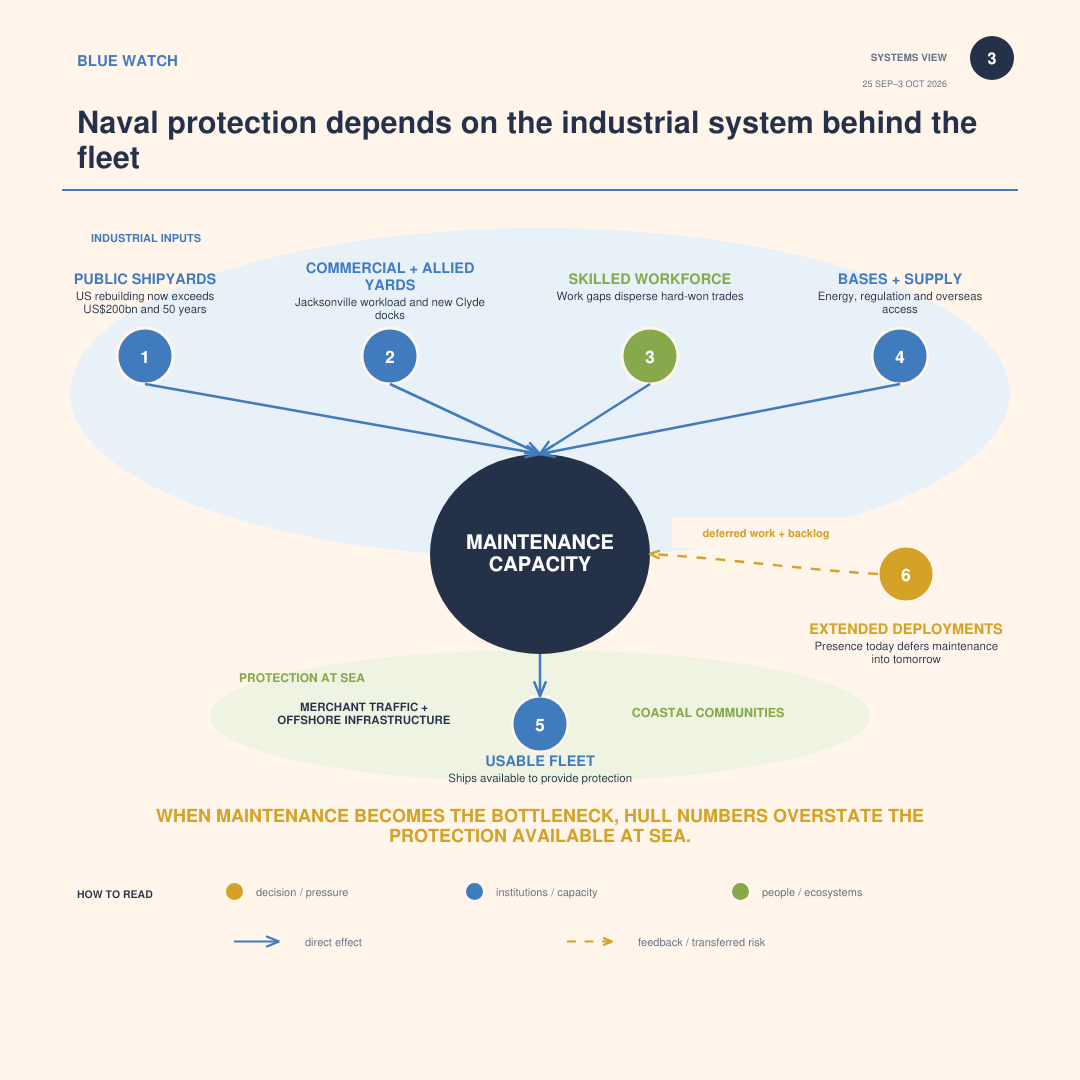
The gap between nominal and usable naval power is now measured in decades. GAO estimates that rebuilding the U.S. Navy’s four public shipyards will cost more than US$200 billion and take over fifty more years, against the 2018 estimate of at least US$21 billion over twenty years. That long deficit is colliding with current operations: fifteen warships are being sustained inside the weapon engagement zone in the Middle East, parts are moving from as far away as Diego Garcia, and extended deployments have pushed major maintenance periods into 2027 while eighteen smaller periods have been cancelled.
The effects reach beyond the fleet. A US$70 million availability for USS Wichita averted 400 possible layoffs in Jacksonville, showing how naval schedules determine whether skilled industrial capacity survives. The Navy’s new sustainment leadership is intended to connect bases, piers, supply and repair, while Britain plans three floating docks at Clyde. Usable power depends on skilled labour, reliable energy, regulation, allied ports and commercial yards. When that system falters, fewer ships are available to protect merchant traffic, offshore infrastructure and coastal communities, however large the fleet appears on paper.
Signals from the week
• GAO concluded that the Shipyard Infrastructure Optimization Program will surpass US$200 billion and take more than another fifty years. The original 2018 estimate was at least US$21 billion over twenty years. U.S. Government Accountability Office.
• The U.S. Navy is sustaining fifteen warships in the weapon engagement zone. Extended deployments pushed three major maintenance periods into 2027, while funding gaps and operational needs led to the cancellation of eighteen smaller periods. USNI News.
• A US$70 million maintenance availability for USS Wichita prevented the immediate loss of 400 jobs at BAE Systems Jacksonville, illustrating how changes in naval schedules create a boom-and-bust workload for repair yards. USNI News.
• Vice Adm. Scott Gray, the new Deputy Chief of Naval Operations for sustainment, told USNI News that Navy shore infrastructure would be in failing condition by 2037 under the current funding path. USNI News.
• The United Kingdom committed to procure three floating docks at Clyde through a UK-only competition under Programme Euston, first set out in 2023. It also committed funding for a British-built marine research vessel expected to enter service in the early 2030s. UK Government.
The unresolved issue
A fleet cannot pause while its industrial base is rebuilt, yet preserving presence by deferring maintenance borrows readiness from the future. A long capital programme creates a second risk if it absorbs funding without producing enough near-term capacity. GAO's call for consolidated cost, schedule and risk information matters because leaders need to see those trade-offs across the whole system rather than one dry dock at a time. The workforce has to be planned with the same care as the infrastructure. A gap in orders disperses experienced trades before the next maintenance surge arrives, while an abrupt concentration of work overloads the same yards and people. Investment will expand usable naval power only if projects and operational schedules create a stable enough flow of work to retain the capability between crises.
4. Canada is asking protection to support expansion
Question: Can ocean protection expand quickly enough to make more shipping politically and operationally sustainable?
The Blue Watch Read
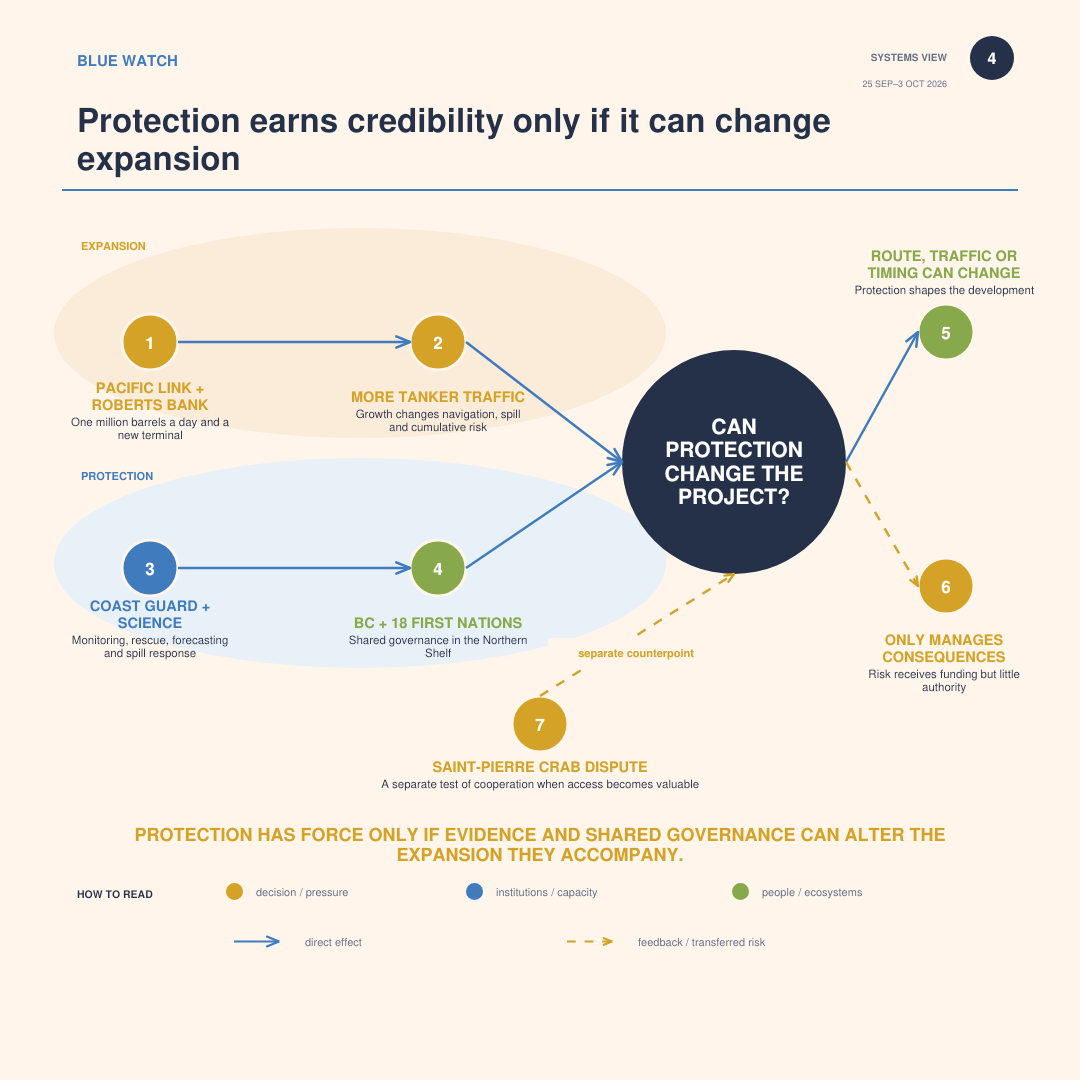
Canada announced a C$1.2 billion ocean-protection package on 29 September and tied it to expanding West Coast trade and marine infrastructure. Two days later, Ottawa designated Pacific Link a project of national interest. The proposed pipeline would carry an additional one million barrels of crude a day to the Pacific coast, requiring a new terminal and more tanker traffic. The sequence matters because protection is being asked to create the operational and political conditions for growth.
The package adds Coast Guard monitoring, rescue, forecasting, spill response, enforcement and marine science, alongside C$186 million for an agreement with British Columbia and 18 First Nations. Its credibility will depend on whether evidence about whales, cumulative effects or navigation risk can change a route, limit traffic or delay work, rather than merely manage the consequences after traffic increases. The separate snow-crab dispute with France provides a warning. Macron promised an exploratory licence, but Canada said none had been issued for the contested extended continental shelf beyond 200 nautical miles. Cooperation becomes harder when jurisdiction and valuable resources are at stake.
Signals from the week
• Ottawa announced a C$1.2 billion package that renews existing Oceans Protection Plan measures and adds investment in traffic monitoring, search and rescue, nearshore forecasting, spill recovery, conservation enforcement and marine science. Prime Minister of Canada.
• The backgrounder explicitly anticipates significant growth in shipping linked to energy, port and resource projects, and says the resulting science will support project reviews and regional planning. Fisheries and Oceans Canada.
• A C$186 million investment will support collaborative governance, conservation and emergency preparedness through a five-year Northern Shelf Bioregion agreement involving British Columbia and 18 First Nations. Prime Minister of Canada.
• Pacific Link was designated a project of national interest on 1 October. Canada says the project needs new conservation measures consistent with the higher maritime traffic it will create and proposes a minimum ten per cent Indigenous ownership interest. Prime Minister of Canada.
• President Emmanuel Macron promised an exploratory snow-crab licence to a Saint-Pierre-based company. On 3 October, Canada's fisheries minister said French officials had confirmed that no new licence had been issued; the proposed area lies beyond 200 nautical miles, within an unresolved extended-shelf claim off Newfoundland. The Canadian Press.
The unresolved issue
Canada's approach will be credible if the protection architecture can change the development it accompanies. That requires ecological baselines before traffic increases, public thresholds for action and a clear account of who can order work to slow or stop. Funding must also extend beyond construction, because noise, spill exposure and cumulative effects continue for the operating life of a port or pipeline. A minimum Indigenous ownership stake can create influence and long-term benefit, but it cannot settle consent among all affected communities. The unresolved test is whether shared governance can alter the project after political momentum and capital have gathered behind it. If protection is expected only to manage the consequences, risk has been funded without being governed.
5. Wester Ross shows what happens when evidence and authority align
Question: When can local evidence become enforceable marine protection?
The Blue Watch Read
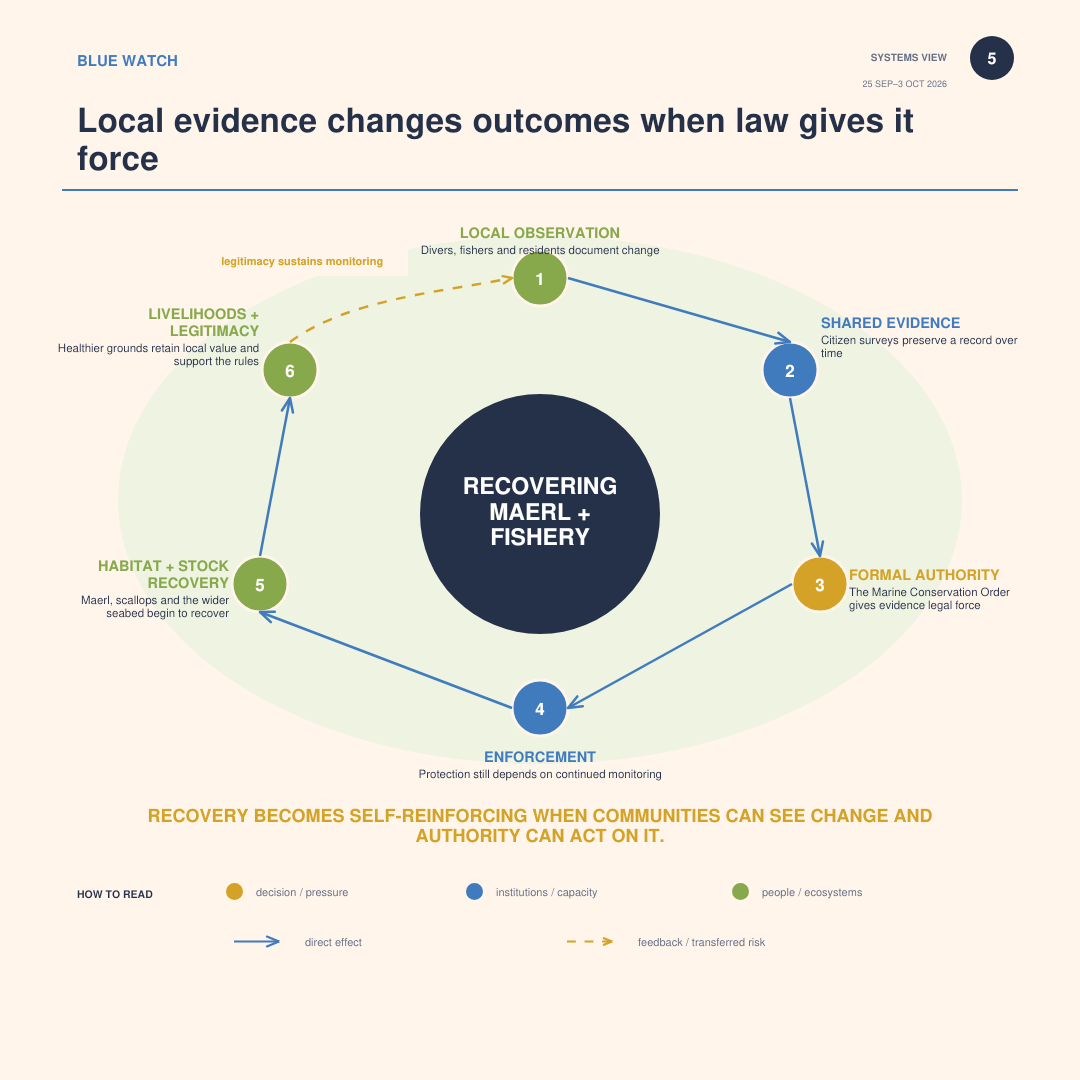
Ten years after scallop dredging was halted in Wester Ross, local people can point to ecological change rather than a designation on a map. Divers, activists and small-scale fishers documented damage to maerl beds and carried the evidence to Scottish ministers; a permanent Marine Conservation Order followed in 2016. The habitat justified the urgency: some maerl is 9,000 years old, while one pass of a scallop dredge can crush or bury up to 70 per cent of a bed. Citizen surveys now report extensive protection and signs of recovery in scallops, fish and the wider seabed.
The benefits also reach the local economy. Creel fishers report healthier grounds and less need to travel, while community research suggests low-impact fishing retains more revenue locally than dredging or trawling. Recovery remains incomplete because surveys still record illegal dredging, possible nutrient pressure from salmon farms and permitted prawn trawling in designated areas. Wester Ross matters because local knowledge did not remain anecdotal: communities preserved it as evidence, formal authority gave it legal force, enforcement changed activity, and compatible livelihoods reinforced the protection.
Signals from the week
• A report drawing on ten years of citizen science around the Summer Isles found that the Wester Ross dredging restriction had protected maerl to a substantial extent, alongside reported recovery in scallop stocks and seabed health. The Guardian.
• The Blue Hope Alliance is creating a community-owned open-source archive of underwater surveys and expanding its evidence-gathering through a three-year restoration project. Blue Hope Alliance.
• NatureScot describes maerl as extremely slow-growing and highly sensitive to disturbance; a single pass of scallop-dredging gear can crush or bury up to 70 per cent of a bed, while recovery after fragmentation is severely limited. NatureScot.
• The Wester Ross Marine Conservation Order came into force in March 2016, prohibiting scallop dredging across the protected area while allowing specified lower-impact fisheries and limited trawling in designated zones. UK legislation.
• Continuing threats include illegal dredging and damaged maerl at some surveyed locations, as well as concern over nutrient pressure from salmon farms. Local monitoring remains necessary after legal protection is established. The Guardian.
The unresolved issue
Wester Ross does not remove the usual questions about data quality, enforcement or competing livelihoods. It shows that local evidence can become powerful when communities can preserve it over time and when an authority is required to respond. The next challenge is to make that route available beyond places with exceptional volunteer capacity or unusually persistent campaigners. Citizen monitoring should strengthen statutory science rather than substitute for it. Governments still need common evidence standards, accessible reporting channels and enforcement resources. Local observers are most valuable when they can show change early and receive a timely institutional response, rather than carrying the cost of proving the same harm repeatedly.
What the week leaves unresolved
Each strand asks when information becomes a decision. Ocean heat cannot remain a warning detached from operating rules. Marine research cannot be separated from jurisdiction once states deploy coastguards to contest who may gather knowledge. Shipyard data must change force planning if fleet presence today is already consuming the maintenance capacity of tomorrow. Canada and Wester Ross expose the political test: protection needs enough authority to alter activity as well as observe its effects.
Timing determines whether institutions retain a choice. Aquaculture authorities need operational triggers before heat produces mass mortality, while states need research protocols before coastguard vessels meet at close range. Naval planners need to sequence work before skilled workers disperse, and project conditions need to be settled before construction commitments harden. Wester Ross shows the same handover at a local scale: community evidence mattered because law and enforcement gave it a consequence.
A less forgiving ocean turns weak handovers into operational risk. Rebuilding margin means connecting observation to a named authority, an agreed threshold and the resources to act before the response has to be improvised at the edge. Wester Ross provides the strongest positive case this week because protection was sustained long enough to change both the seabed and the local economy. It demonstrates the principle in one setting: evidence can alter outcomes when institutions give it force.