

Protection gaps do not disappear - they migrate.
Seven questions connecting contested passage, commercial confidence, infrastructure, fisheries enforcement, sanctions and autonomous systems.
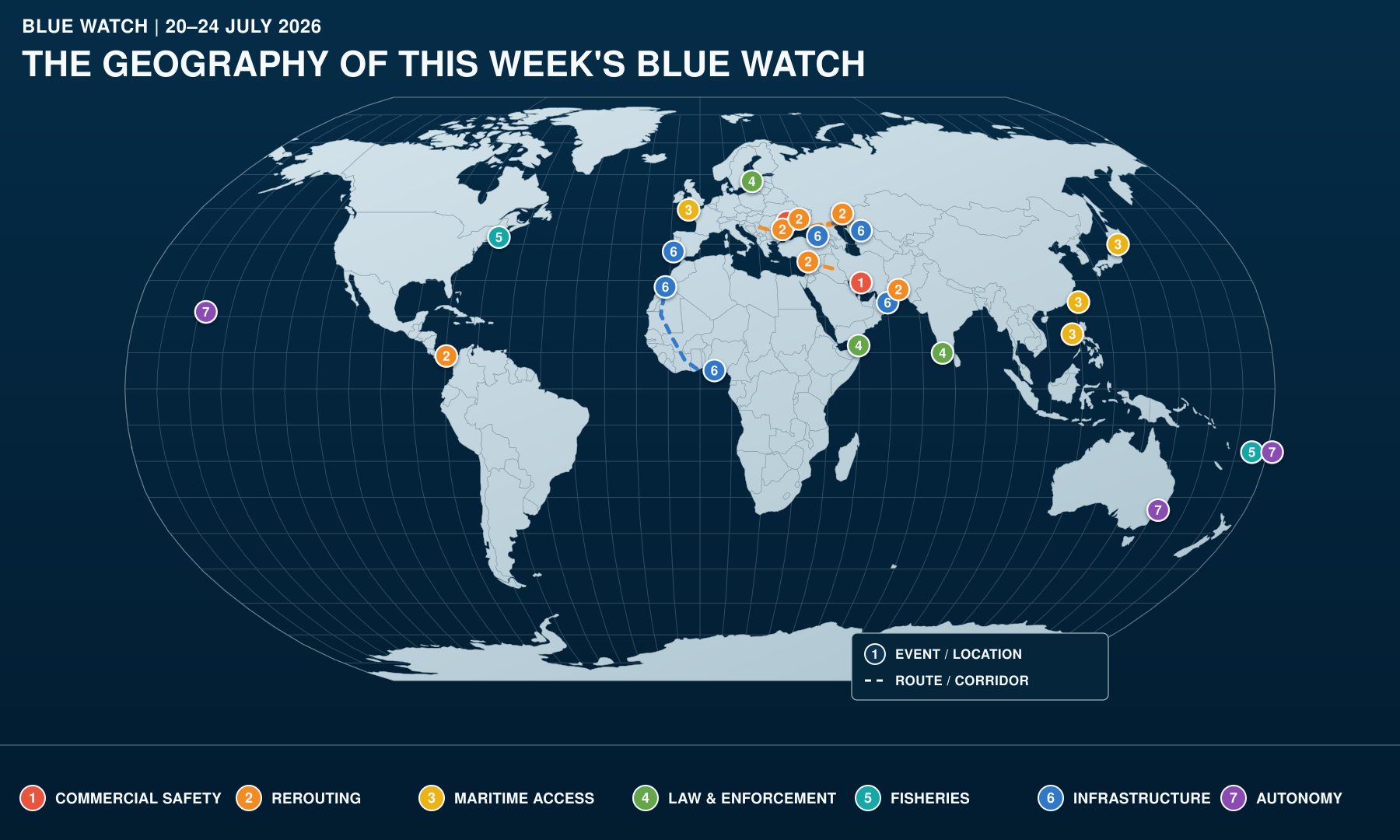
Disclaimer: this is an AI-generated map - some corridors do not appear exactly as they should.
1. Safety is a commercial verdict
Question:
Who decides whether a maritime route is safe: the force protecting it, or the people expected to sail through it?
The Blue Watch read
Naval forces can patrol a route, escort vessels and prepare to clear mines. But they cannot, by themselves, make passage acceptable to shipowners, insurers or crews.
That gap is visible in the Strait of Hormuz. Despite naval presence and mine-countermeasure readiness, tanker traffic remained extremely limited during the reporting period. The route was not formally closed, but neither was it functioning as an ordinary commercial passage. Whether a vessel sailed depended on the individual decisions of its owner, insurer, charterer and crew—and on how each assessed a risk that military protection could reduce but not eliminate.
A similar outcome can be seen around Ukraine, although the circumstances are different. Repeated attacks on ports and vessels have led shipowners to halt new calls despite efforts to preserve maritime export routes. In both cases, a route can remain technically navigable while becoming functionally closed through private decisions.
Selective passage also changes the protection problem facing naval forces. The objective is no longer simply to keep a route physically open for normal commercial traffic. It becomes a question of supporting occasional movements, responding to different risk tolerances and providing assurances that may still be insufficient for the people expected to sail.
Safety is therefore not only a military condition. It is a commercial and human judgement—and one that naval presence can influence without ultimately controlling.
Signals from the week
Tanker traffic through Hormuz remained exceptionally limited despite naval presence and mine-countermeasure readiness.
Shipowners continued to assess passage independently of official assurances and available military protection.
Shipowners halted new calls at Ukrainian Black Sea ports following attacks on ports and vessels.
Seafarers faced continued exposure aboard vessels in high-risk areas, alongside reported financial incentives to accept Hormuz transits.
The Royal Navy has prepared crewless mine-hunting capability for a potential Hormuz mission, but readiness to clear a route is not the same as certifying that every voyage is safe. Recent Hormuz transit data and the WTO’s AIS-based trade tracker illustrate both the disruption and the limitations of vessel-tracking evidence.
The unresolved issue
There is no single accepted test for whether a contested maritime route is genuinely open. Legal status, military presence and navigational guidance may point in one direction while owners, insurers and crews reach the opposite conclusion.
The remaining risk is not distributed evenly. Shipowners can suspend services, while seafarers may face pressure to sail, extended contracts or delayed repatriation. It remains unclear who should compensate those asked to accept risks that military protection can reduce but cannot remove—and whose judgement ultimately determines whether an official assurance has restored meaningful access.
2. Rerouting moves the protection problem
Question:
When a chokepoint is bypassed, does risk disappear—or move ashore?
The Blue Watch read
The response to disrupted sea routes is increasingly multimodal. Cargo moves from ship to road, pipeline, river, rail and alternative port. These alternatives create resilience, but they also produce new concentration points, dependencies and protection requirements.
Plans for new terminals on the UAE’s east coast point towards a longer-term effort to reduce dependence on Hormuz. The concession would connect new facilities in Fujairah with Jebel Ali and the UAE’s wider logistics network. But the terminals will take years to construct. They do not relieve this week’s disruption, and their eventual value will depend on the capacity of the roads, railways, pipelines and storage facilities behind them.
A more immediate workaround is visible in Iraqi fuel oil being transported by truck to the Syrian Mediterranean port of Baniyas before shipment to the United States. The route avoids Hormuz, but it also transfers the security and environmental burden onto thousands of kilometres of road, a Syrian port and the authorities responsible for protecting the cargo at each stage.
The same transfer is occurring around the Black Sea. Disruption has increased pressure on the Danube, rail networks and Romanian ports. Yet Romania’s section of the Danube has reached its lowest level since 1996, restricting vessel loads and leaving some grain barges idle. A route intended to provide resilience against war is itself being constrained by climate and hydrology.
Rerouting therefore does not remove the protection problem. It redistributes it—often across a longer chain and among authorities that may not have planned to carry it.
Signals from the week
The UAE granted a long-term concession for new east-coast port terminals intended to strengthen routes bypassing Hormuz.
Iraqi fuel oil reached Baniyas by road before being loaded for the United States.
Black Sea disruption continued to transfer pressure towards the Danube, railways and Romanian ports.
Exceptionally low Danube levels restricted the capacity of these alternative routes.
Disruption affecting the Caspian Pipeline Consortium’s maritime export system caused production consequences deep inside Kazakhstan.
Panama Canal booking flexibility was reduced amid continued hydrological uncertainty.
The impact on Kazakhstan was particularly instructive. Disruption at a maritime export node propagated backwards through the pipeline system and into inland production. Reuters reported a sharp fall in Kazakh output after loadings were disrupted.
The unresolved issue
Rerouting is usually assessed through capacity: how much cargo can be redirected and how quickly. Less attention is paid to the governance and protection of the resulting route.
Who protects large numbers of road-tanker movements? Who manages congestion, emissions and spill risks around alternative ports? Who funds additional rail, storage and river capacity? And which authority coordinates protection when cargo repeatedly moves between land and sea and crosses several jurisdictions?
The danger is that resilience at one node creates fragility at the next—and that no actor remains responsible for the entire route.
3. Maritime access is being shaped below the threshold of war
Question:
When does an ordinary maritime activity become an operation to assert control?
The Blue Watch read
At Scarborough Shoal, sovereignty is not being asserted only through legal declarations or military deployments. It is being performed through coastguard patrols, fishing activity, fuel and food deliveries, close manoeuvres and control over practical access.
Supporting fishers is therefore more than a humanitarian or economic activity. It enables them to remain present, connecting livelihoods and food security to the exercise of effective maritime sovereignty. Fishers become both beneficiaries of state protection and participants—sometimes involuntarily—in a wider contest over jurisdiction. This creates an uncomfortable overlap between civilian activity and strategic signalling.
Live-fire exercises shape access in a different way. This week, Russian activity near Plymouth, China–Russia drills in waters claimed by Japan as part of its exclusive economic zone, and Chinese exercises near Taiwan all generated navigational warnings as well as strategic signals. The events are not equivalent and should not automatically be described as unlawful. What connects them is the use of maritime activity and navigational restrictions to communicate presence, capability and intent. The same mechanisms intended to keep mariners safe can also alter patterns of access and create political pressure below the threshold of war.
Signals from the week
Philippine support missions delivered food and fuel to fishers near Scarborough Shoal.
Coastguard vessels continued close and confrontational operations around the shoal.
Russia conducted notified firing south of Plymouth under Royal Navy observation.
China and Russia exercised in waters claimed by Japan.
China established a temporary live-fire area near Taiwan.
The unresolved issue
Mariners must distinguish between routine training, legitimate navigational precaution and coercive signalling, even though the same warnings, exclusion areas and military movements can serve all three purposes.
At Scarborough Shoal, the dilemma is particularly acute: how can states protect traditional fishing access without turning civilian fishers into instruments of sovereignty policy or exposing them to increasingly dangerous coastguard confrontations?
4. Law is becoming an operational capability—and an operational burden
Question:
Can maritime enforcement expand without stretching missions and legal authorities beyond control?
The Blue Watch read
The EU’s sanctions policy now connects Russia’s shadow fleet, Hormuz-driven oil prices, naval capacity and the law governing boarding at sea.
The EU paused the automatic adjustment of its Russian oil-price cap until July 2027 because of what it described as exceptional market conditions linked to the Hormuz crisis. Its latest package also targeted another 41 shadow-fleet vessels. Disruption in one energy corridor has therefore altered the political appetite for imposing pressure in another.
Yet adding vessels to a sanctions list is easier than enforcing restrictions at sea. Operation Atalanta’s reported role concerns verifying a vessel’s flag when there are grounds to suspect statelessness or false registration. That is considerably narrower than a general authority to board any tanker suspected of evading sanctions.
Article 110 of UNCLOS allows a warship to visit a vessel on the high seas only on specified grounds. Sanctions do not independently create an unlimited boarding power. The legal basis, flag status, location and conduct of the vessel still matter.
Enforcement can also generate new naval requirements. Russia’s reported use of warships to escort sanctioned tankers consumes naval availability and increases the risk that a legal or law-enforcement encounter becomes a military confrontation. Sanctions do not therefore impose only financial costs. They can alter deployments, readiness requirements and escalation calculations.
India’s first reported convictions under its 2022 anti-piracy legislation show another side of maritime enforcement. Interception is only one stage in a much longer process involving lawful boarding, evidence collection, detention, prosecution, due process and, eventually, imprisonment or repatriation. The accompanying multinational training in Kochi reinforces the point: law is an operational capability that must be trained and resourced.
Signals from the week
Hormuz-driven market conditions affected the EU’s willingness to adjust its Russian oil-price cap.
The EU added another 41 vessels to its shadow-fleet restrictions.
Operation Atalanta’s reported role raised questions about flag verification, sanctions and the limits of high-seas boarding.
Russia reportedly increased naval escorts for sanctions-evading tankers.
India trained multinational participants in maritime law and boarding before securing its first convictions under the 2022 anti-piracy law.
The EU’s 21st sanctions package explicitly connected the pause in the oil-cap adjustment to exceptional market conditions created by the Hormuz disruption.
The unresolved issue
The central problem is mission expansion. Can Atalanta take on flag-verification and sanctions-related activity without weakening counter-piracy coverage? Can European navies provide the ships, intelligence analysts, legal advisers and detention arrangements required—or are missions receiving additional tasks without additional capability?
Responsibility aboard shadow-fleet vessels is also difficult to separate. Crews may have little influence over ownership structures, registration or cargo decisions. Enforcement must penetrate deliberately opaque commercial arrangements while preserving crew safety, consular access and procedural rights.
5. Managing fish stocks means managing security trade-offs
Question:
How do you protect a depleted marine resource without making coastal livelihoods less secure?
The Blue Watch read
NOAA assesses Atlantic herring as overfished but not currently subject to overfishing. The distinction matters: current fishing pressure may be controlled even while the stock remains below a healthy level. Limited reopening can provide some access to livelihoods without declaring the resource fully recovered. But it also exposes the difficult balance between biological rebuilding and immediate household income.
If restrictions are designed entirely around stock indicators, they can transfer the cost of recovery onto communities least able to absorb it. If access is restored too quickly, the same communities may face a deeper collapse later. The question is not simply whether to open or close a fishery, but how the costs, risks and remaining access are distributed.
Fiji’s proposed monitoring, control and surveillance approach offers part of an answer. Better coordination between fisheries authorities, customs, police and naval forces—supported by improved information sharing—could focus enforcement more effectively on illegal and industrial activity rather than relying only on broad restrictions.
That does not resolve the entire problem. Better surveillance cannot replace lost household income, determine who should retain limited access or compensate communities during a closure. Enforcement can protect the resource, but social and economic policy still determines who pays while it recovers.
The longer-term security relevance is important but should not be overstated. Depleted resources and lost livelihoods can increase vulnerability to illegal fishing, organised crime or piracy recruitment. They do not produce those outcomes automatically. The pathway depends on governance, exclusion, economic alternatives and the presence of networks able to exploit the resulting insecurity.
Signals from the week
Atlantic herring remains overfished despite not currently experiencing overfishing.
Limited access seeks to balance stock rebuilding with livelihood needs.
NOAA’s wider ecosystem-based fisheries approach raises questions about how environmental and social indicators are combined.
Fiji is consulting on a more integrated monitoring, control and surveillance strategy involving several maritime agencies.
NOAA’s current Atlantic herring assessment confirms the distinction between an overfished stock and continued overfishing. Any reference to a new ecosystem-based consultation should nevertheless be checked against the final formal notice and deadline before publication.
The unresolved issue
Fisheries management still measures ecological and economic outcomes more consistently than social ones. Biomass, catch and fishing mortality can be tracked more readily than household resilience, food access or the distribution of losses between artisanal and industrial operators.
The central question is therefore not whether conservation itself creates insecurity. It is whether conservation costs are distributed in ways that compound existing exclusion and economic vulnerability.
6. Critical maritime systems have no single defender
Question:
Who protects infrastructure whose owner, operator, host state, users and strategic value belong to different actors?
The Blue Watch read
This week’s infrastructure stories expose the same responsibility gap in several different forms.
Satellite imagery around Larak Island confirmed two oil slicks, including one associated with a tanker operating without normal AIS visibility. Only one slick has been clearly connected to a vessel recently damaged during the crisis, while neither the complete composition nor the ecological consequences have yet been established. The slicks are therefore best understood as the first verified pollution signal from the crisis—not yet as a quantified ecological disaster. Attribution matters because responsibility for containment, compensation and environmental monitoring depends on identifying both the source of the pollution and the actors legally connected to the vessel.
The Caspian Pipeline Consortium presents a different version of the same problem. Disruption at a maritime export node rapidly affected production inside Kazakhstan. A vulnerability at the coast propagated backwards through more than a thousand kilometres of infrastructure, demonstrating that the effects of a maritime incident may fall on a state or operator located far from where it occurs.
At Sines, in Portugal, the landing of a new transatlantic subsea cable increases connectivity and route diversity. Yet every high-capacity landing point also becomes a concentration of strategic value. Its protection depends on coordination between cable owners, landing-station operators, communications providers, national authorities, security services and the companies capable of inspecting and repairing the system.
The proposed African Atlantic gas pipeline raises the challenge at continental scale. More than 5,000 kilometres would run offshore through the waters of multiple coastal states. Protecting it cannot be reduced to naval patrols. It will require common arrangements for environmental monitoring, cyber protection, incident reporting, repair access, attribution, liability and compensation.
Signals from the week
Oil slicks near Larak raised questions about attribution, AIS-dark vessels and environmental responsibility.
Disruption at the Caspian Pipeline Consortium’s maritime node affected inland Kazakh production.
The Nuvem cable landing at Sines added connectivity while concentrating strategic infrastructure at a coastal site.
ECOWAS backed the next phase of a pipeline that would cross numerous coastal jurisdictions.
The unresolved issue
Critical maritime infrastructure often has many stakeholders but no single defender. The owner may be private, the host state controls coastal security, users may be located on another continent, and repair vessels and replacement equipment may come from elsewhere.
Responsibility needs to be established before a crisis: who detects an incident, who attributes it, who may intervene, who repairs the damage, who compensates those affected—and who is authorised to share the information required at each stage?
7. Two autonomy rulebooks are converging in the same water
Question:
What happens when civilian autonomy is being regulated while naval autonomy is being armed?
The Blue Watch read
Autonomous systems are well suited to dull, dirty and dangerous work. They can provide persistent surveillance, collect environmental data, inspect infrastructure and monitor fisheries at a scale that crewed vessels cannot always sustain. This can improve attribution and maritime awareness. More sensors and greater persistence make it harder for certain activities to remain unseen. But they also distribute responsibility across the platform, its shore-control centre, communications links, software providers and the authorities or companies using the resulting data.
The IMO’s non-mandatory Maritime Autonomous Surface Ships Code entered into effect on 1 July 2026. It begins to provide a common framework for autonomous commercial operations, including human oversight, risk management and safe navigation. It applies to relevant commercial vessels, not warships.
At the same time, military experimentation is moving in a different direction. RIMPAC displayed an unmanned surface vessel fitted with a missile launcher, while a Ukrainian developer announced a partnership to manufacture the combat-tested Magura family in the United States. Neither development establishes that the systems have completed live-fire certification or been ordered by the US Navy, but both demonstrate the growing interest in pairing autonomy with combat capability.
Civilian and military autonomy will not be governed by identical rules. Nevertheless, both will operate in the same waters, encounter the same merchant vessels and depend on human operators interpreting the same movements. A commercial crew may therefore need to distinguish between a remotely operated vessel following a recognised navigational framework, a surveillance platform whose purpose is unclear and an armed unmanned craft that may not be transmitting or able to communicate its intentions.
The IMO adopted the non-mandatory MASS Code in May 2026, while the existing collision-prevention framework remains central to the interaction between autonomous and crewed vessels. But rules written separately for commercial safety and military capability will increasingly meet at sea.
Signals from the week
The IMO code began guiding autonomous commercial operations.
Crews and shore-based operators started training against the new framework.
RIMPAC experimentation paired an unmanned surface vessel with a missile launcher.
A private US–Ukrainian partnership proposed American production of Magura vessels.
Australia and Fiji demonstrated how autonomous surveillance and integrated data can support fisheries and resource protection.
The unresolved issue
Commercial regulation and military experimentation are advancing at different speeds and under different legal regimes. Neither yet provides a complete answer for encounters between autonomous merchant vessels, crewed ships, coastguards and armed unmanned systems.
Who identifies an autonomous vessel’s intent? What counts as a predictable manoeuvre? When must a human intervene? Who is responsible when software, communications or remote control fail? And how should a merchant vessel respond to an armed unmanned craft that cannot explain its intentions?
These are interface questions. They cannot be solved entirely within either the commercial or naval rulebook.